 Add to Chrome
 Add to Firefox
 Add to Edge
Prediction of Rectal Cancer Regrowth from Longitudinal Endoscopy
May 13, 2026
Clinical trial studies indicate benefit of watch-and-wait (WW) surveillance for patients with rectal cancer showing a complete or near clinical response (CR) directly after treatment (restaging). However, there are no objectively accurate methods to early detect local tumor regrowth (LR) in patients undergoing WW from follow-up exams. Hence, we developed Temporal Rectal Endoscopy Cross-attention (TREX), a longitudinal deep learning approach that combines pairs of images acquired at restaging and follow-up to distinguish CR from LR. TREX uses pretrained Swin Transformers in a siamese setting to extract features from longitudinal images and dual cross-attention to combine the features without spatial co-registration between image pairs. TREX and Swin-based baselines were trained under two settings: (a) detecting LR or CR at the last available follow-up and (b) early detection of LR at 3--6, 6--12, and 12--24 months before clinical confirmation. TREX achieved the highest accuracy in detecting LR with a high sensitivity of 97% $\pm$ 6% and a balanced accuracy of 90% $\pm$ 3%, and outperformed all baselines in early detection at both 3--6 (74% $\pm$ 1%) and 6--12 months (62% $\pm$ 4%) prior to clinical detection. Clinical validation via a surgeon survey showed that TREX matched attending-level overall accuracy (TREX: 86.21% vs.\ Clinicians: 87.84% $\pm$ 1.28%). Finally, we explored TREX's ability to predict treatment response by combining pre-treatment (pre-TNT) and restaging endoscopies, achieving a balanced accuracy of 73% $\pm$ 12%. These results show that longitudinal deep learning analysis of endoscopy may improve surveillance and enable earlier identification of rectal cancer regrowth.

Large-Scale Intelligent Microservices
Sep 17, 2020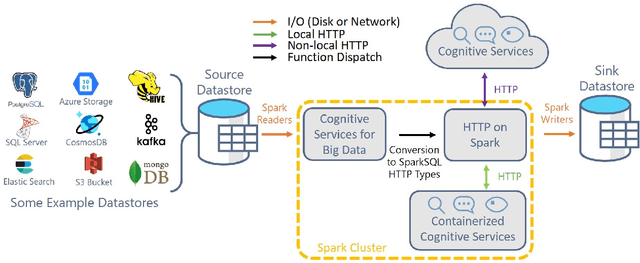
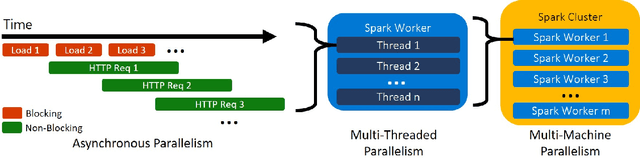
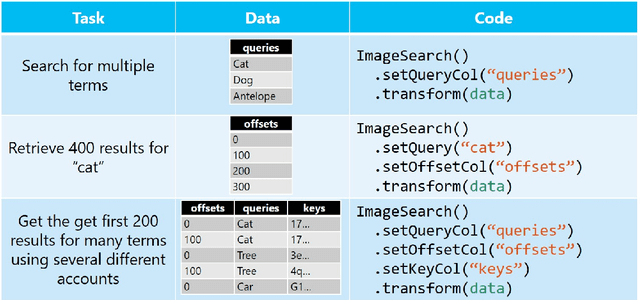
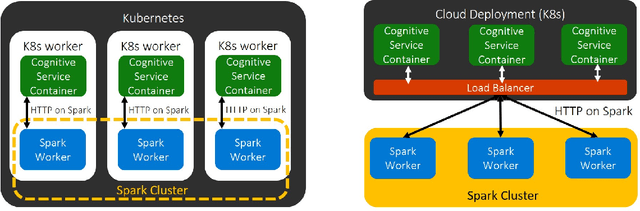
Deploying Machine Learning (ML) algorithms within databases is a challenge due to the varied computational footprints of modern ML algorithms and the myriad of database technologies each with their own restrictive syntax. We introduce an Apache Spark-based micro-service orchestration framework that extends database operations to include web service primitives. Our system can orchestrate web services across hundreds of machines and takes full advantage of cluster, thread, and asynchronous parallelism. Using this framework, we provide large scale clients for intelligent services such as speech, vision, search, anomaly detection, and text analysis. This allows users to integrate ready-to-use intelligence into any datastore with an Apache Spark connector. To eliminate the majority of overhead from network communication, we also introduce a low-latency containerized version of our architecture. Finally, we demonstrate that the services we investigate are competitive on a variety of benchmarks, and present two applications of this framework to create intelligent search engines, and real time auto race analytics systems.