 Add to Chrome
 Add to Firefox
 Add to Edge
Compressing Observation History into Agent Memory: Distilling Transformers into Recurrent Transformers
Jun 19, 2026
Transformers are AI's workhorse with strong performance in modeling sequential data, but their computational cost becomes prohibitive when processing long sequences. We target long-horizon streaming vision and robotics applications like map-free pose estimation, where it is particularly impractical to store and maintain a history of observations. Recurrent Transformers address this limitation by maintaining fixed-size memory but their performance lags behind that of transformers operating over the full observation history. We argue that this gap does not stem from architectural limitations, but from differences in how these models learn to compress past information. Without access to an observation history, recurrent models must explicitly decide what to retain in memory at each step, a significantly harder learning problem. In this work, we propose a distillation approach that transfers the compression strategy of a classical full-history transformer to a recurrent variant. We enable this by designing a teacher model that explicitly compresses its observation history into a fixed-size bottleneck representation. By directly supervising the student's memory with this bottleneck representation, we align the two compression mechanisms. We show that this approach allows to train a recurrent latent robotic memory with linear-time complexity while substantially narrowing the performance gap to full-history transformers.

A scalar per patch from pre-trained ViTs enables fast moving navigation in the real world
Jun 19, 2026Trained policies for real-world robotics rely on computer vision components, typically in the form of pre-trained visual encoders. These encoders are an essential component and it has been shown that their power does not emerge from training on robotics downstream losses alone. Pre-training with auxiliary losses in the form of computer-vision pre-text tasks is a defining factor and heavily conditions agent performance in robotics tasks. In this unprecedented large-scale study, we ran 966 navigation episodes of static point goal navigation in a real-world building for 24km and asked which components really matter for the computer vision aspects of robotics: we evaluate state-of-the art visual encoders in realistic conditions. We explore the usefulness of heterogeneous multi-teacher distillation leading to encoders with multiple different and complementary skills. We investigate how much information from these encoders is necessary for robotics by bottlenecking them in a principled and spatially useful way and we show that this leads to the emergence of interpretable features linked to affordances. We also argue that training policies on RGB data alone does not lead to an optimal usage of visual features and show this by finetuning policies pre-trained on privileged information. All in all, we paint a more complete picture of what aspects of computer vision are relevant for real-world navigation.
* European Conference on Computer Vision -- ECCV 2026
What does really matter in image goal navigation?
Jul 02, 2025Image goal navigation requires two different skills: firstly, core navigation skills, including the detection of free space and obstacles, and taking decisions based on an internal representation; and secondly, computing directional information by comparing visual observations to the goal image. Current state-of-the-art methods either rely on dedicated image-matching, or pre-training of computer vision modules on relative pose estimation. In this paper, we study whether this task can be efficiently solved with end-to-end training of full agents with RL, as has been claimed by recent work. A positive answer would have impact beyond Embodied AI and allow training of relative pose estimation from reward for navigation alone. In a large study we investigate the effect of architectural choices like late fusion, channel stacking, space-to-depth projections and cross-attention, and their role in the emergence of relative pose estimators from navigation training. We show that the success of recent methods is influenced up to a certain extent by simulator settings, leading to shortcuts in simulation. However, we also show that these capabilities can be transferred to more realistic setting, up to some extend. We also find evidence for correlations between navigation performance and probed (emerging) relative pose estimation performance, an important sub skill.
RANa: Retrieval-Augmented Navigation
Apr 04, 2025Methods for navigation based on large-scale learning typically treat each episode as a new problem, where the agent is spawned with a clean memory in an unknown environment. While these generalization capabilities to an unknown environment are extremely important, we claim that, in a realistic setting, an agent should have the capacity of exploiting information collected during earlier robot operations. We address this by introducing a new retrieval-augmented agent, trained with RL, capable of querying a database collected from previous episodes in the same environment and learning how to integrate this additional context information. We introduce a unique agent architecture for the general navigation task, evaluated on ObjectNav, ImageNav and Instance-ImageNav. Our retrieval and context encoding methods are data-driven and heavily employ vision foundation models (FM) for both semantic and geometric understanding. We propose new benchmarks for these settings and we show that retrieval allows zero-shot transfer across tasks and environments while significantly improving performance.
Reasoning in visual navigation of end-to-end trained agents: a dynamical systems approach
Mar 12, 2025Progress in Embodied AI has made it possible for end-to-end-trained agents to navigate in photo-realistic environments with high-level reasoning and zero-shot or language-conditioned behavior, but benchmarks are still dominated by simulation. In this work, we focus on the fine-grained behavior of fast-moving real robots and present a large-scale experimental study involving \numepisodes{} navigation episodes in a real environment with a physical robot, where we analyze the type of reasoning emerging from end-to-end training. In particular, we study the presence of realistic dynamics which the agent learned for open-loop forecasting, and their interplay with sensing. We analyze the way the agent uses latent memory to hold elements of the scene structure and information gathered during exploration. We probe the planning capabilities of the agent, and find in its memory evidence for somewhat precise plans over a limited horizon. Furthermore, we show in a post-hoc analysis that the value function learned by the agent relates to long-term planning. Put together, our experiments paint a new picture on how using tools from computer vision and sequential decision making have led to new capabilities in robotics and control. An interactive tool is available at europe.naverlabs.com/research/publications/reasoning-in-visual-navigation-of-end-to-end-trained-agents.
Zero-BEV: Zero-shot Projection of Any First-Person Modality to BEV Maps
Feb 21, 2024Bird's-eye view (BEV) maps are an important geometrically structured representation widely used in robotics, in particular self-driving vehicles and terrestrial robots. Existing algorithms either require depth information for the geometric projection, which is not always reliably available, or are trained end-to-end in a fully supervised way to map visual first-person observations to BEV representation, and are therefore restricted to the output modality they have been trained for. In contrast, we propose a new model capable of performing zero-shot projections of any modality available in a first person view to the corresponding BEV map. This is achieved by disentangling the geometric inverse perspective projection from the modality transformation, eg. RGB to occupancy. The method is general and we showcase experiments projecting to BEV three different modalities: semantic segmentation, motion vectors and object bounding boxes detected in first person. We experimentally show that the model outperforms competing methods, in particular the widely used baseline resorting to monocular depth estimation.
Task-conditioned adaptation of visual features in multi-task policy learning
Feb 12, 2024Successfully addressing a wide variety of tasks is a core ability of autonomous agents, which requires flexibly adapting the underlying decision-making strategies and, as we argue in this work, also adapting the underlying perception modules. An analogical argument would be the human visual system, which uses top-down signals to focus attention determined by the current task. Similarly, in this work, we adapt pre-trained large vision models conditioned on specific downstream tasks in the context of multi-task policy learning. We introduce task-conditioned adapters that do not require finetuning any pre-trained weights, combined with a single policy trained with behavior cloning and capable of addressing multiple tasks. We condition the policy and visual adapters on task embeddings, which can be selected at inference if the task is known, or alternatively inferred from a set of example demonstrations. To this end, we propose a new optimization-based estimator. We evaluate the method on a wide variety of tasks of the CortexBench benchmark and show that, compared to existing work, it can be addressed with a single policy. In particular, we demonstrate that adapting visual features is a key design choice and that the method generalizes to unseen tasks given visual demonstrations.
Learning to navigate efficiently and precisely in real environments
Jan 25, 2024In the context of autonomous navigation of terrestrial robots, the creation of realistic models for agent dynamics and sensing is a widespread habit in the robotics literature and in commercial applications, where they are used for model based control and/or for localization and mapping. The more recent Embodied AI literature, on the other hand, focuses on modular or end-to-end agents trained in simulators like Habitat or AI-Thor, where the emphasis is put on photo-realistic rendering and scene diversity, but high-fidelity robot motion is assigned a less privileged role. The resulting sim2real gap significantly impacts transfer of the trained models to real robotic platforms. In this work we explore end-to-end training of agents in simulation in settings which minimize the sim2real gap both, in sensing and in actuation. Our agent directly predicts (discretized) velocity commands, which are maintained through closed-loop control in the real robot. The behavior of the real robot (including the underlying low-level controller) is identified and simulated in a modified Habitat simulator. Noise models for odometry and localization further contribute in lowering the sim2real gap. We evaluate on real navigation scenarios, explore different localization and point goal calculation methods and report significant gains in performance and robustness compared to prior work.
Multi-Object Navigation in real environments using hybrid policies
Jan 24, 2024Navigation has been classically solved in robotics through the combination of SLAM and planning. More recently, beyond waypoint planning, problems involving significant components of (visual) high-level reasoning have been explored in simulated environments, mostly addressed with large-scale machine learning, in particular RL, offline-RL or imitation learning. These methods require the agent to learn various skills like local planning, mapping objects and querying the learned spatial representations. In contrast to simpler tasks like waypoint planning (PointGoal), for these more complex tasks the current state-of-the-art models have been thoroughly evaluated in simulation but, to our best knowledge, not yet in real environments. In this work we focus on sim2real transfer. We target the challenging Multi-Object Navigation (Multi-ON) task and port it to a physical environment containing real replicas of the originally virtual Multi-ON objects. We introduce a hybrid navigation method, which decomposes the problem into two different skills: (1) waypoint navigation is addressed with classical SLAM combined with a symbolic planner, whereas (2) exploration, semantic mapping and goal retrieval are dealt with deep neural networks trained with a combination of supervised learning and RL. We show the advantages of this approach compared to end-to-end methods both in simulation and a real environment and outperform the SOTA for this task.
End-to-End -Image Goal Navigation through Correspondence as an Emergent Phenomenon
Sep 28, 2023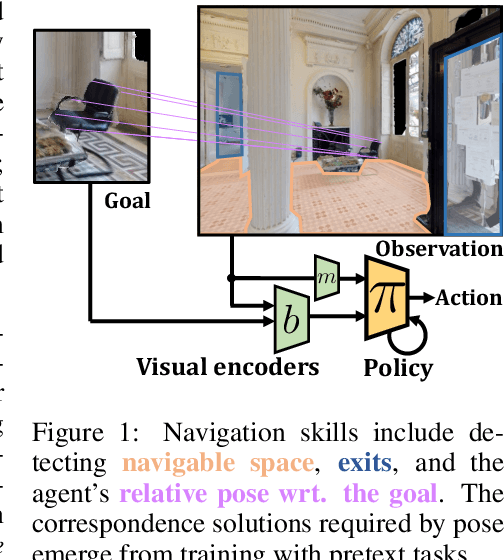



Most recent work in goal oriented visual navigation resorts to large-scale machine learning in simulated environments. The main challenge lies in learning compact representations generalizable to unseen environments and in learning high-capacity perception modules capable of reasoning on high-dimensional input. The latter is particularly difficult when the goal is not given as a category ("ObjectNav") but as an exemplar image ("ImageNav"), as the perception module needs to learn a comparison strategy requiring to solve an underlying visual correspondence problem. This has been shown to be difficult from reward alone or with standard auxiliary tasks. We address this problem through a sequence of two pretext tasks, which serve as a prior for what we argue is one of the main bottleneck in perception, extremely wide-baseline relative pose estimation and visibility prediction in complex scenes. The first pretext task, cross-view completion is a proxy for the underlying visual correspondence problem, while the second task addresses goal detection and finding directly. We propose a new dual encoder with a large-capacity binocular ViT model and show that correspondence solutions naturally emerge from the training signals. Experiments show significant improvements and SOTA performance on the two benchmarks, ImageNav and the Instance-ImageNav variant, where camera intrinsics and height differ between observation and goal.