 Add to Chrome
 Add to Firefox
 Add to Edge
Equilibrium Residuals Expose Three Regimes of Matrix-Game Strategic Reasoning in Language Models
May 11, 2026
Large language models can score well on named game-theory benchmarks while failing on the same strategic computation once semantic cues are removed. We show this gap with procedurally generated zero-sum matrix games: a model that recognizes familiar games drops to 34%, 18%, and 2% success on anonymous $2{\times}2$, $3{\times}3$, and $5{\times}5$ payoff matrices. The benchmark separates semantic recall, learned approximate Nash computation, and an output-interface bottleneck that limits scale. Training only on $2{\times}2$ and $3{\times}3$ games, supervised fine-tuning raises unseen $5{\times}5$--$7{\times}7$ success from 2% to 61%, while exploitability-reward training averages 37% with high seed variance. We prove that the exploitability residual is $2$-Lipschitz in payoff perturbations, unlike discontinuous vertex-returning LP equilibrium selectors, explaining why residual training can transfer under payoff shifts even when formatting instability limits mean performance. A dominated-action padding experiment provides causal evidence: trained models solve $3{\times}3$ games embedded in much larger matrices, while random-padded controls fail and dense $12{\times}12$ games remain near failure. Procedural evaluation is therefore necessary for measuring strategic reasoning, and residual rewards expose a real but format-limited route to approximate equilibrium computation.

milliMamba: Specular-Aware Human Pose Estimation via Dual mmWave Radar with Multi-Frame Mamba Fusion
Dec 23, 2025
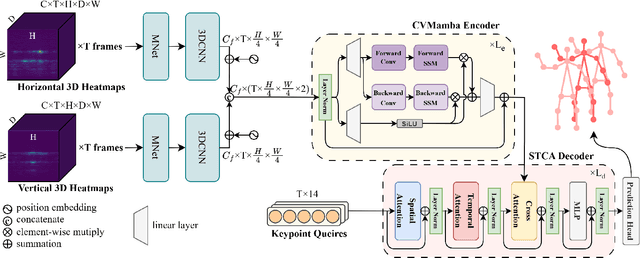


Millimeter-wave radar offers a privacy-preserving and lighting-invariant alternative to RGB sensors for Human Pose Estimation (HPE) task. However, the radar signals are often sparse due to specular reflection, making the extraction of robust features from radar signals highly challenging. To address this, we present milliMamba, a radar-based 2D human pose estimation framework that jointly models spatio-temporal dependencies across both the feature extraction and decoding stages. Specifically, given the high dimensionality of radar inputs, we adopt a Cross-View Fusion Mamba encoder to efficiently extract spatio-temporal features from longer sequences with linear complexity. A Spatio-Temporal-Cross Attention decoder then predicts joint coordinates across multiple frames. Together, this spatio-temporal modeling pipeline enables the model to leverage contextual cues from neighboring frames and joints to infer missing joints caused by specular reflections. To reinforce motion smoothness, we incorporate a velocity loss alongside the standard keypoint loss during training. Experiments on the TransHuPR and HuPR datasets demonstrate that our method achieves significant performance improvements, exceeding the baselines by 11.0 AP and 14.6 AP, respectively, while maintaining reasonable complexity. Code: https://github.com/NYCU-MAPL/milliMamba
HuPR: A Benchmark for Human Pose Estimation Using Millimeter Wave Radar
Oct 22, 2022This paper introduces a novel human pose estimation benchmark, Human Pose with Millimeter Wave Radar (HuPR), that includes synchronized vision and radio signal components. This dataset is created using cross-calibrated mmWave radar sensors and a monocular RGB camera for cross-modality training of radar-based human pose estimation. There are two advantages of using mmWave radar to perform human pose estimation. First, it is robust to dark and low-light conditions. Second, it is not visually perceivable by humans and thus, can be widely applied to applications with privacy concerns, e.g., surveillance systems in patient rooms. In addition to the benchmark, we propose a cross-modality training framework that leverages the ground-truth 2D keypoints representing human body joints for training, which are systematically generated from the pre-trained 2D pose estimation network based on a monocular camera input image, avoiding laborious manual label annotation efforts. The framework consists of a new radar pre-processing method that better extracts the velocity information from radar data, Cross- and Self-Attention Module (CSAM), to fuse multi-scale radar features, and Pose Refinement Graph Convolutional Networks (PRGCN), to refine the predicted keypoint confidence heatmaps. Our intensive experiments on the HuPR benchmark show that the proposed scheme achieves better human pose estimation performance with only radar data, as compared to traditional pre-processing solutions and previous radio-frequency-based methods.