 Add to Chrome
 Add to Firefox
 Add to Edge
milliMamba: Specular-Aware Human Pose Estimation via Dual mmWave Radar with Multi-Frame Mamba Fusion
Dec 23, 2025

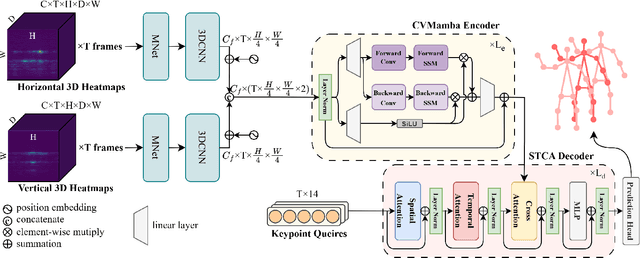


Millimeter-wave radar offers a privacy-preserving and lighting-invariant alternative to RGB sensors for Human Pose Estimation (HPE) task. However, the radar signals are often sparse due to specular reflection, making the extraction of robust features from radar signals highly challenging. To address this, we present milliMamba, a radar-based 2D human pose estimation framework that jointly models spatio-temporal dependencies across both the feature extraction and decoding stages. Specifically, given the high dimensionality of radar inputs, we adopt a Cross-View Fusion Mamba encoder to efficiently extract spatio-temporal features from longer sequences with linear complexity. A Spatio-Temporal-Cross Attention decoder then predicts joint coordinates across multiple frames. Together, this spatio-temporal modeling pipeline enables the model to leverage contextual cues from neighboring frames and joints to infer missing joints caused by specular reflections. To reinforce motion smoothness, we incorporate a velocity loss alongside the standard keypoint loss during training. Experiments on the TransHuPR and HuPR datasets demonstrate that our method achieves significant performance improvements, exceeding the baselines by 11.0 AP and 14.6 AP, respectively, while maintaining reasonable complexity. Code: https://github.com/NYCU-MAPL/milliMamba

Transformer-based Learned Image Compression for Joint Decoding and Denoising
Feb 20, 2024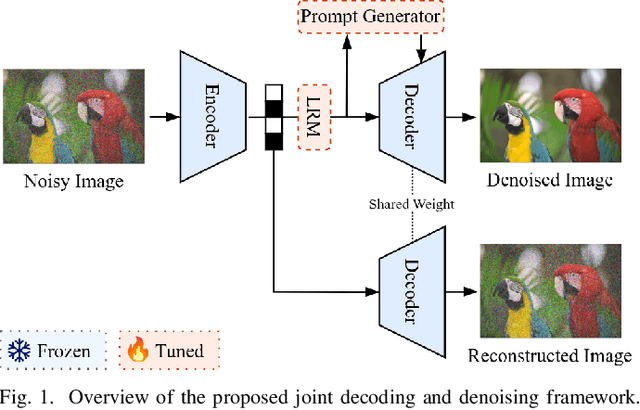
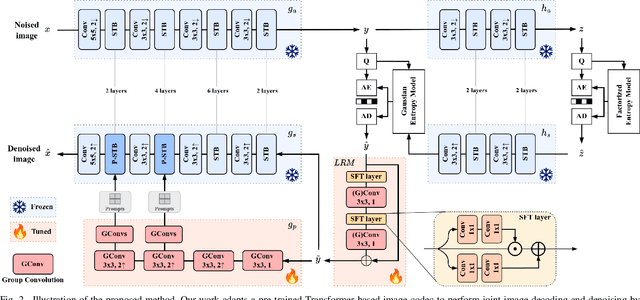
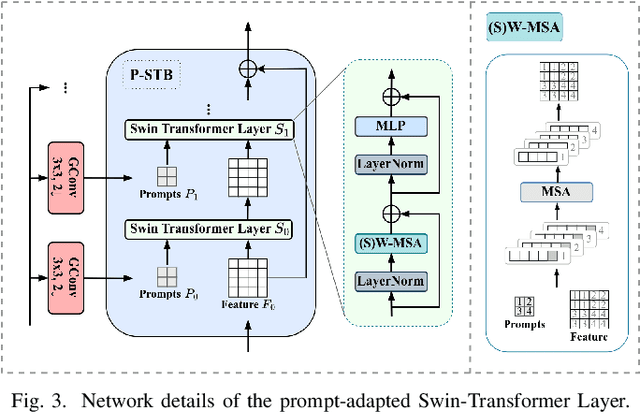
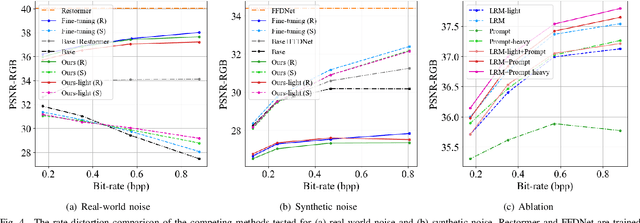
This work introduces a Transformer-based image compression system. It has the flexibility to switch between the standard image reconstruction and the denoising reconstruction from a single compressed bitstream. Instead of training separate decoders for these tasks, we incorporate two add-on modules to adapt a pre-trained image decoder from performing the standard image reconstruction to joint decoding and denoising. Our scheme adopts a two-pronged approach. It features a latent refinement module to refine the latent representation of a noisy input image for reconstructing a noise-free image. Additionally, it incorporates an instance-specific prompt generator that adapts the decoding process to improve on the latent refinement. Experimental results show that our method achieves a similar level of denoising quality to training a separate decoder for joint decoding and denoising at the expense of only a modest increase in the decoder's model size and computational complexity.