 Add to Chrome
 Add to Firefox
 Add to Edge
Agentic Self-Healing for Data and AI Pipelines: An Affordable Vendor-Agnostic Architecture using Open-Source Software
Aug 03, 2026
Modern organizations rely on data, machine learning, and software delivery pipelines to move data, train models, deploy applications, refresh dashboards, and support business-critical decisions. However, these pipelines often fail because of data quality issues, schema changes, upstream source changes, infrastructure problems, orchestration failures, and model workflow issues. Existing ZeroOps, observability, and AI operations platforms can help teams detect incidents, investigate root causes, and in some cases recommend or execute fixes. However, many of these solutions are expensive, vendor-specific, or difficult for smaller teams to adapt across different tools and environments. This paper first compares existing off-the-shelf solutions for AI-assisted pipeline monitoring, root-cause analysis, and automated remediation, including their strengths, limitations, and practical trade-offs. Based on this comparison, we find that the main gap is architectural rather than technological: the required ingredients for self-healing pipelines already exist, but they are fragmented across vendor-specific platforms, observability tools, incident systems, and open-source components. We therefore propose an affordable, vendor-agnostic reference architecture for agentic self-healing pipelines using open-source and low-cost tools. The proposed architecture combines monitoring, pipeline metadata, incident history, deterministic policy checks, AI-assisted diagnosis, approval workflows, and controlled remediation actions to help teams detect, diagnose, repair, verify, and learn from pipeline issues with less manual effort. The goal is to provide a practical reference architecture that can be adapted across data engineering, machine learning operations, and software delivery environments.

LARK: Learnability-Grounded Trajectory Selection for Efficient Reasoning Distillation
May 28, 2026We study trajectory selection for reasoning distillation, where teacher-generated reasoning trajectories are selectively used as supervision for a student model. Existing methods rely on heuristics such as trajectory quality or model confidence, but they often overlook whether a trajectory is learnable by the student. In this paper, we present LARK, a learnability-grounded method for reasoning trajectory selection. LARK selects trajectories that the student can learn efficiently while preserving the generalization of the full training distribution. At the core of LARK is a learnability factor $ρ$, which characterizes the rate at which the student's training loss decreases. To estimate this rate efficiently and maintain generalization, we introduce a learnability proxy and a $χ^2$-regularized selection policy that balances learnability and distributional coverage, both with strong theoretical guarantees on their estimation error. Empirically, LARK consistently outperforms data selection baselines across multiple base models and reasoning tasks. Diagnostic analyses show that the LARK score predicts downstream training utility and that LARK-selected trajectories induce faster supervised fine-tuning loss reduction. Our code is available at https://github.com/Tianrun-Yu/LARK.
Loosely Coupled Factor Graph Optimization for Pseudolite-Augmented Navigation
May 24, 2026In Global Navigation Satellite System (GNSS)-degraded environments, pseudolites (PLs) provide additional signal sources to enhance positioning performance, but their integration in optimization-based frameworks remains limited. This paper presents a loosely coupled factor graph optimization (FGO) framework that fuses the GNSS/PL least-squares (LS) solutions with inertial measurement unit (IMU) data. The evaluation considers low GNSS visibility scenarios with four high-elevation GNSS satellites and up to two PL transmitters over an 80~s window. FGO achieves a 22.8\% to 41.3\% reduction in mean 3D error compared to standard LS methods. Compared to a GNSS-IMU baseline, incorporating PL transmitters further improves positioning accuracy, with performance depending on geometry.
GNSS/Multi-Sensor Fusion Using Continuous-Time Factor Graph Optimization for Robust Localization
Sep 20, 2023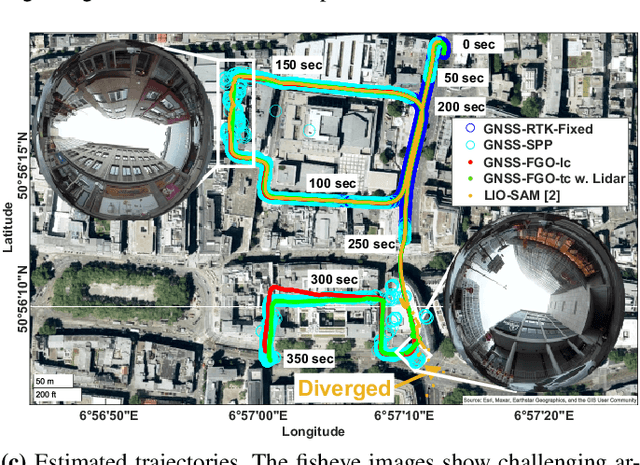
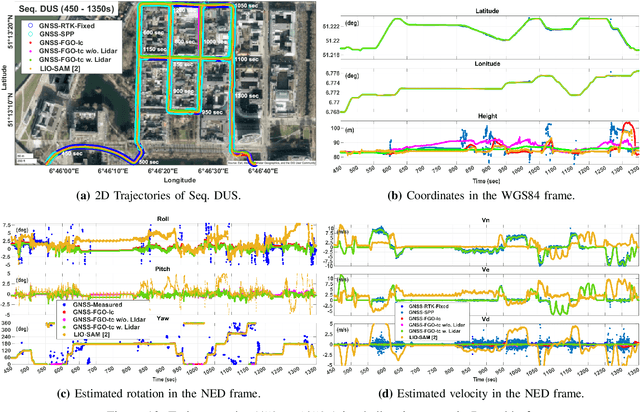
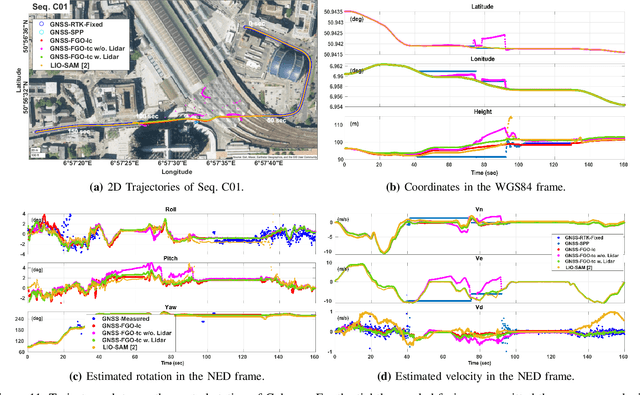

Accurate and robust vehicle localization in highly urbanized areas is challenging. Sensors are often corrupted in those complicated and large-scale environments. This paper introduces GNSS-FGO, an online and global trajectory estimator that fuses GNSS observations alongside multiple sensor measurements for robust vehicle localization. In GNSS-FGO, we fuse asynchronous sensor measurements into the graph with a continuous-time trajectory representation using Gaussian process regression. This enables querying states at arbitrary timestamps so that sensor observations are fused without requiring strict state and measurement synchronization. Thus, the proposed method presents a generalized factor graph for multi-sensor fusion. To evaluate and study different GNSS fusion strategies, we fuse GNSS measurements in loose and tight coupling with a speed sensor, IMU, and lidar-odometry. We employed datasets from measurement campaigns in Aachen, Duesseldorf, and Cologne in experimental studies and presented comprehensive discussions on sensor observations, smoother types, and hyperparameter tuning. Our results show that the proposed approach enables robust trajectory estimation in dense urban areas, where the classic multi-sensor fusion method fails due to sensor degradation. In a test sequence containing a 17km route through Aachen, the proposed method results in a mean 2D positioning error of 0.19m for loosely coupled GNSS fusion and 0.48m while fusing raw GNSS observations with lidar odometry in tight coupling.