 Add to Chrome
 Add to Firefox
 Add to Edge
SandWorm: Event-based Visuotactile Perception with Active Vibration for Screw-Actuated Robot in Granular Media
Jan 20, 2026
Perception in granular media remains challenging due to unpredictable particle dynamics. To address this challenge, we present SandWorm, a biomimetic screw-actuated robot augmented by peristaltic motion to enhance locomotion, and SWTac, a novel event-based visuotactile sensor with an actively vibrated elastomer. The event camera is mechanically decoupled from vibrations by a spring isolation mechanism, enabling high-quality tactile imaging of both dynamic and stationary objects. For algorithm design, we propose an IMU-guided temporal filter to enhance imaging consistency, improving MSNR by 24%. Moreover, we systematically optimize SWTac with vibration parameters, event camera settings and elastomer properties. Motivated by asymmetric edge features, we also implement contact surface estimation by U-Net. Experimental validation demonstrates SWTac's 0.2 mm texture resolution, 98% stone classification accuracy, and 0.15 N force estimation error, while SandWorm demonstrates versatile locomotion (up to 12.5 mm/s) in challenging terrains, successfully executes pipeline dredging and subsurface exploration in complex granular media (observed 90% success rate). Field experiments further confirm the system's practical performance.

FlexiCup: Wireless Multimodal Suction Cup with Dual-Zone Vision-Tactile Sensing
Nov 18, 2025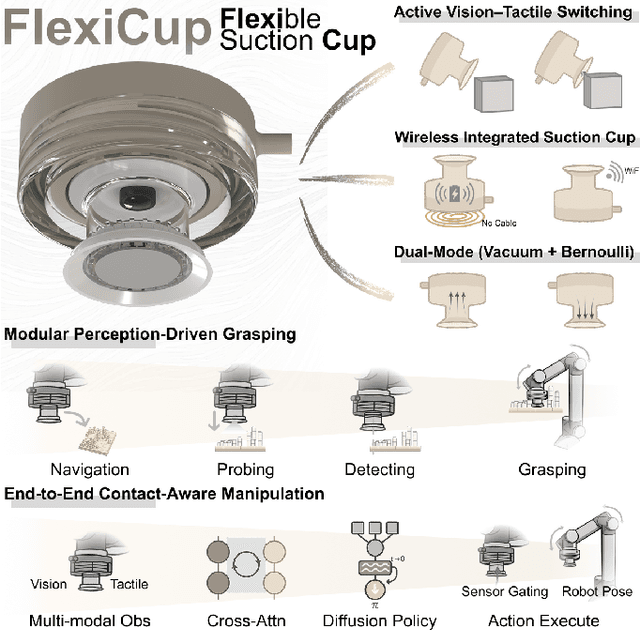
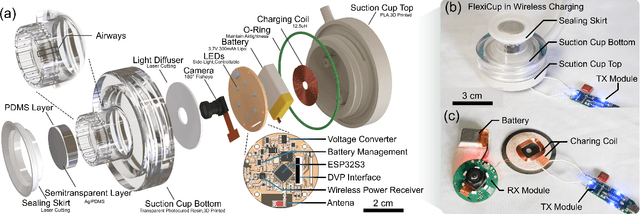
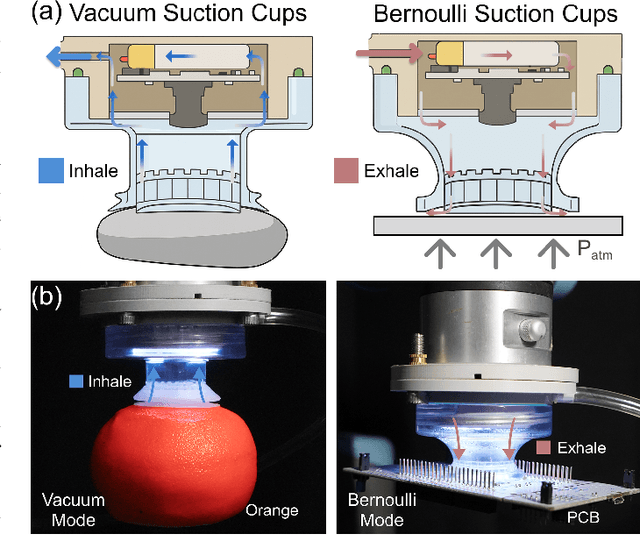
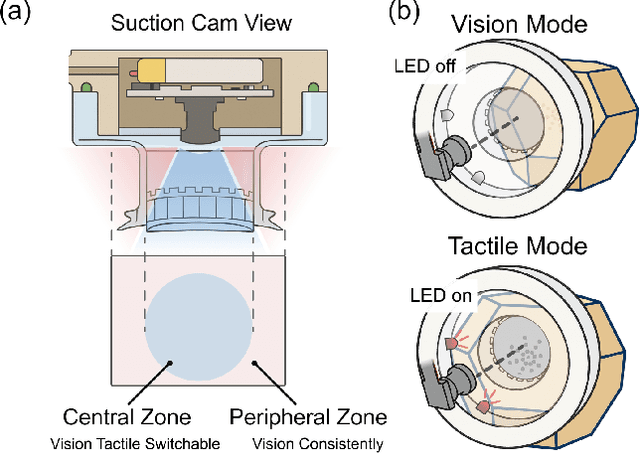
Conventional suction cups lack sensing capabilities for contact-aware manipulation in unstructured environments. This paper presents FlexiCup, a fully wireless multimodal suction cup that integrates dual-zone vision-tactile sensing. The central zone dynamically switches between vision and tactile modalities via illumination control for contact detection, while the peripheral zone provides continuous spatial awareness for approach planning. FlexiCup supports both vacuum and Bernoulli suction modes through modular mechanical configurations, achieving complete wireless autonomy with onboard computation and power. We validate hardware versatility through dual control paradigms. Modular perception-driven grasping across structured surfaces with varying obstacle densities demonstrates comparable performance between vacuum (90.0% mean success) and Bernoulli (86.7% mean success) modes. Diffusion-based end-to-end learning achieves 73.3% success on inclined transport and 66.7% on orange extraction tasks. Ablation studies confirm that multi-head attention coordinating dual-zone observations provides 13% improvements for contact-aware manipulation. Hardware designs and firmware are available at https://anonymous.4open.science/api/repo/FlexiCup-DA7D/file/index.html?v=8f531b44.