 Add to Chrome
 Add to Firefox
 Add to Edge
PRIOR: Perceptive Learning for Humanoid Locomotion with Reference Gait Priors
Mar 19, 2026
Training perceptive humanoid locomotion policies that traverse complex terrains with natural gaits remains an open challenge, typically demanding multi-stage training pipelines, adversarial objectives, or extensive real-world calibration. We present PRIOR, an efficient and reproducible framework built on Isaac Lab that achieves robust terrain traversal with human-like gaits through a simple yet effective design: (i) a parametric gait generator that supplies stable reference trajectories derived from motion capture without adversarial training, (ii) a GRU-based state estimator that infers terrain geometry directly from egocentric depth images via self-supervised heightmap reconstruction, and (iii) terrain-adaptive footstep rewards that guide foot placement toward traversable regions. Through systematic analysis of depth image resolution trade-offs, we identify configurations that maximize terrain fidelity under real-time constraints, substantially reducing perceptual overhead without degrading traversal performance. Comprehensive experiments across terrains of varying difficulty-including stairs, boxes, and gaps-demonstrate that each component yields complementary and essential performance gains, with the full framework achieving a 100% traversal success rate. We will open-source the complete PRIOR framework, including the training pipeline, parametric gait generator, and evaluation benchmarks, to serve as a reproducible foundation for humanoid locomotion research on Isaac Lab.

PMG: Parameterized Motion Generator for Human-like Locomotion Control
Feb 13, 2026Recent advances in data-driven reinforcement learning and motion tracking have substantially improved humanoid locomotion, yet critical practical challenges remain. In particular, while low-level motion tracking and trajectory-following controllers are mature, whole-body reference-guided methods are difficult to adapt to higher-level command interfaces and diverse task contexts: they require large, high-quality datasets, are brittle across speed and pose regimes, and are sensitive to robot-specific calibration. To address these limitations, we propose the Parameterized Motion Generator (PMG), a real-time motion generator grounded in an analysis of human motion structure that synthesizes reference trajectories using only a compact set of parameterized motion data together with High-dimensional control commands. Combined with an imitation-learning pipeline and an optimization-based sim-to-real motor parameter identification module, we validate the complete approach on our humanoid prototype ZERITH Z1 and show that, within a single integrated system, PMG produces natural, human-like locomotion, responds precisely to high-dimensional control inputs-including VR-based teleoperation-and enables efficient, verifiable sim-to-real transfer. Together, these results establish a practical, experimentally validated pathway toward natural and deployable humanoid control.
Structural Optimization of Lightweight Bipedal Robot via SERL
Aug 28, 2024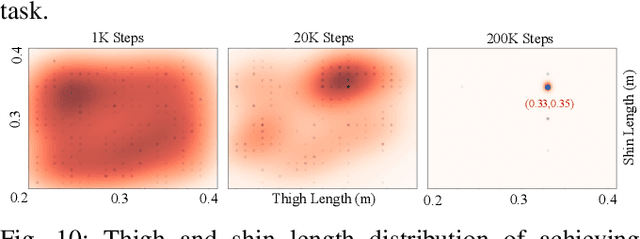
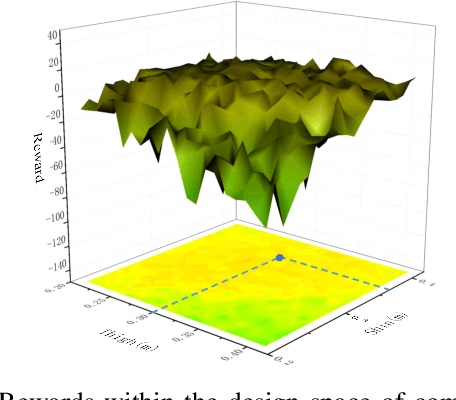

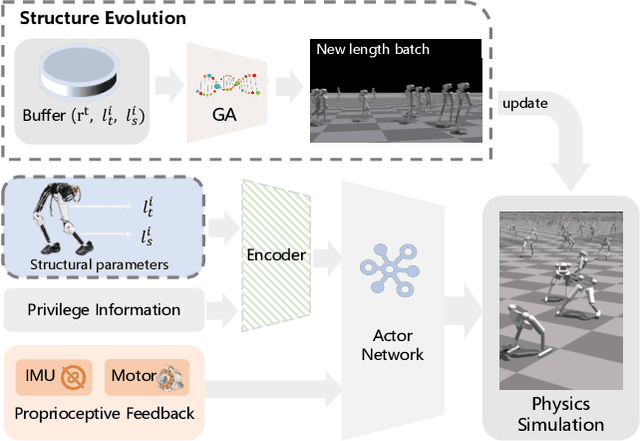
Designing a bipedal robot is a complex and challenging task, especially when dealing with a multitude of structural parameters. Traditional design methods often rely on human intuition and experience. However, such approaches are time-consuming, labor-intensive, lack theoretical guidance and hard to obtain optimal design results within vast design spaces, thus failing to full exploit the inherent performance potential of robots. In this context, this paper introduces the SERL (Structure Evolution Reinforcement Learning) algorithm, which combines reinforcement learning for locomotion tasks with evolution algorithms. The aim is to identify the optimal parameter combinations within a given multidimensional design space. Through the SERL algorithm, we successfully designed a bipedal robot named Wow Orin, where the optimal leg length are obtained through optimization based on body structure and motor torque. We have experimentally validated the effectiveness of the SERL algorithm, which is capable of optimizing the best structure within specified design space and task conditions. Additionally, to assess the performance gap between our designed robot and the current state-of-the-art robots, we compared Wow Orin with mainstream bipedal robots Cassie and Unitree H1. A series of experimental results demonstrate the Outstanding energy efficiency and performance of Wow Orin, further validating the feasibility of applying the SERL algorithm to practical design.