 Add to Chrome
 Add to Firefox
 Add to Edge
Clinical Notes Reveal Physician Fatigue
Dec 05, 2023
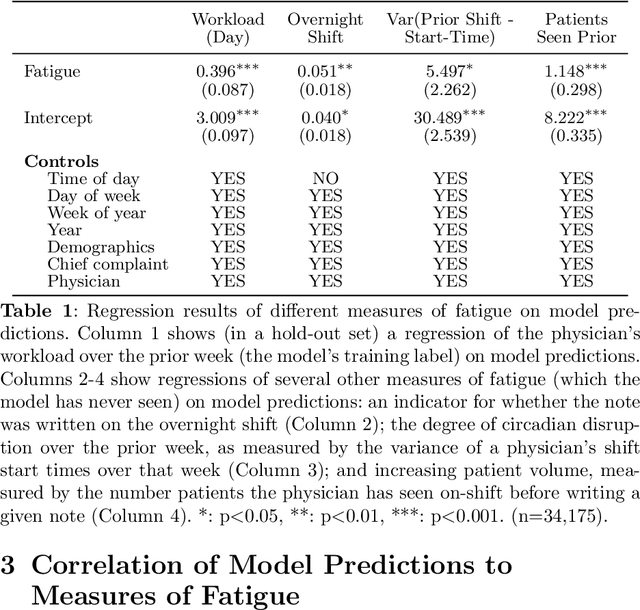
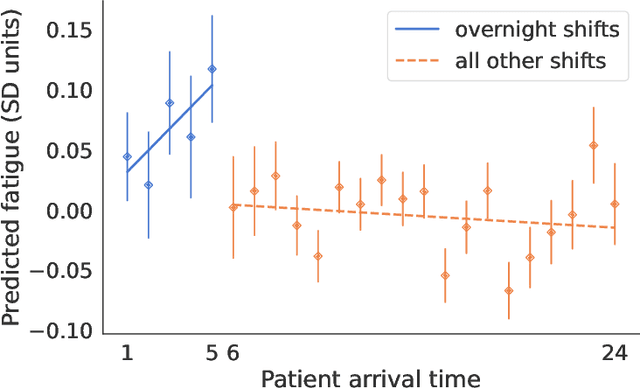
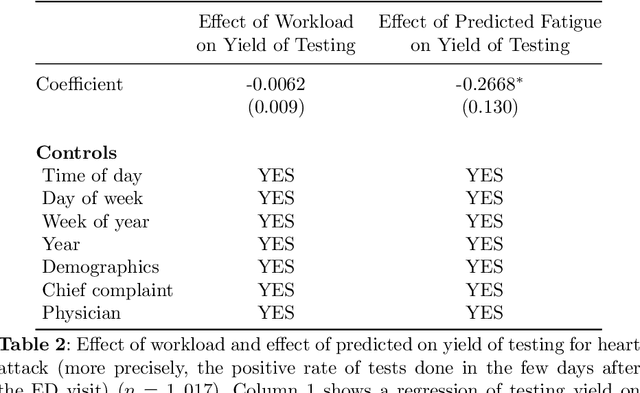
Physicians write notes about patients. In doing so, they reveal much about themselves. Using data from 129,228 emergency room visits, we train a model to identify notes written by fatigued physicians -- those who worked 5 or more of the prior 7 days. In a hold-out set, the model accurately identifies notes written by these high-workload physicians, and also flags notes written in other high-fatigue settings: on overnight shifts, and after high patient volumes. Model predictions also correlate with worse decision-making on at least one important metric: yield of testing for heart attack is 18% lower with each standard deviation increase in model-predicted fatigue. Finally, the model indicates that notes written about Black and Hispanic patients have 12% and 21% higher predicted fatigue than Whites -- larger than overnight vs. daytime differences. These results have an important implication for large language models (LLMs). Our model indicates that fatigued doctors write more predictable notes. Perhaps unsurprisingly, because word prediction is the core of how LLMs work, we find that LLM-written notes have 17% higher predicted fatigue than real physicians' notes. This indicates that LLMs may introduce distortions in generated text that are not yet fully understood.

Pragmatic Radiology Report Generation
Nov 28, 2023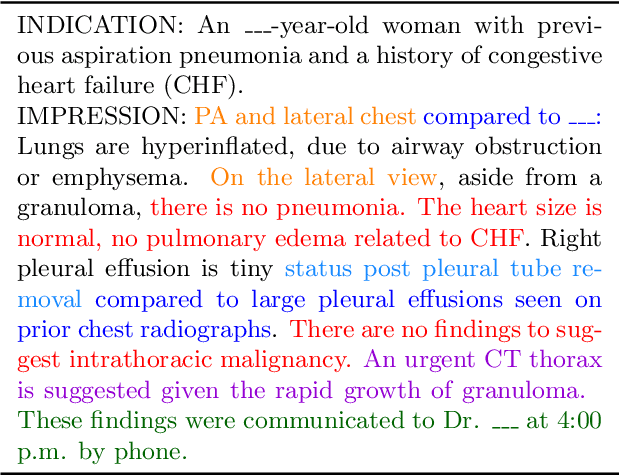

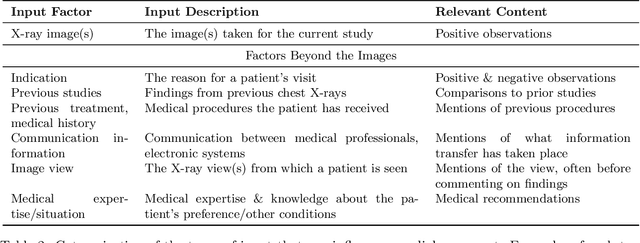
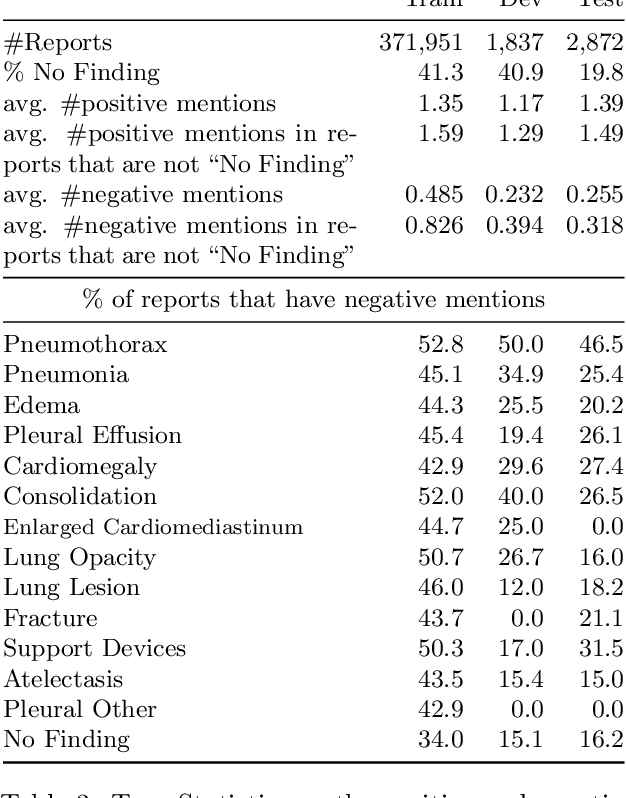
When pneumonia is not found on a chest X-ray, should the report describe this negative observation or omit it? We argue that this question cannot be answered from the X-ray alone and requires a pragmatic perspective, which captures the communicative goal that radiology reports serve between radiologists and patients. However, the standard image-to-text formulation for radiology report generation fails to incorporate such pragmatic intents. Following this pragmatic perspective, we demonstrate that the indication, which describes why a patient comes for an X-ray, drives the mentions of negative observations and introduce indications as additional input to report generation. With respect to the output, we develop a framework to identify uninferable information from the image as a source of model hallucinations, and limit them by cleaning groundtruth reports. Finally, we use indications and cleaned groundtruth reports to develop pragmatic models, and show that they outperform existing methods not only in new pragmatics-inspired metrics (+4.3 Negative F1) but also in standard metrics (+6.3 Positive F1 and +11.0 BLEU-2).
Ecologically Valid Explanations for Label Variation in NLI
Oct 20, 2023Human label variation, or annotation disagreement, exists in many natural language processing (NLP) tasks, including natural language inference (NLI). To gain direct evidence of how NLI label variation arises, we build LiveNLI, an English dataset of 1,415 ecologically valid explanations (annotators explain the NLI labels they chose) for 122 MNLI items (at least 10 explanations per item). The LiveNLI explanations confirm that people can systematically vary on their interpretation and highlight within-label variation: annotators sometimes choose the same label for different reasons. This suggests that explanations are crucial for navigating label interpretations in general. We few-shot prompt large language models to generate explanations but the results are inconsistent: they sometimes produces valid and informative explanations, but it also generates implausible ones that do not support the label, highlighting directions for improvement.
FLamE: Few-shot Learning from Natural Language Explanations
Jun 13, 2023Natural language explanations have the potential to provide rich information that in principle guides model reasoning. Yet, recent work by Lampinen et al. (2022) has shown limited utility of natural language explanations in improving classification. To effectively learn from explanations, we present FLamE, a two-stage few-shot learning framework that first generates explanations using GPT-3, and then finetunes a smaller model (e.g., RoBERTa) with generated explanations. Our experiments on natural language inference demonstrate effectiveness over strong baselines, increasing accuracy by 17.6% over GPT-3 Babbage and 5.7% over GPT-3 Davinci in e-SNLI. Despite improving classification performance, human evaluation surprisingly reveals that the majority of generated explanations does not adequately justify classification decisions. Additional analyses point to the important role of label-specific cues (e.g., "not know" for the neutral label) in generated explanations.
Language of Bargaining
Jun 12, 2023Leveraging an established exercise in negotiation education, we build a novel dataset for studying how the use of language shapes bilateral bargaining. Our dataset extends existing work in two ways: 1) we recruit participants via behavioral labs instead of crowdsourcing platforms and allow participants to negotiate through audio, enabling more naturalistic interactions; 2) we add a control setting where participants negotiate only through alternating, written numeric offers.Despite the two contrasting forms of communication, we find that the average agreed prices of the two treatments are identical. But when subjects can talk, fewer offers are exchanged, negotiations finish faster, the likelihood of reaching agreement rises, and the variance of prices at which subjects agree drops substantially. We further propose a taxonomy of speech acts in negotiation and enrich the dataset with annotated speech acts. We set up prediction tasks to predict negotiation success and find that being reactive to the arguments of the other party is advantageous over driving the negotiation.
Language Models Can Improve Event Prediction by Few-Shot Abductive Reasoning
May 26, 2023Large language models have shown astonishing performance on a wide range of reasoning tasks. In this paper, we investigate whether they could reason about real-world events and help improve the prediction accuracy of event sequence models. We design a modeling and prediction framework where a large language model performs abductive reasoning to assist an event sequence model: the event model proposes predictions on future events given the past; instructed by a few expert-annotated demonstrations, the language model learns to suggest possible causes for each proposal; a search module finds out the previous events that match the causes; a scoring function learns to examine whether the retrieved events could actually cause the proposal. Through extensive experiments on two challenging real-world datasets (Amazon Review and GDELT), we demonstrate that our framework -- thanks to the reasoning ability of language models -- could significantly outperform the state-of-the-art event sequence models.
Causal Reasoning and Large Language Models: Opening a New Frontier for Causality
May 08, 2023The causal capabilities of large language models (LLMs) is a matter of significant debate, with critical implications for the use of LLMs in societally impactful domains such as medicine, science, law, and policy. We further our understanding of LLMs and their causal implications, considering the distinctions between different types of causal reasoning tasks, as well as the entangled threats of construct and measurement validity. LLM-based methods establish new state-of-the-art accuracies on multiple causal benchmarks. Algorithms based on GPT-3.5 and 4 outperform existing algorithms on a pairwise causal discovery task (97%, 13 points gain), counterfactual reasoning task (92%, 20 points gain), and actual causality (86% accuracy in determining necessary and sufficient causes in vignettes). At the same time, LLMs exhibit unpredictable failure modes and we provide some techniques to interpret their robustness. Crucially, LLMs perform these causal tasks while relying on sources of knowledge and methods distinct from and complementary to non-LLM based approaches. Specifically, LLMs bring capabilities so far understood to be restricted to humans, such as using collected knowledge to generate causal graphs or identifying background causal context from natural language. We envision LLMs to be used alongside existing causal methods, as a proxy for human domain knowledge and to reduce human effort in setting up a causal analysis, one of the biggest impediments to the widespread adoption of causal methods. We also see existing causal methods as promising tools for LLMs to formalize, validate, and communicate their reasoning especially in high-stakes scenarios. In capturing common sense and domain knowledge about causal mechanisms and supporting translation between natural language and formal methods, LLMs open new frontiers for advancing the research, practice, and adoption of causality.
Characterizing Political Bias in Automatic Summaries: A Case Study of Trump and Biden
May 03, 2023Growing literature has shown that powerful NLP systems may encode social biases; however, the political bias of summarization models remains relatively unknown. In this work, we use an entity replacement method to investigate the portrayal of politicians in automatically generated summaries of news articles. We develop a computational framework based on political entities and lexical resources, and use it to assess biases about Donald Trump and Joe Biden in both extractive and abstractive summarization models. We find consistent differences, such as stronger associations of a collective US government (i.e., administration) with Biden than with Trump. These summary dissimilarities are most prominent when the entity is heavily featured in the source article. Our systematic characterization provides a framework for future studies of bias in summarization.
Understanding and Predicting Human Label Variation in Natural Language Inference through Explanation
Apr 24, 2023Human label variation (Plank 2022), or annotation disagreement, exists in many natural language processing (NLP) tasks. To be robust and trusted, NLP models need to identify such variation and be able to explain it. To this end, we created the first ecologically valid explanation dataset with diverse reasoning, LiveNLI. LiveNLI contains annotators' highlights and free-text explanations for the label(s) of their choice for 122 English Natural Language Inference items, each with at least 10 annotations. We used its explanations for chain-of-thought prompting, and found there is still room for improvement in GPT-3's ability to predict label distribution with in-context learning.
Learning Human-Compatible Representations for Case-Based Decision Support
Mar 06, 2023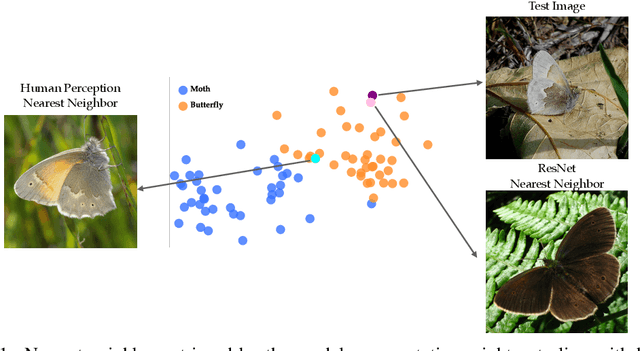
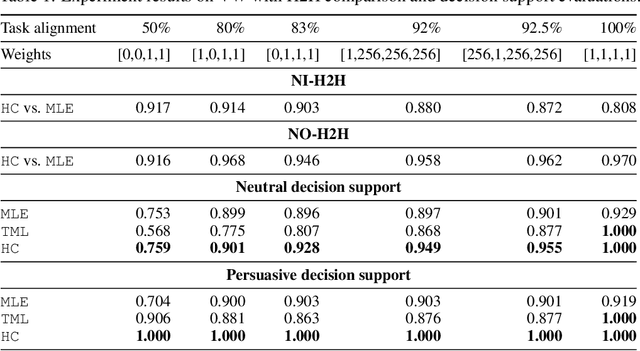


Algorithmic case-based decision support provides examples to help human make sense of predicted labels and aid human in decision-making tasks. Despite the promising performance of supervised learning, representations learned by supervised models may not align well with human intuitions: what models consider as similar examples can be perceived as distinct by humans. As a result, they have limited effectiveness in case-based decision support. In this work, we incorporate ideas from metric learning with supervised learning to examine the importance of alignment for effective decision support. In addition to instance-level labels, we use human-provided triplet judgments to learn human-compatible decision-focused representations. Using both synthetic data and human subject experiments in multiple classification tasks, we demonstrate that such representation is better aligned with human perception than representation solely optimized for classification. Human-compatible representations identify nearest neighbors that are perceived as more similar by humans and allow humans to make more accurate predictions, leading to substantial improvements in human decision accuracies (17.8% in butterfly vs. moth classification and 13.2% in pneumonia classification).