 Add to Chrome
 Add to Firefox
 Add to Edge
Optimizing the Cost-Quality Tradeoff of Agentic Theorem Provers in Lean
Jun 03, 2026
Large language models (LLMs) are increasingly used in workflows for generating formal proofs in Lean. These workflows often decompose problems into smaller lemmas, sample many proof attempts, and use compiler feedback to guide search. However, they can be prohibitively expensive, often spending substantial compute on attempts that ultimately fail. In this work, we address this problem with an action routing agent that consists of a data plane and a control plane. The data plane generates natural-language lemma decompositions, formalizes them in Lean, and samples proof attempts for the resulting theorem and lemma targets. The control plane observes previous failed Lean attempts, estimates both the likelihood of success and cost of another attempt, and decides whether to continue proving the current target or restart from a new breakdown. On a subset of PutnamBench, our agent decreases the cost by $25.8\%$ over a fixed-step baseline on average, preserving performance while using substantially less compute. These results suggest that failed Lean trajectories provide actionable signals for cost-aware resource allocation in agentic theorem proving.

OmniCD: A Foundational Framework for Remote Sensing Image Change Detection Guided by Multimodal Semantics
May 28, 2026Change detection (CD) in remote sensing is vital for applications such as urban monitoring and disaster assessment, yet traditional methods struggle with generalization across diverse scenarios. We present OmniCD, a foundational framework that unifies and enhances remote sensing CD through multimodal semantic guidance. OmniCD incorporates image and text prompts -- such as textual descriptions, semantic maps, and geospatial metadata -- into a unified architecture, supporting tasks from binary CD to zero-shot semantic change understanding. The framework integrates a hierarchical scene retrieval module and a change detection module, reinforced by a style disentanglement mechanism for improved cross-domain robustness. We further introduce RSITCD, a large-scale multimodal dataset with 300K+ annotated image-text pairs. Extensive experiments show that OmniCD achieves state-of-the-art performance across benchmarks, demonstrating strong adaptability and setting a solid foundation for general-purpose CD systems in remote sensing.
Don't Think of the White Bear: Ironic Negation in Transformer Models Under Cognitive Load
Nov 15, 2025Negation instructions such as 'do not mention $X$' can paradoxically increase the accessibility of $X$ in human thought, a phenomenon known as ironic rebound. Large language models (LLMs) face the same challenge: suppressing a concept requires internally activating it, which may prime rebound instead of avoidance. We investigated this tension with two experiments. \textbf{(1) Load \& content}: after a negation instruction, we vary distractor text (semantic, syntactic, repetition) and measure rebound strength. \textbf{(2) Polarity separation}: We test whether models distinguish neutral from negative framings of the same concept and whether this separation predicts rebound persistence. Results show that rebound consistently arises immediately after negation and intensifies with longer or semantic distractors, while repetition supports suppression. Stronger polarity separation correlates with more persistent rebound. Together, these findings, complemented by a circuit tracing analysis that identifies sparse middle-layer attention heads amplifying forbidden tokens while early layers suppress, link cognitive predictions of ironic rebound with mechanistic insights into long-context interference. To support future work, we release ReboundBench, a dataset of $5,000$ systematically varied negation prompts designed to probe rebound in LLMs.
Average Certified Radius is a Poor Metric for Randomized Smoothing
Oct 09, 2024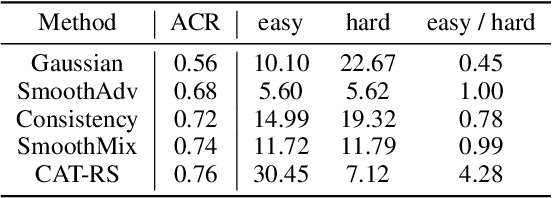
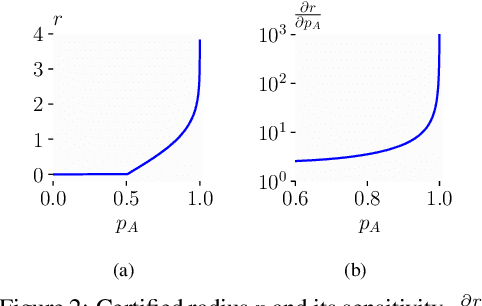
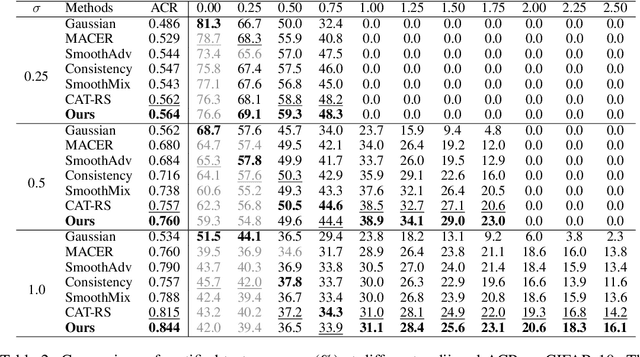
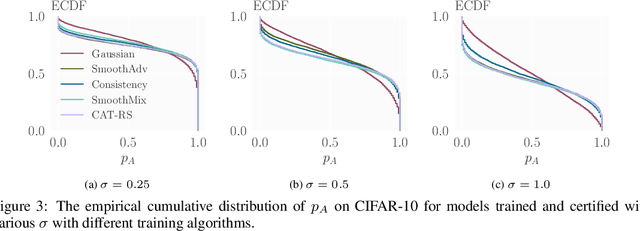
Randomized smoothing is a popular approach for providing certified robustness guarantees against adversarial attacks, and has become a very active area of research. Over the past years, the average certified radius (ACR) has emerged as the single most important metric for comparing methods and tracking progress in the field. However, in this work, we show that ACR is an exceptionally poor metric for evaluating robustness guarantees provided by randomized smoothing. We theoretically show not only that a trivial classifier can have arbitrarily large ACR, but also that ACR is much more sensitive to improvements on easy samples than on hard ones. Empirically, we confirm that existing training strategies that improve ACR reduce the model's robustness on hard samples. Further, we show that by focusing on easy samples, we can effectively replicate the increase in ACR. We develop strategies, including explicitly discarding hard samples, reweighing the dataset with certified radius, and extreme optimization for easy samples, to achieve state-of-the-art ACR, although these strategies ignore robustness for the general data distribution. Overall, our results suggest that ACR has introduced a strong undesired bias to the field, and better metrics are required to holistically evaluate randomized smoothing.
Integrated Dynamic Phenological Feature for Remote Sensing Image Land Cover Change Detection
Aug 08, 2024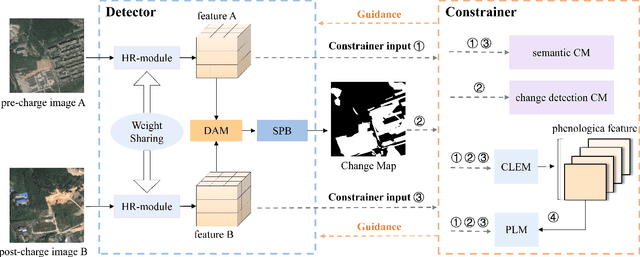
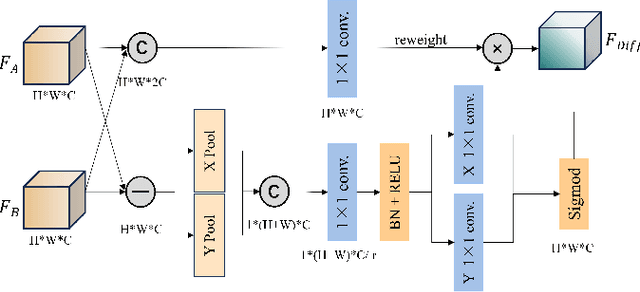
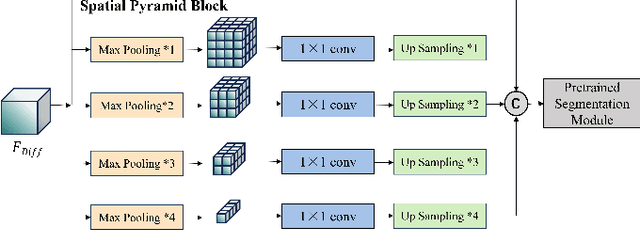
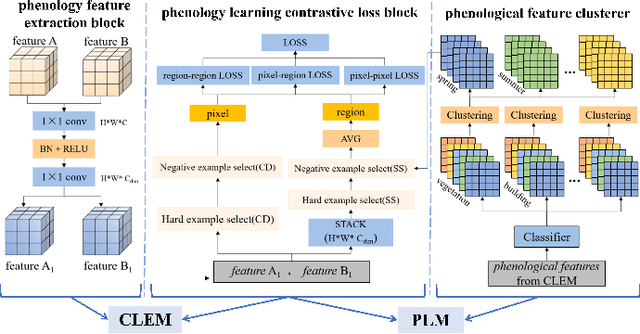
Remote sensing image change detection (CD) is essential for analyzing land surface changes over time, with a significant challenge being the differentiation of actual changes from complex scenes while filtering out pseudo-changes. A primary contributor to this challenge is the intra-class dynamic changes due to phenological characteristics in natural areas. To overcome this, we introduce the InPhea model, which integrates phenological features into a remote sensing image CD framework. The model features a detector with a differential attention module for improved feature representation of change information, coupled with high-resolution feature extraction and spatial pyramid blocks to enhance performance. Additionally, a constrainer with four constraint modules and a multi-stage contrastive learning approach is employed to aid in the model's understanding of phenological characteristics. Experiments on the HRSCD, SECD, and PSCD-Wuhan datasets reveal that InPhea outperforms other models, confirming its effectiveness in addressing phenological pseudo-changes and its overall model superiority.
DeepAngle: Fast calculation of contact angles in tomography images using deep learning
Nov 28, 2022DeepAngle is a machine learning-based method to determine the contact angles of different phases in the tomography images of porous materials. Measurement of angles in 3--D needs to be done within the surface perpendicular to the angle planes, and it could become inaccurate when dealing with the discretized space of the image voxels. A computationally intensive solution is to correlate and vectorize all surfaces using an adaptable grid, and then measure the angles within the desired planes. On the contrary, the present study provides a rapid and low-cost technique powered by deep learning to estimate the interfacial angles directly from images. DeepAngle is tested on both synthetic and realistic images against the direct measurement technique and found to improve the r-squared by 5 to 16% while lowering the computational cost 20 times. This rapid method is especially applicable for processing large tomography data and time-resolved images, which is computationally intensive. The developed code and the dataset are available at an open repository on GitHub (https://www.github.com/ArashRabbani/DeepAngle).