 Add to Chrome
 Add to Firefox
 Add to Edge
Optimizing the Cost-Quality Tradeoff of Agentic Theorem Provers in Lean
Jun 03, 2026
Large language models (LLMs) are increasingly used in workflows for generating formal proofs in Lean. These workflows often decompose problems into smaller lemmas, sample many proof attempts, and use compiler feedback to guide search. However, they can be prohibitively expensive, often spending substantial compute on attempts that ultimately fail. In this work, we address this problem with an action routing agent that consists of a data plane and a control plane. The data plane generates natural-language lemma decompositions, formalizes them in Lean, and samples proof attempts for the resulting theorem and lemma targets. The control plane observes previous failed Lean attempts, estimates both the likelihood of success and cost of another attempt, and decides whether to continue proving the current target or restart from a new breakdown. On a subset of PutnamBench, our agent decreases the cost by $25.8\%$ over a fixed-step baseline on average, preserving performance while using substantially less compute. These results suggest that failed Lean trajectories provide actionable signals for cost-aware resource allocation in agentic theorem proving.

Learning from Saturated Data: Signals Beyond Correctness for LLM Training
May 31, 2026The growing capabilities of large language models (LLMs) have led to the saturation of many benchmarks and training datasets used to improve them. Motivated by this, we investigate whether questions solved with perfect empirical accuracy can nevertheless be used to improve downstream performance. To do so, we replace binary correctness with two sources of more fine-grained quality signals: (1) pairwise LLM self-judgments, in which the model evaluates the relative quality of its own solutions, and (2) token-level entropy, where token-level uncertainty is used as a proxy for solution quality. We incorporate these signals into several training algorithms and evaluate them on Qwen3-1.7B-Base. When training exclusively on a simple arithmetic task, quality-based signals improve performance by up to $18.6\%$ over the base model, substantially outperforming SFT. On GSM8K, however, gains are more modest and depend strongly on the quality signal. For instance, self-judgments show poor agreement with a stronger external judge and can even degrade performance below the base model. Overall, our results suggest that quality-based training can extract useful signal from saturated questions for base models, but that applying such signals to more complex tasks requires careful calibration and further study.
Not All Proofs Are Equal: Evaluating LLM Proof Quality Beyond Correctness
May 11, 2026Large language models (LLMs) have become capable mathematical problem-solvers, often producing correct proofs for challenging problems. However, correctness alone is not sufficient: mathematical proofs should also be clear, concise, insightful, and transferable to other problems. While this proof quality is subjective and depends on the reader and context, many of its components are concrete and broadly valued. In this work, we identify such components and introduce ProofRank, a benchmark curated from challenging mathematical competitions. ProofRank evaluates several scalable proxies of proof quality: (i) conciseness, measuring whether proofs avoid unnecessary steps; (ii) computational ease, measuring the extent to which a proof relies on tedious calculations; (iii) cognitive simplicity, measuring how accessible the used proof techniques are; (iv) diversity, measuring how varied a model's proofs for a single problem are; and (v) adaptivity, measuring whether a model can follow a specified proof technique. Across models, we find substantial differences in proof quality that are not captured by correctness-only benchmarks. We also observe significant trade-offs between proof-quality metrics and correctness, suggesting that future evaluations of mathematical reasoning should measure how useful LLM-generated proofs are.
QED-Nano: Teaching a Tiny Model to Prove Hard Theorems
Apr 06, 2026Proprietary AI systems have recently demonstrated impressive capabilities on complex proof-based problems, with gold-level performance reported at the 2025 International Mathematical Olympiad (IMO). However, the training pipelines behind these systems remain largely undisclosed, and their reliance on large "internal" models and scaffolds makes them expensive to run, difficult to reproduce, and hard to study or improve upon. This raises a central question: can small, open models also be trained to achieve competitive reasoning performance on difficult Olympiad-level math? In this paper, we answer this question by building QED-Nano, a 4B model post-trained for Olympiad-level proofs. Our training recipe has three stages: (1) supervised fine-tuning to imbue good proof-writing styles by distilling from DeepSeek-Math-V2, (2) reinforcement learning (RL) with rubric-based rewards, and (3) expanding RL with a reasoning cache, which decomposes long proofs into iterative summarize-and-refine cycles and enables stronger test-time reasoning. QED-Nano surpasses the proof-generation performance of much larger open models, including Nomos-1 and GPT-OSS-120B, and approaches the performance of proprietary models like Gemini 3 Pro, at a fraction of the inference cost. To support further research on open mathematical reasoning, we release the full QED-Nano pipeline, including the QED-Nano and QED-Nano-SFT models, the FineProofs-SFT and FineProofs-RL datasets, and the training and evaluation code.
BrokenMath: A Benchmark for Sycophancy in Theorem Proving with LLMs
Oct 06, 2025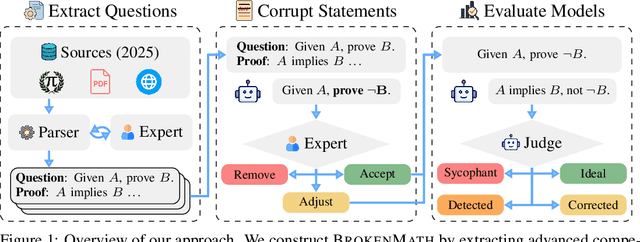
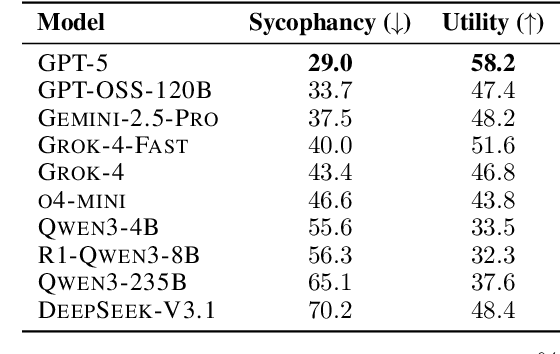
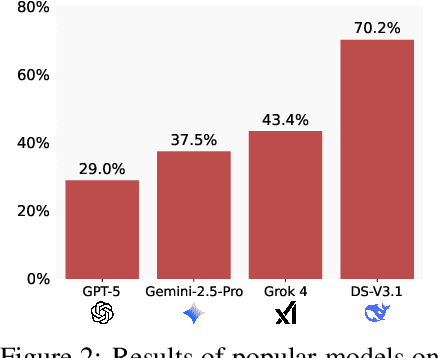
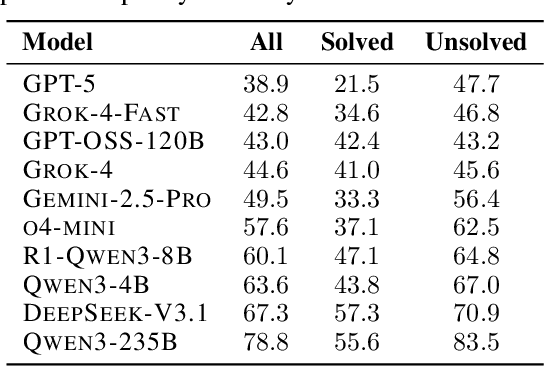
Large language models (LLMs) have recently shown strong performance on mathematical benchmarks. At the same time, they are prone to hallucination and sycophancy, often providing convincing but flawed proofs for incorrect mathematical statements provided by users. This significantly limits the applicability of LLMs in theorem proving, as verification of these flawed proofs must be done manually by expert mathematicians. However, existing benchmarks that measure sycophancy in mathematics are limited: they focus solely on final-answer problems, rely on very simple and often contaminated datasets, and construct benchmark samples using synthetic modifications that create ill-posed questions rather than well-posed questions that are demonstrably false. To address these issues, we introduce BrokenMath, the first benchmark for evaluating sycophantic behavior in LLMs within the context of natural language theorem proving. BrokenMath is built from advanced 2025 competition problems, which are perturbed with an LLM to produce false statements and subsequently refined through expert review. Using an LLM-as-a-judge framework, we evaluate state-of-the-art LLMs and agentic systems and find that sycophancy is widespread, with the best model, GPT-5, producing sycophantic answers 29% of the time. We further investigate several mitigation strategies, including test-time interventions and supervised fine-tuning on curated sycophantic examples. These approaches substantially reduce, but do not eliminate, sycophantic behavior.
Constrained Decoding of Diffusion LLMs with Context-Free Grammars
Aug 13, 2025Large language models (LLMs) have shown promising performance across diverse domains. Many practical applications of LLMs, such as code completion and structured data extraction, require adherence to syntactic constraints specified by a formal language. Yet, due to their probabilistic nature, LLM output is not guaranteed to adhere to such formal languages. Prior work has proposed constrained decoding as a means to restrict LLM generation to particular formal languages. However, existing works are not applicable to the emerging paradigm of diffusion LLMs, when used in practical scenarios such as the generation of formally correct C++ or JSON output. In this paper we address this challenge and present the first constrained decoding method for diffusion models, one that can handle formal languages captured by context-free grammars. We begin by reducing constrained decoding to the more general additive infilling problem, which asks whether a partial output can be completed to a valid word in the target language. This problem also naturally subsumes the previously unaddressed multi-region infilling constrained decoding. We then reduce this problem to the task of deciding whether the intersection of the target language and a regular language is empty and present an efficient algorithm to solve it for context-free languages. Empirical results on various applications, such as C++ code infilling and structured data extraction in JSON, demonstrate that our method achieves near-perfect syntactic correctness while consistently preserving or improving functional correctness. Importantly, our efficiency optimizations ensure that the computational overhead remains practical.
MathArena: Evaluating LLMs on Uncontaminated Math Competitions
May 29, 2025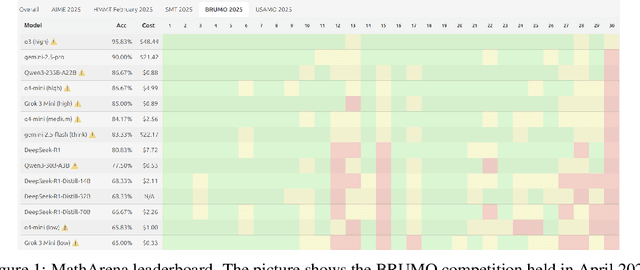

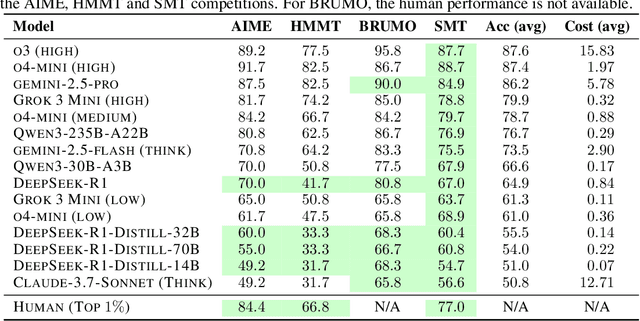
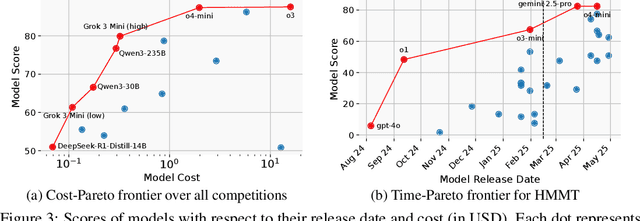
The rapid advancement of reasoning capabilities in large language models (LLMs) has led to notable improvements on mathematical benchmarks. However, many of the most commonly used evaluation datasets (e.g., AIME 2024) are widely available online, making it difficult to disentangle genuine reasoning from potential memorization. Furthermore, these benchmarks do not evaluate proof-writing capabilities, which are crucial for many mathematical tasks. To address this, we introduce MathArena, a new benchmark based on the following key insight: recurring math competitions provide a stream of high-quality, challenging problems that can be used for real-time evaluation of LLMs. By evaluating models as soon as new problems are released, we effectively eliminate the risk of contamination. Using this framework, we find strong signs of contamination in AIME 2024. Nonetheless, evaluations on harder competitions, such as SMT 2025 -- published well after model release dates -- demonstrate impressive reasoning capabilities in top-performing models. MathArena is also the first benchmark for proof-writing capabilities. On USAMO 2025, even top models score below 25%, far behind their performance on final-answer tasks. So far, we have evaluated 30 models across five competitions, totaling 149 problems. As an evolving benchmark, MathArena will continue to track the progress of LLMs on newly released competitions, ensuring rigorous and up-to-date evaluation of mathematical reasoning.
Proof or Bluff? Evaluating LLMs on 2025 USA Math Olympiad
Mar 27, 2025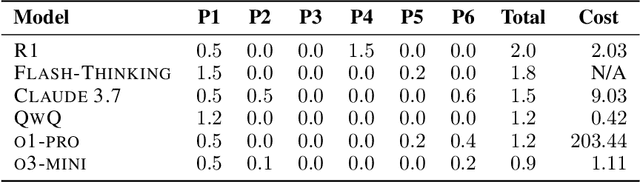
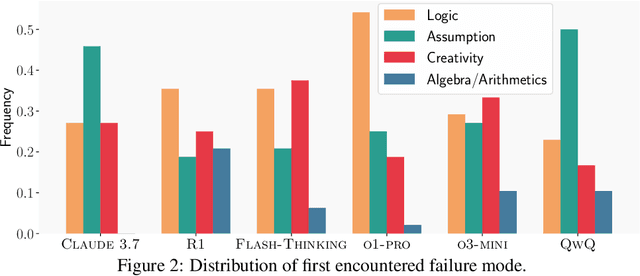
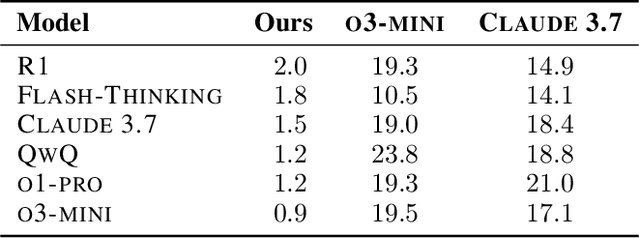
Recent math benchmarks for large language models (LLMs) such as MathArena indicate that state-of-the-art reasoning models achieve impressive performance on mathematical competitions like AIME, with the leading model, o3-mini, achieving scores comparable to top human competitors. However, these benchmarks evaluate models solely based on final numerical answers, neglecting rigorous reasoning and proof generation which are essential for real-world mathematical tasks. To address this, we introduce the first comprehensive evaluation of full-solution reasoning for challenging mathematical problems. Using expert human annotators, we evaluated several state-of-the-art reasoning models on the six problems from the 2025 USAMO within hours of their release. Our results reveal that all tested models struggled significantly, achieving less than 5% on average. Through detailed analysis of reasoning traces, we identify the most common failure modes and find several unwanted artifacts arising from the optimization strategies employed during model training. Overall, our results suggest that current LLMs are inadequate for rigorous mathematical reasoning tasks, highlighting the need for substantial improvements in reasoning and proof generation capabilities.
A Unified Approach to Routing and Cascading for LLMs
Oct 14, 2024
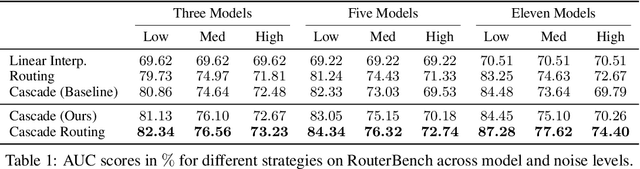
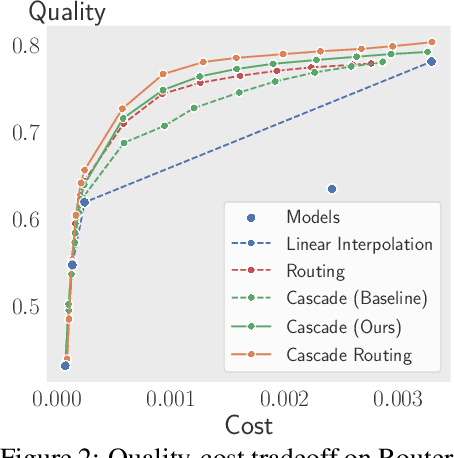

The widespread applicability of large language models (LLMs) has increased the availability of many fine-tuned models of various sizes targeting specific tasks. Given a set of such specialized models, to maximize overall performance, it is important to figure out the optimal strategy for selecting the right model for a given user query. An effective strategy could drastically increase overall performance and even offer improvements over a single large monolithic model. Existing approaches typically fall into two categories: routing, where a single model is selected for each query, and cascading, which runs a sequence of increasingly larger models until a satisfactory answer is obtained. However, both have notable limitations: routing commits to an initial model without flexibility, while cascading requires executing every model in sequence, which can be inefficient. Additionally, the conditions under which these strategies are provably optimal remain unclear. In this work, we derive optimal strategies for both routing and cascading. Building on this analysis, we propose a novel approach called cascade routing, which combines the adaptability of routing with the cost-efficiency of cascading. Our experiments demonstrate that cascade routing consistently outperforms both routing and cascading across a variety of settings, improving both output quality and lowering computational cost, thus offering a unified and efficient solution to the model selection problem.
Polyrating: A Cost-Effective and Bias-Aware Rating System for LLM Evaluation
Sep 01, 2024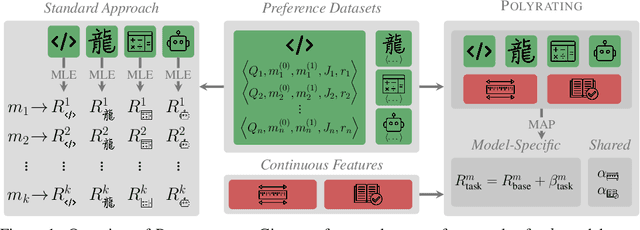
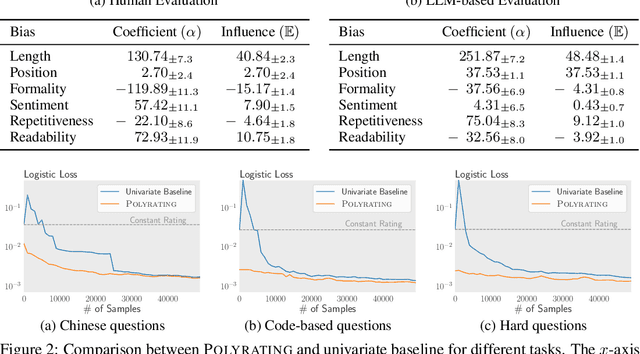
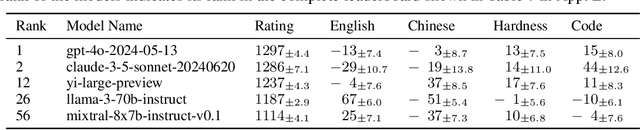
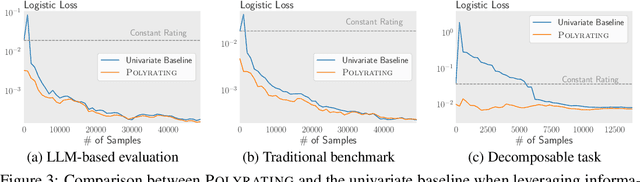
Rating-based human evaluation has become an essential tool to accurately evaluate the impressive performance of Large language models (LLMs). However, current rating systems suffer from several critical limitations. Specifically, they fail to account for human biases that significantly influence evaluation results, require large and expensive preference datasets to obtain accurate ratings, and do not facilitate meaningful comparisons of model ratings across different tasks. To address these issues, we introduce Polyrating, an expressive and flexible rating system based on maximum a posteriori estimation that enables a more nuanced and thorough analysis of model performance at lower costs. Polyrating can detect and quantify biases affecting human preferences, ensuring fairer model comparisons. Furthermore, Polyrating can reduce the cost of human evaluations by up to $41\%$ for new models and up to $77\%$ for new tasks by leveraging existing benchmark scores. Lastly, Polyrating enables direct comparisons of ratings across different tasks, providing a comprehensive understanding of an LLMs' strengths, weaknesses, and relative performance across different applications.