 Add to Chrome
 Add to Firefox
 Add to Edge
MinerU.Chem: A High-Precision System for Optical Chemical Structure and Reaction Recognition
Aug 05, 2026
In organic chemistry papers and patents, molecular structures, reaction schemes, and experimental conditions are often presented as molecular structure depictions, reaction diagrams, and complex tables or figures. Such information is difficult for general-purpose document parsing systems to directly convert into machine-readable data. This limits data production for organic chemistry knowledge base construction and for AI for Chemistry tasks such as reaction prediction, retrosynthesis, condition recommendation, molecular property prediction, and drug molecule design. This report introduces MinerU-Chem, a document parsing system for organic chemistry literature integrated into the MinerU online platform. Built on top of MinerU's general document parsing pipeline, MinerU-Chem adds five chemistry-specific modules: chemistry relevance filtering, molecular structure detection, molecule identifier extraction, molecular structure recognition, and reaction scheme parsing. Together, these modules convert organic-chemistry-related image regions in documents into a Molecule Summary List and a Reaction Summary List. For molecular structure recognition, MinerU-Chem uses CARBON (Complex Atomic Representation and Bonding Object Notation) as its core representation. CARBON enables recognition results to preserve both the visual layout of the original image and complex chemical semantics, while supporting the export of standard downstream formats such as MolFile and SMILES. On the SMILES-evaluable subset of MolRecBench-Wild (N=2,392), MinerU-Chem's molecular structure recognition module achieves a SMILES exact-match accuracy of 93.02%, outperforming the best evaluated comparison system, GPT-5.6-Sol (74.87%), by 18.15 percentage points. The system has been integrated into the MinerU online platform and is available at https://mineru.net/OpenSourceTools/Extractor .

GTR-CoT: Graph Traversal as Visual Chain of Thought for Molecular Structure Recognition
Jun 09, 2025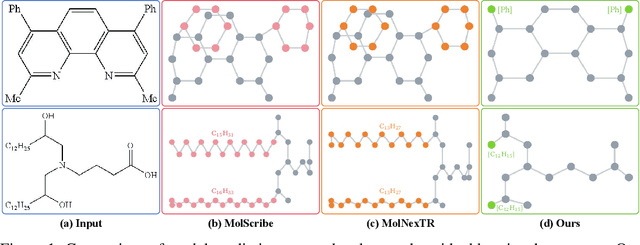
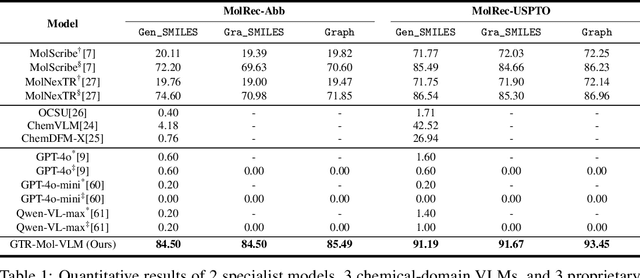
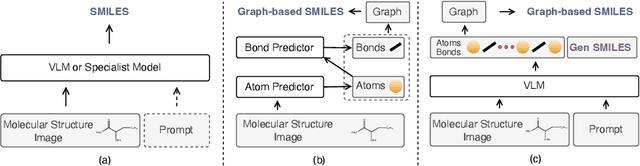
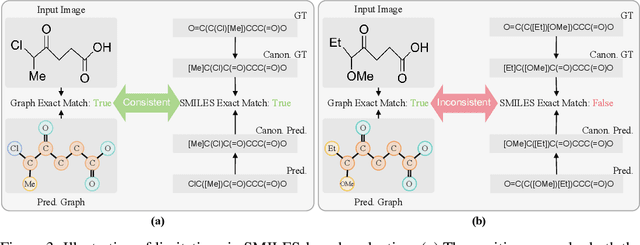
Optical Chemical Structure Recognition (OCSR) is crucial for digitizing chemical knowledge by converting molecular images into machine-readable formats. While recent vision-language models (VLMs) have shown potential in this task, their image-captioning approach often struggles with complex molecular structures and inconsistent annotations. To overcome these challenges, we introduce GTR-Mol-VLM, a novel framework featuring two key innovations: (1) the \textit{Graph Traversal as Visual Chain of Thought} mechanism that emulates human reasoning by incrementally parsing molecular graphs through sequential atom-bond predictions, and (2) the data-centric principle of \textit{Faithfully Recognize What You've Seen}, which addresses the mismatch between abbreviated structures in images and their expanded annotations. To support model development, we constructed GTR-CoT-1.3M, a large-scale instruction-tuning dataset with meticulously corrected annotations, and introduced MolRec-Bench, the first benchmark designed for a fine-grained evaluation of graph-parsing accuracy in OCSR. Comprehensive experiments demonstrate that GTR-Mol-VLM achieves superior results compared to specialist models, chemistry-domain VLMs, and commercial general-purpose VLMs. Notably, in scenarios involving molecular images with functional group abbreviations, GTR-Mol-VLM outperforms the second-best baseline by approximately 14 percentage points, both in SMILES-based and graph-based metrics. We hope that this work will drive OCSR technology to more effectively meet real-world needs, thereby advancing the fields of cheminformatics and AI for Science. We will release GTR-CoT at https://github.com/opendatalab/GTR-CoT.