 Add to Chrome
 Add to Firefox
 Add to Edge
Event ActivityNet: A Large-Scale Simulated-Event Benchmark for Untrimmed Action Understanding
Aug 03, 2026
Long-horizon event-based action understanding remains underexplored because existing datasets largely comprise short, trimmed clips, while collecting native event streams with dense temporal annotations is costly. We introduce Event ActivityNet, a large-scale simulated-event benchmark derived from human-annotated, untrimmed ActivityNet videos. It comprises 3,263 videos, 200 action classes, and 106.94 hours, with matched 5-bin and 9-bin event-voxel representations, temporal action annotations, and timestamped captions. The benchmark supports annotated-segment action recognition, auxiliary event-language alignment, and causal online temporal action localization. We generate event voxels directly from non-interpolated source videos in decoded frame order, retain per-video rational nominal or average frame-rate metadata for approximate time mapping, and use action-center reconstruction LPIPS as a soft diagnostic of retained reconstructable content. We establish baselines for adaptive event framing, prompt-caption alignment, and event-only, RGB-only, and RGB-event localization. Under a progressive nested-scale training protocol, recognition Top-1 accuracy increases from 52.25 to 66.42, while online temporal localization average mAP improves from 21.7 to 29.0. Moreover, staged Event ActivityNet pretraining followed by native-event fine-tuning consistently outperforms target-only and joint-from-scratch training across multiple supervision budgets. Event ActivityNet provides a scalable benchmark for long-horizon event modeling, although native-camera evaluation remains essential for deployment-oriented conclusions.

Test-Time Registers as Global Priors for Tokenized Image Generation
Jul 21, 2026Attention-based models often develop attention sinks, where a small number of tokens repeatedly attract attention and accumulate unusually large activations. In vision transformers, these outliers are closely related to registers, which have been diagnostically linked to global, low-frequency image structure. Existing work has largely studied registers through interpretability analyses and linear probes, leaving open whether they can be operationalized as plug-and-play signals for generation without retraining. We revisit this question in tokenized image generation. Using OpenCLIP and DINOv2 on ImageNet, we find that test-time register features exhibit stronger low-frequency concentration than both [CLS] readouts and patch-mean features, and show a consistent (albeit moderate) correlation with pixel-space DCT low-frequency energy. Motivated by these diagnostics, we introduce RegToken, a training-free procedure that converts register structure into a small set of global prior tokens by (i) NFN-based layer localization, (ii) TokenRank-guided subspace extraction, and (iii) a projection-and-conservation update on the register subspace. Inserted into a frozen compact 1D token generation pipeline, RegToken improves ImageNet generation and alignment metrics (e.g., FID-5k 20.5 to 20.1, SigLIP 3.6 to 3.9) without modifying pretrained weights, and accelerates test-time optimization (Steps@$τ$ 74 to 52). Overall, our results suggest that structures often viewed as attention artifacts can be repurposed as lightweight global priors for tokenized generation.
Decoupled Contrastive Learning
Oct 23, 2021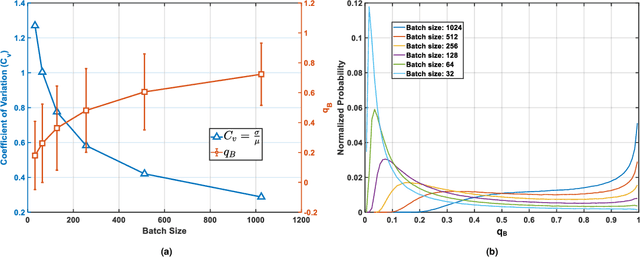
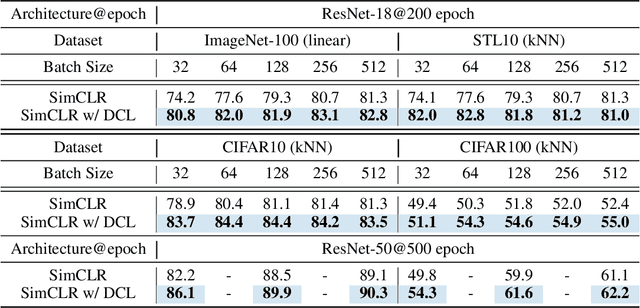
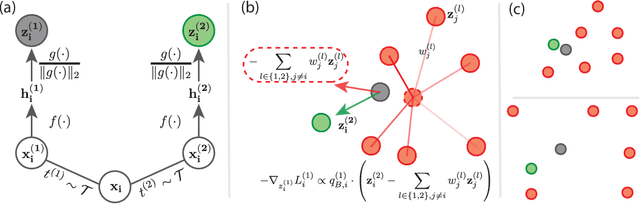

Contrastive learning (CL) is one of the most successful paradigms for self-supervised learning (SSL). In a principled way, it considers two augmented "views" of the same image as positive to be pulled closer, and all other images negative to be pushed further apart. However, behind the impressive success of CL-based techniques, their formulation often relies on heavy-computation settings, including large sample batches, extensive training epochs, etc. We are thus motivated to tackle these issues and aim at establishing a simple, efficient, and yet competitive baseline of contrastive learning. Specifically, we identify, from theoretical and empirical studies, a noticeable negative-positive-coupling (NPC) effect in the widely used cross-entropy (InfoNCE) loss, leading to unsuitable learning efficiency with respect to the batch size. Indeed the phenomenon tends to be neglected in that optimizing infoNCE loss with a small-size batch is effective in solving easier SSL tasks. By properly addressing the NPC effect, we reach a decoupled contrastive learning (DCL) objective function, significantly improving SSL efficiency. DCL can achieve competitive performance, requiring neither large batches in SimCLR, momentum encoding in MoCo, or large epochs. We demonstrate the usefulness of DCL in various benchmarks, while manifesting its robustness being much less sensitive to suboptimal hyperparameters. Notably, our approach achieves $66.9\%$ ImageNet top-1 accuracy using batch size 256 within 200 epochs pre-training, outperforming its baseline SimCLR by $5.1\%$. With further optimized hyperparameters, DCL can improve the accuracy to $68.2\%$. We believe DCL provides a valuable baseline for future contrastive learning-based SSL studies.
Fine-Grained Visual Recognition with Batch Confusion Norm
Oct 28, 2019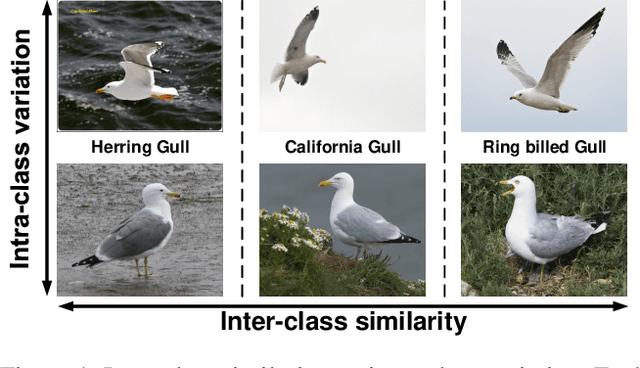
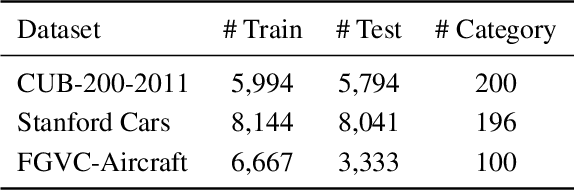
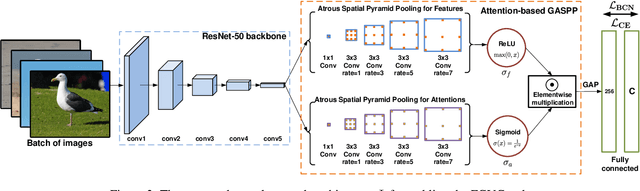
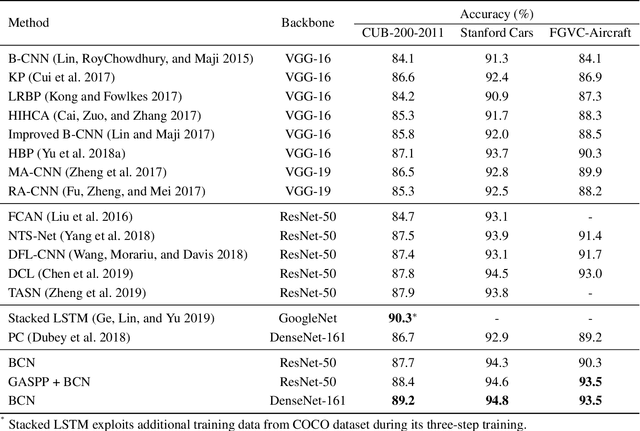
We introduce a regularization concept based on the proposed Batch Confusion Norm (BCN) to address Fine-Grained Visual Classification (FGVC). The FGVC problem is notably characterized by its two intriguing properties, significant inter-class similarity and intra-class variations, which cause learning an effective FGVC classifier a challenging task. Inspired by the use of pairwise confusion energy as a regularization mechanism, we develop the BCN technique to improve the FGVC learning by imposing class prediction confusion on each training batch, and consequently alleviate the possible overfitting due to exploring image feature of fine details. In addition, our method is implemented with an attention gated CNN model, boosted by the incorporation of Atrous Spatial Pyramid Pooling (ASPP) to extract discriminative features and proper attentions. To demonstrate the usefulness of our method, we report state-of-the-art results on several benchmark FGVC datasets, along with comprehensive ablation comparisons.