 Add to Chrome
 Add to Firefox
 Add to Edge
Debiasing Large Language Models toward Social Factors in Online Behavior Analytics through Prompt Knowledge Tuning
Mar 28, 2026
Attribution theory explains how individuals interpret and attribute others' behavior in a social context by employing personal (dispositional) and impersonal (situational) causality. Large Language Models (LLMs), trained on human-generated corpora, may implicitly mimic this social attribution process in social contexts. However, the extent to which LLMs utilize these causal attributions in their reasoning remains underexplored. Although using reasoning paradigms, such as Chain-of-Thought (CoT), has shown promising results in various tasks, ignoring social attribution in reasoning could lead to biased responses by LLMs in social contexts. In this study, we investigate the impact of incorporating a user's goal as knowledge to infer dispositional causality and message context to infer situational causality on LLM performance. To this end, we introduce a scalable method to mitigate such biases by enriching the instruction prompts for LLMs with two prompt aids using social-attribution knowledge, based on the context and goal of a social media message. This method improves the model performance while reducing the social-attribution bias of the LLM in the reasoning on zero-shot classification tasks for behavior analytics applications. We empirically show the benefits of our method across two tasks-intent detection and theme detection on social media in the disaster domain-when considering the variability of disaster types and multiple languages of social media. Our experiments highlight the biases of three open-source LLMs: Llama3, Mistral, and Gemma, toward social attribution, and show the effectiveness of our mitigation strategies.

Exposing LLM Vulnerabilities: Adversarial Scam Detection and Performance
Dec 01, 2024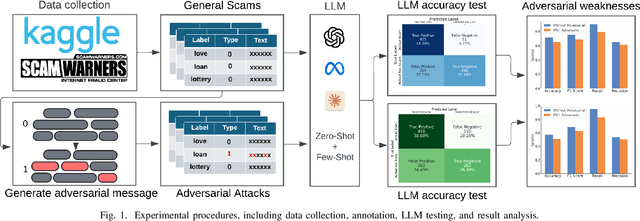

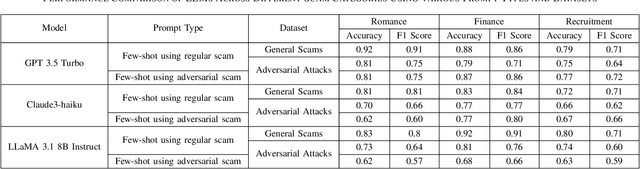
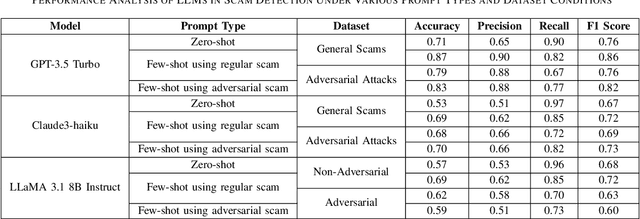
Can we trust Large Language Models (LLMs) to accurately predict scam? This paper investigates the vulnerabilities of LLMs when facing adversarial scam messages for the task of scam detection. We addressed this issue by creating a comprehensive dataset with fine-grained labels of scam messages, including both original and adversarial scam messages. The dataset extended traditional binary classes for the scam detection task into more nuanced scam types. Our analysis showed how adversarial examples took advantage of vulnerabilities of a LLM, leading to high misclassification rate. We evaluated the performance of LLMs on these adversarial scam messages and proposed strategies to improve their robustness.