 Add to Chrome
 Add to Firefox
 Add to Edge
Interactive Reward Agent: GUI Task Evaluation via Environment-State Verification
Jul 29, 2026
Graphical user interface task evaluation aims to determine whether a GUI agent has successfully completed a user instruction. Automated GUI task evaluation has received increasing attention because the evaluation results can serve as reward signals for both test-time scaling and post-training. However, reliable GUI task evaluation remains challenging because the judgments often require access to environment states, such as system configurations, file data, and application settings, beyond the screenshots of execution trajectories. In this paper, we propose an interactive reward agent (IRA) based on a propose-then-verify framework to acquire and verify evidence from the post-execution environment. Given a task instruction and a GUI environment after the GUI agent execution, IRA first proposes the task completion conditions and then verifies them by invoking system tools, application tools, and GUI tools. This design combines evidence from both visible interfaces and the environment state in an interactive process. We further introduce GUI-RewardBench, a benchmark of 321 GUI task trajectories spanning 10 Ubuntu desktop application categories. Experiments show that IRA achieves 86.9% accuracy on GUI-RewardBench, outperforming existing evaluator baselines. We further apply IRA to reinforcement learning of GUI agents, achieving a 34.0% OSWorld success rate, which demonstrates that IRA can provide effective reward signals for training GUI agents.

Composition-Incremental Learning for Compositional Generalization
Nov 12, 2025Compositional generalization has achieved substantial progress in computer vision on pre-collected training data. Nonetheless, real-world data continually emerges, with possible compositions being nearly infinite, long-tailed, and not entirely visible. Thus, an ideal model is supposed to gradually improve the capability of compositional generalization in an incremental manner. In this paper, we explore Composition-Incremental Learning for Compositional Generalization (CompIL) in the context of the compositional zero-shot learning (CZSL) task, where models need to continually learn new compositions, intending to improve their compositional generalization capability progressively. To quantitatively evaluate CompIL, we develop a benchmark construction pipeline leveraging existing datasets, yielding MIT-States-CompIL and C-GQA-CompIL. Furthermore, we propose a pseudo-replay framework utilizing a visual synthesizer to synthesize visual representations of learned compositions and a linguistic primitive distillation mechanism to maintain aligned primitive representations across the learning process. Extensive experiments demonstrate the effectiveness of the proposed framework.
Neural 3D Scene Reconstruction from Multiple 2D Images without 3D Supervision
Jul 04, 2023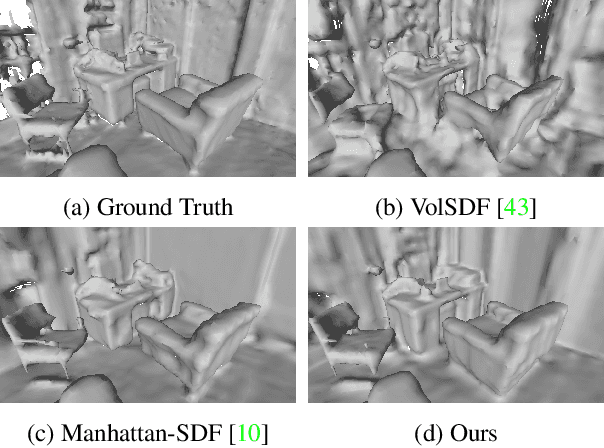

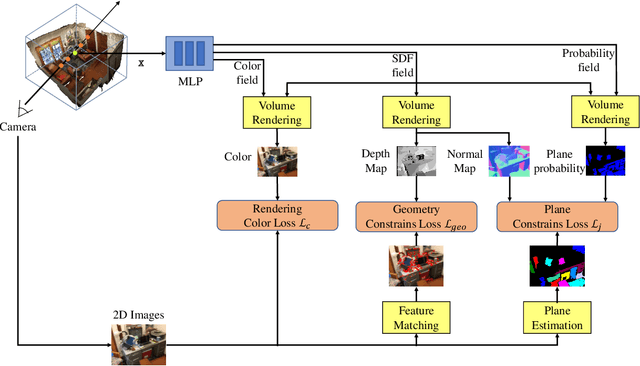
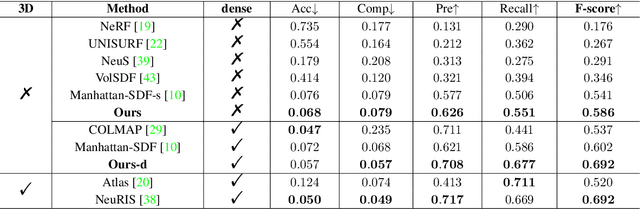
Neural 3D scene reconstruction methods have achieved impressive performance when reconstructing complex geometry and low-textured regions in indoor scenes. However, these methods heavily rely on 3D data which is costly and time-consuming to obtain in real world. In this paper, we propose a novel neural reconstruction method that reconstructs scenes using sparse depth under the plane constraints without 3D supervision. We introduce a signed distance function field, a color field, and a probability field to represent a scene. We optimize these fields to reconstruct the scene by using differentiable ray marching with accessible 2D images as supervision. We improve the reconstruction quality of complex geometry scene regions with sparse depth obtained by using the geometric constraints. The geometric constraints project 3D points on the surface to similar-looking regions with similar features in different 2D images. We impose the plane constraints to make large planes parallel or vertical to the indoor floor. Both two constraints help reconstruct accurate and smooth geometry structures of the scene. Without 3D supervision, our method achieves competitive performance compared with existing methods that use 3D supervision on the ScanNet dataset.