 Add to Chrome
 Add to Firefox
 Add to Edge
Omnilingual MT: Machine Translation for 1,600 Languages
Mar 17, 2026
High-quality machine translation (MT) can scale to hundreds of languages, setting a high bar for multilingual systems. However, compared to the world's 7,000 languages, current systems still offer only limited coverage: about 200 languages on the target side, and maybe a few hundreds more on the source side, supported due to cross-lingual transfer. And even these numbers have been hard to evaluate due to the lack of reliable benchmarks and metrics. We present Omnilingual Machine Translation (OMT), the first MT system supporting more than 1,600 languages. This scale is enabled by a comprehensive data strategy that integrates large public multilingual corpora with newly created datasets, including manually curated MeDLEY bitext. We explore two ways of specializing a Large Language model (LLM) for machine translation: as a decoder-only model (OMT-LLaMA) or as a module in an encoder-decoder architecture (OMT-NLLB). Notably, all our 1B to 8B parameter models match or exceed the MT performance of a 70B LLM baseline, revealing a clear specialization advantage and enabling strong translation quality in low-compute settings. Moreover, our evaluation of English-to-1,600 translations further shows that while baseline models can interpret undersupported languages, they frequently fail to generate them with meaningful fidelity; OMT-LLaMA models substantially expand the set of languages for which coherent generation is feasible. Additionally, OMT models improve in cross-lingual transfer, being close to solving the "understanding" part of the puzzle in MT for the 1,600 evaluated. Our leaderboard and main human-created evaluation datasets (BOUQuET and Met-BOUQuET) are dynamically evolving towards Omnilinguality and freely available.

SpidR-Adapt: A Universal Speech Representation Model for Few-Shot Adaptation
Dec 24, 2025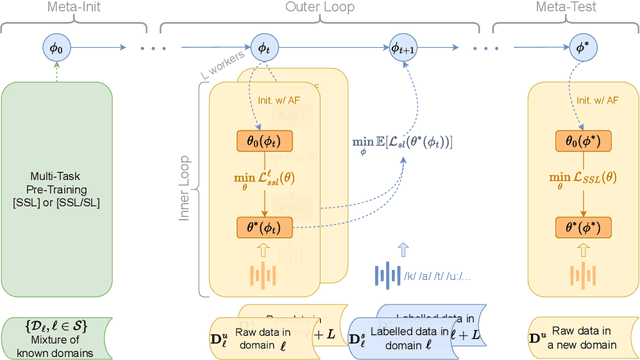
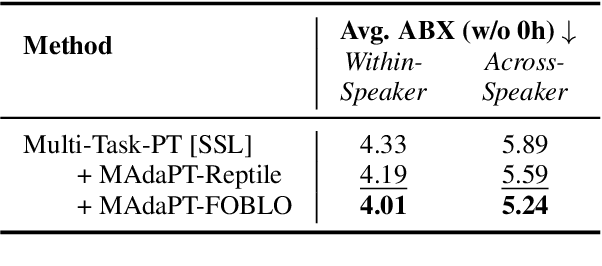
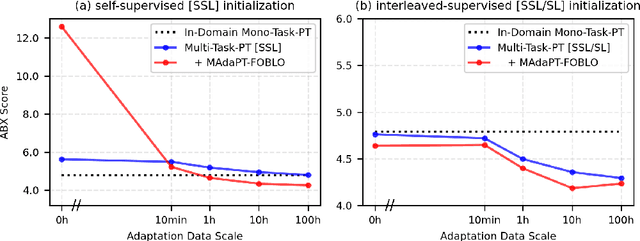
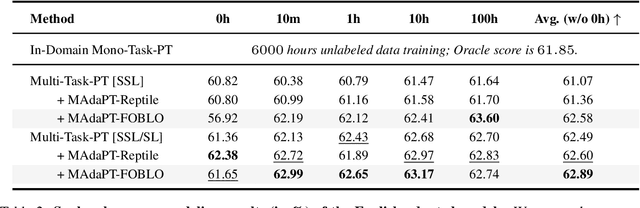
Human infants, with only a few hundred hours of speech exposure, acquire basic units of new languages, highlighting a striking efficiency gap compared to the data-hungry self-supervised speech models. To address this gap, this paper introduces SpidR-Adapt for rapid adaptation to new languages using minimal unlabeled data. We cast such low-resource speech representation learning as a meta-learning problem and construct a multi-task adaptive pre-training (MAdaPT) protocol which formulates the adaptation process as a bi-level optimization framework. To enable scalable meta-training under this framework, we propose a novel heuristic solution, first-order bi-level optimization (FOBLO), avoiding heavy computation costs. Finally, we stabilize meta-training by using a robust initialization through interleaved supervision which alternates self-supervised and supervised objectives. Empirically, SpidR-Adapt achieves rapid gains in phonemic discriminability (ABX) and spoken language modeling (sWUGGY, sBLIMP, tSC), improving over in-domain language models after training on less than 1h of target-language audio, over $100\times$ more data-efficient than standard training. These findings highlight a practical, architecture-agnostic path toward biologically inspired, data-efficient representations. We open-source the training code and model checkpoints at https://github.com/facebookresearch/spidr-adapt.