 Add to Chrome
 Add to Firefox
 Add to Edge
Universal Image Immunization against Diffusion-based Image Editing via Semantic Injection
Feb 16, 2026
Recent advances in diffusion models have enabled powerful image editing capabilities guided by natural language prompts, unlocking new creative possibilities. However, they introduce significant ethical and legal risks, such as deepfakes and unauthorized use of copyrighted visual content. To address these risks, image immunization has emerged as a promising defense against AI-driven semantic manipulation. Yet, most existing approaches rely on image-specific adversarial perturbations that require individual optimization for each image, thereby limiting scalability and practicality. In this paper, we propose the first universal image immunization framework that generates a single, broadly applicable adversarial perturbation specifically designed for diffusion-based editing pipelines. Inspired by universal adversarial perturbation (UAP) techniques used in targeted attacks, our method generates a UAP that embeds a semantic target into images to be protected. Simultaneously, it suppresses original content to effectively misdirect the model's attention during editing. As a result, our approach effectively blocks malicious editing attempts by overwriting the original semantic content in the image via the UAP. Moreover, our method operates effectively even in data-free settings without requiring access to training data or domain knowledge, further enhancing its practicality and broad applicability in real-world scenarios. Extensive experiments show that our method, as the first universal immunization approach, significantly outperforms several baselines in the UAP setting. In addition, despite the inherent difficulty of universal perturbations, our method also achieves performance on par with image-specific methods under a more restricted perturbation budget, while also exhibiting strong black-box transferability across different diffusion models.

Uncertainty Reduction for 3D Point Cloud Self-Supervised Traversability Estimation
Nov 21, 2022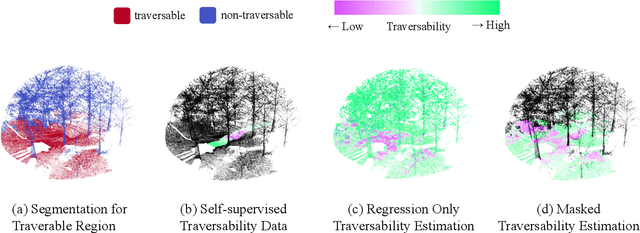
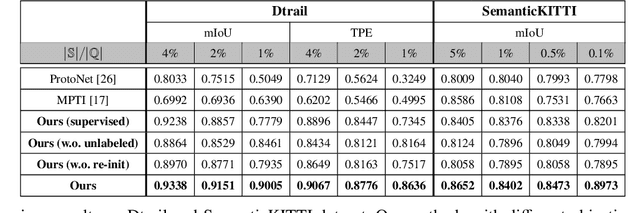
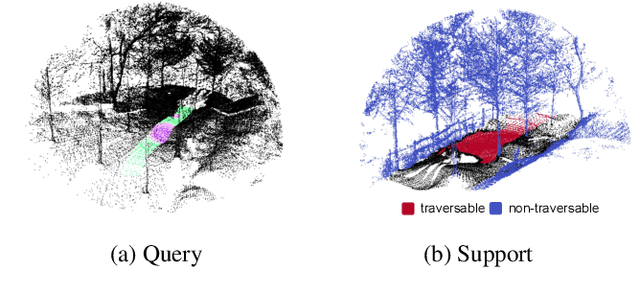

Traversability estimation in off-road environments requires a robust perception system. Recently, approaches to learning a traversability estimation from past vehicle experiences in a self-supervised manner are arising as they can greatly reduce human labeling costs and labeling errors. Nonetheless, the learning setting from self-supervised traversability estimation suffers from congenital uncertainties that appear according to the scarcity of negative information. Negative data are rarely harvested as the system can be severely damaged while logging the data. To mitigate the uncertainty, we introduce a method to incorporate unlabeled data in order to leverage the uncertainty. First, we design a learning architecture that inputs query and support data. Second, unlabeled data are assigned based on the proximity in the metric space. Third, a new metric for uncertainty measures is introduced. We evaluated our approach on our own dataset, `Dtrail', which is composed of a wide variety of negative data.