 Add to Chrome
 Add to Firefox
 Add to Edge
Physics-Guided Tiny-Mamba Transformer for Reliability-Aware Early Fault Warning
Jan 29, 2026
Reliability-centered prognostics for rotating machinery requires early warning signals that remain accurate under nonstationary operating conditions, domain shifts across speed/load/sensors, and severe class imbalance, while keeping the false-alarm rate small and predictable. We propose the Physics-Guided Tiny-Mamba Transformer (PG-TMT), a compact tri-branch encoder tailored for online condition monitoring. A depthwise-separable convolutional stem captures micro-transients, a Tiny-Mamba state-space branch models near-linear long-range dynamics, and a lightweight local Transformer encodes cross-channel resonances. We derive an analytic temporal-to-spectral mapping that ties the model's attention spectrum to classical bearing fault-order bands, yielding a band-alignment score that quantifies physical plausibility and provides physics-grounded explanations. To ensure decision reliability, healthy-score exceedances are modeled with extreme-value theory (EVT), which yields an on-threshold achieving a target false-alarm intensity (events/hour); a dual-threshold hysteresis with a minimum hold time further suppresses chatter. Under a leakage-free streaming protocol with right-censoring of missed detections on CWRU, Paderborn, XJTU-SY, and an industrial pilot, PG-TMT attains higher precision-recall AUC (primary under imbalance), competitive or better ROC AUC, and shorter mean time-to-detect at matched false-alarm intensity, together with strong cross-domain transfer. By coupling physics-aligned representations with EVT-calibrated decision rules, PG-TMT delivers calibrated, interpretable, and deployment-ready early warnings for reliability-centric prognostics and health management.

W-MAE: Pre-trained weather model with masked autoencoder for multi-variable weather forecasting
Apr 18, 2023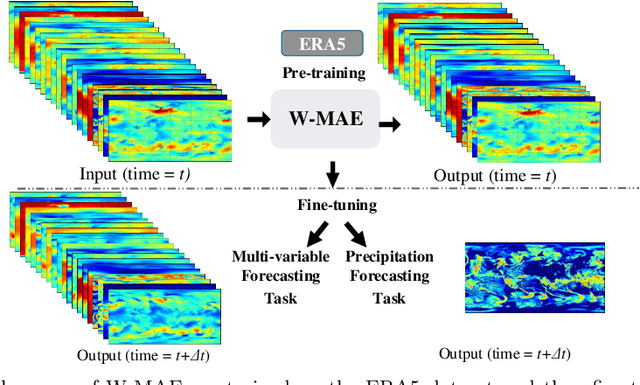
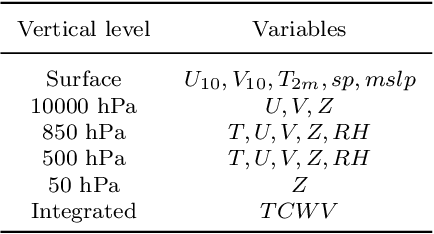
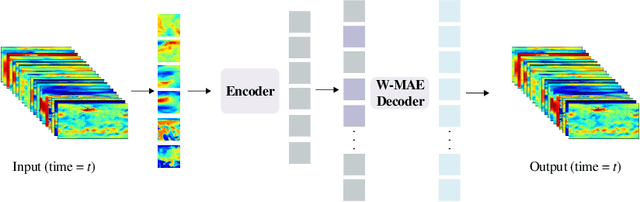
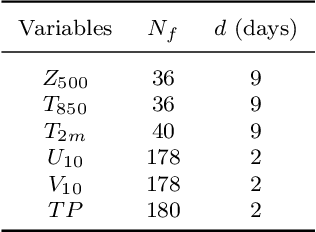
Weather forecasting is a long-standing computational challenge with direct societal and economic impacts. This task involves a large amount of continuous data collection and exhibits rich spatiotemporal dependencies over long periods, making it highly suitable for deep learning models. In this paper, we apply pre-training techniques to weather forecasting and propose W-MAE, a Weather model with Masked AutoEncoder pre-training for multi-variable weather forecasting. W-MAE is pre-trained in a self-supervised manner to reconstruct spatial correlations within meteorological variables. On the temporal scale, we fine-tune the pre-trained W-MAE to predict the future states of meteorological variables, thereby modeling the temporal dependencies present in weather data. We pre-train W-MAE using the fifth-generation ECMWF Reanalysis (ERA5) data, with samples selected every six hours and using only two years of data. Under the same training data conditions, we compare W-MAE with FourCastNet, and W-MAE outperforms FourCastNet in precipitation forecasting. In the setting where the training data is far less than that of FourCastNet, our model still performs much better in precipitation prediction (0.80 vs. 0.98). Additionally, experiments show that our model has a stable and significant advantage in short-to-medium-range forecasting (i.e., forecasting time ranges from 6 hours to one week), and the longer the prediction time, the more evident the performance advantage of W-MAE, further proving its robustness.
Diverse Preference Augmentation with Multiple Domains for Cold-start Recommendations
Apr 01, 2022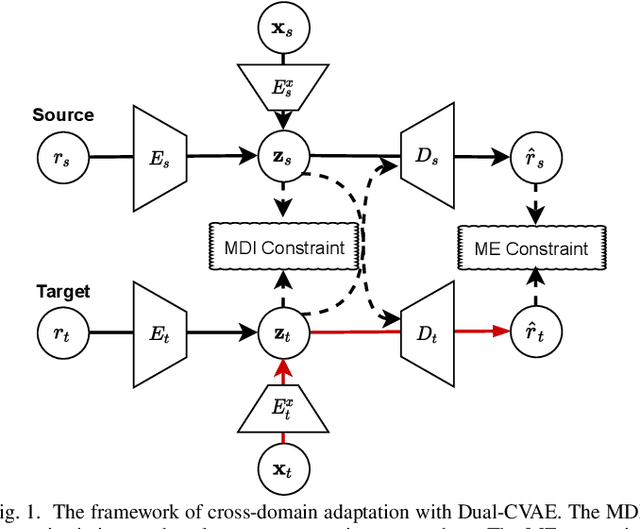
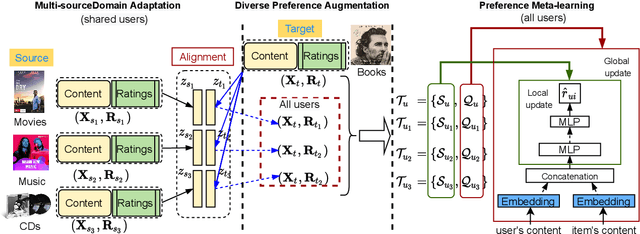
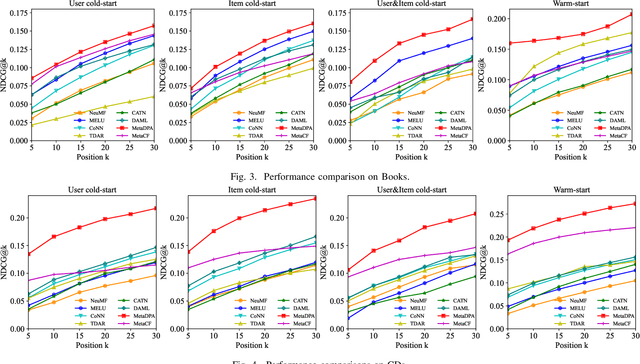
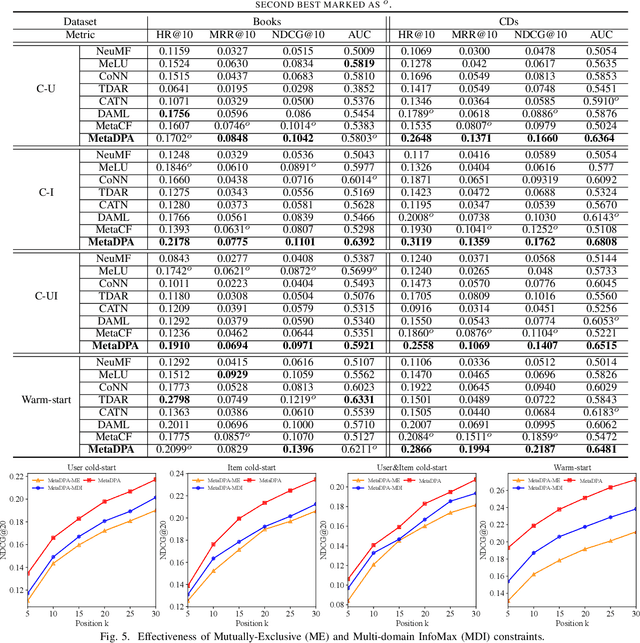
Cold-start issues have been more and more challenging for providing accurate recommendations with the fast increase of users and items. Most existing approaches attempt to solve the intractable problems via content-aware recommendations based on auxiliary information and/or cross-domain recommendations with transfer learning. Their performances are often constrained by the extremely sparse user-item interactions, unavailable side information, or very limited domain-shared users. Recently, meta-learners with meta-augmentation by adding noises to labels have been proven to be effective to avoid overfitting and shown good performance on new tasks. Motivated by the idea of meta-augmentation, in this paper, by treating a user's preference over items as a task, we propose a so-called Diverse Preference Augmentation framework with multiple source domains based on meta-learning (referred to as MetaDPA) to i) generate diverse ratings in a new domain of interest (known as target domain) to handle overfitting on the case of sparse interactions, and to ii) learn a preference model in the target domain via a meta-learning scheme to alleviate cold-start issues. Specifically, we first conduct multi-source domain adaptation by dual conditional variational autoencoders and impose a Multi-domain InfoMax (MDI) constraint on the latent representations to learn domain-shared and domain-specific preference properties. To avoid overfitting, we add a Mutually-Exclusive (ME) constraint on the output of decoders to generate diverse ratings given content data. Finally, these generated diverse ratings and the original ratings are introduced into the meta-training procedure to learn a preference meta-learner, which produces good generalization ability on cold-start recommendation tasks. Experiments on real-world datasets show our proposed MetaDPA clearly outperforms the current state-of-the-art baselines.