 Add to Chrome
 Add to Firefox
 Add to Edge
Reinforcement Learning Disrupts Gradient-Based Adversarial Optimization
Jun 10, 2026
Gradient-based adversarial attacks remain a dominant threat to deep neural networks (DNNs), as they exploit gradient information to efficiently optimize adversarial perturbations. To address this, we investigate whether reinforcement learning (RL) training can disrupt the gradient structure used by attackers by training image classifiers with policy-gradient objectives and epsilon-greedy exploration. Through systematic experiments across CIFAR-10, CIFAR-100, and ImageNet-100 with multiple architectures, we find that RL-trained classifiers significantly disrupt gradient-based adversarial optimization. To explain this, we conduct a comprehensive mechanism analysis using loss landscape visualization, static and dynamic gradient indicators, and predictive entropy. Our analysis reveals that RL acts as an implicit regularizer, producing models with highly unstable gradient directions and smaller gradient magnitudes. This combination makes each PGD step both unreliable in direction and limited in magnitude, causing gradient-based attacks to fail within practical iteration budgets. We further show that combining RL with adversarial training (RL-adv) provides a dual-layer defense operating at two complementary levels: RL degrades gradient information available to attackers (gradient-level defense), while adversarial training strengthens decision boundaries (boundary-level defense). RL-adv achieves the highest robustness across all major attack types evaluated, including gradient-based (PGD, AutoAttack), transfer-based, and query-based attacks, outperforming SL-adv by a significant margin. These findings identify RL-induced gradient disruption as a complementary robustness mechanism and motivate future research on hybrid SL-RL training schedules that combine SL's efficiency with RL's gradient-regularization properties.

ThinkDrive: Chain-of-Thought Guided Progressive Reinforcement Learning Fine-Tuning for Autonomous Driving
Jan 08, 2026With the rapid advancement of large language models (LLMs) technologies, their application in the domain of autonomous driving has become increasingly widespread. However, existing methods suffer from unstructured reasoning, poor generalization, and misalignment with human driving intent. While Chain-of-Thought (CoT) reasoning enhances decision transparency, conventional supervised fine-tuning (SFT) fails to fully exploit its potential, and reinforcement learning (RL) approaches face instability and suboptimal reasoning depth. We propose ThinkDrive, a CoT guided progressive RL fine-tuning framework for autonomous driving that synergizes explicit reasoning with difficulty-aware adaptive policy optimization. Our method employs a two-stage training strategy. First, we perform SFT using CoT explanations. Then, we apply progressive RL with a difficulty-aware adaptive policy optimizer that dynamically adjusts learning intensity based on sample complexity. We evaluate our approach on a public dataset. The results show that ThinkDrive outperforms strong RL baselines by 1.45%, 1.95%, and 1.01% on exam, easy-exam, and accuracy, respectively. Moreover, a 2B-parameter model trained with our method surpasses the much larger GPT-4o by 3.28% on the exam metric.
AIVD: Adaptive Edge-Cloud Collaboration for Accurate and Efficient Industrial Visual Detection
Jan 08, 2026Multimodal large language models (MLLMs) demonstrate exceptional capabilities in semantic understanding and visual reasoning, yet they still face challenges in precise object localization and resource-constrained edge-cloud deployment. To address this, this paper proposes the AIVD framework, which achieves unified precise localization and high-quality semantic generation through the collaboration between lightweight edge detectors and cloud-based MLLMs. To enhance the cloud MLLM's robustness against edge cropped-box noise and scenario variations, we design an efficient fine-tuning strategy with visual-semantic collaborative augmentation, significantly improving classification accuracy and semantic consistency. Furthermore, to maintain high throughput and low latency across heterogeneous edge devices and dynamic network conditions, we propose a heterogeneous resource-aware dynamic scheduling algorithm. Experimental results demonstrate that AIVD substantially reduces resource consumption while improving MLLM classification performance and semantic generation quality. The proposed scheduling strategy also achieves higher throughput and lower latency across diverse scenarios.
Multi-Class Segmentation of Aortic Branches and Zones in Computed Tomography Angiography: The AortaSeg24 Challenge
Feb 07, 2025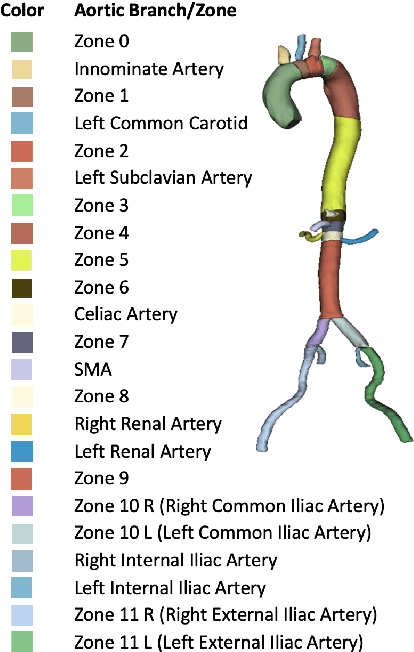
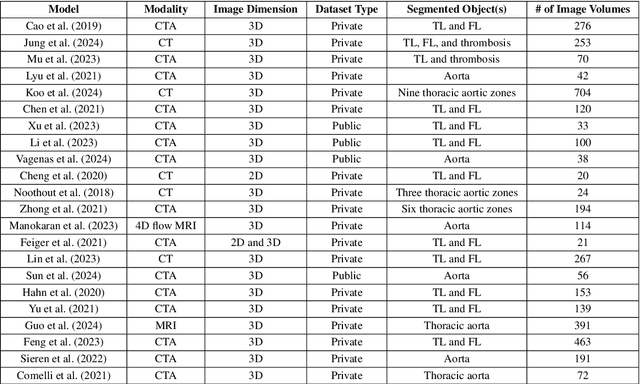
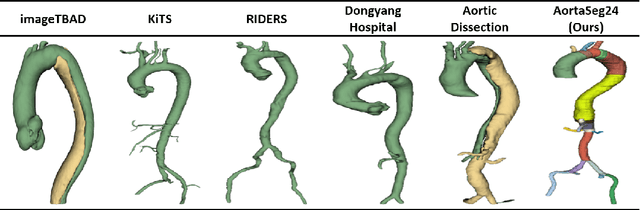

Multi-class segmentation of the aorta in computed tomography angiography (CTA) scans is essential for diagnosing and planning complex endovascular treatments for patients with aortic dissections. However, existing methods reduce aortic segmentation to a binary problem, limiting their ability to measure diameters across different branches and zones. Furthermore, no open-source dataset is currently available to support the development of multi-class aortic segmentation methods. To address this gap, we organized the AortaSeg24 MICCAI Challenge, introducing the first dataset of 100 CTA volumes annotated for 23 clinically relevant aortic branches and zones. This dataset was designed to facilitate both model development and validation. The challenge attracted 121 teams worldwide, with participants leveraging state-of-the-art frameworks such as nnU-Net and exploring novel techniques, including cascaded models, data augmentation strategies, and custom loss functions. We evaluated the submitted algorithms using the Dice Similarity Coefficient (DSC) and Normalized Surface Distance (NSD), highlighting the approaches adopted by the top five performing teams. This paper presents the challenge design, dataset details, evaluation metrics, and an in-depth analysis of the top-performing algorithms. The annotated dataset, evaluation code, and implementations of the leading methods are publicly available to support further research. All resources can be accessed at https://aortaseg24.grand-challenge.org.
Quantifying Heterogeneous Ecosystem Services With Multi-Label Soft Classification
Jun 24, 2024
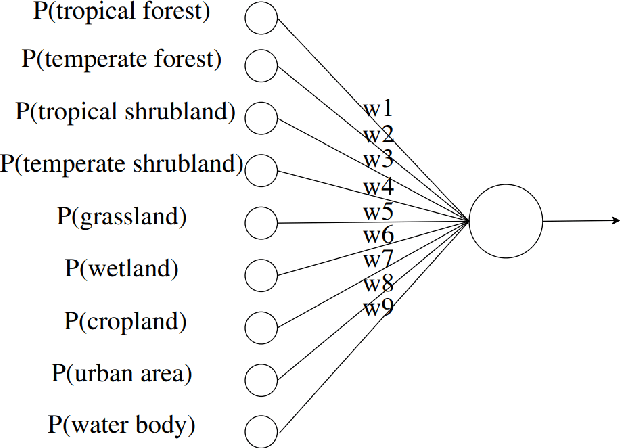
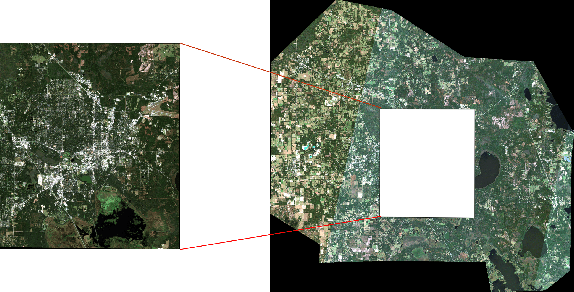
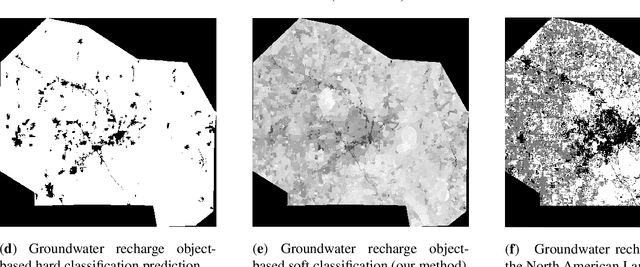
Understanding and quantifying ecosystem services are crucial for sustainable environmental management, conservation efforts, and policy-making. The advancement of remote sensing technology and machine learning techniques has greatly facilitated this process. Yet, ground truth labels, such as biodiversity, are very difficult and expensive to measure. In addition, more easily obtainable proxy labels, such as land use, often fail to capture the complex heterogeneity of the ecosystem. In this paper, we demonstrate how land use proxy labels can be implemented with a soft, multi-label classifier to predict ecosystem services with complex heterogeneity.