 Add to Chrome
 Add to Firefox
 Add to Edge
MoE Routing Testbed: Studying Expert Specialization and Routing Behavior at Small Scale
Apr 08, 2026
Sparse Mixture-of-Experts (MoE) architectures are increasingly popular for frontier large language models (LLM) but they introduce training challenges due to routing complexity. Fully leveraging parameters of an MoE model requires all experts to be well-trained and to specialize in non-redundant ways. Assessing this, however, is complicated due to lack of established metrics and, importantly, many routing techniques exhibit similar performance at smaller sizes, which is often not reflective of their behavior at large scale. To address this challenge, we propose the MoE Routing Testbed, a setup that gives clearer visibility into routing dynamics at small scale while using realistic data. The testbed pairs a data mix with clearly distinguishable domains with a reference router that prescribes ideal routing based on these domains, providing a well-defined upper bound for comparison. This enables quantifiable measurement of expert specialization. To demonstrate the value of the testbed, we compare various MoE routing approaches and show that balancing scope is the crucial factor that allows specialization while maintaining high expert utilization. We confirm that this observation generalizes to models 35x larger.

MATTER: Memory-Augmented Transformer Using Heterogeneous Knowledge Sources
Jun 07, 2024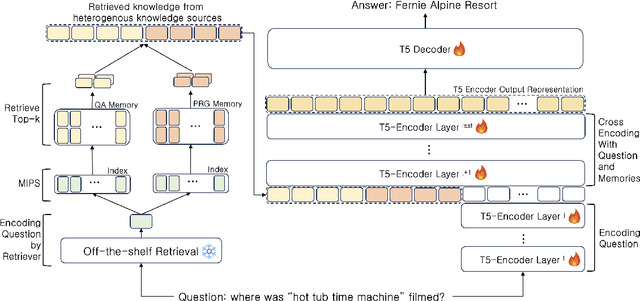
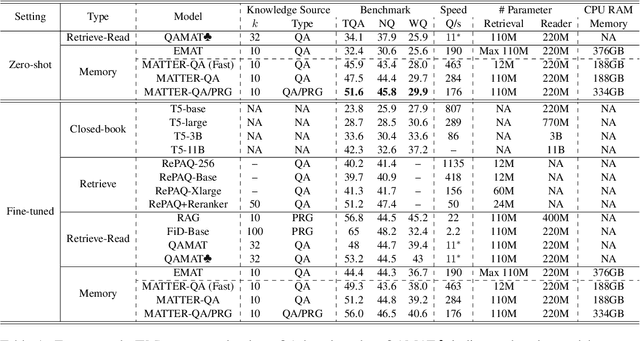
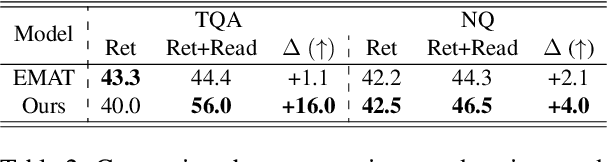
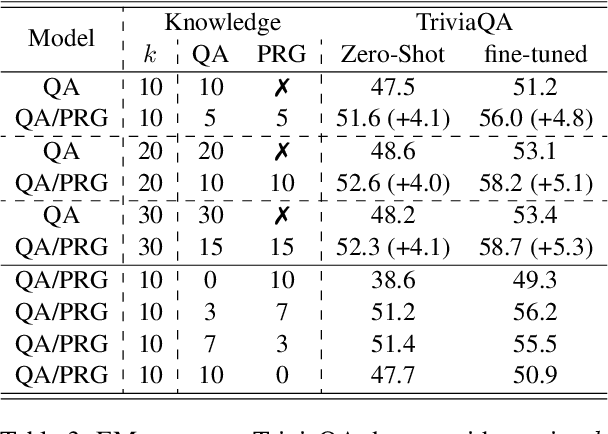
Leveraging external knowledge is crucial for achieving high performance in knowledge-intensive tasks, such as question answering. The retrieve-and-read approach is widely adopted for integrating external knowledge into a language model. However, this approach suffers from increased computational cost and latency due to the long context length, which grows proportionally with the number of retrieved knowledge. Furthermore, existing retrieval-augmented models typically retrieve information from a single type of knowledge source, limiting their scalability to diverse knowledge sources with varying structures. In this work, we introduce an efficient memory-augmented transformer called MATTER, designed to retrieve relevant knowledge from multiple heterogeneous knowledge sources. Specifically, our model retrieves and reads from both unstructured sources (paragraphs) and semi-structured sources (QA pairs) in the form of fixed-length neural memories. We demonstrate that our model outperforms existing efficient retrieval-augmented models on popular QA benchmarks in terms of both accuracy and speed. Furthermore, MATTER achieves competitive results compared to conventional read-and-retrieve models while having 100x throughput during inference.
AlexaTM 20B: Few-Shot Learning Using a Large-Scale Multilingual Seq2Seq Model
Aug 03, 2022

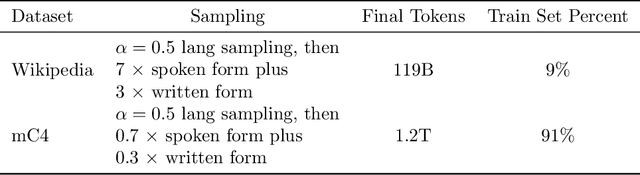
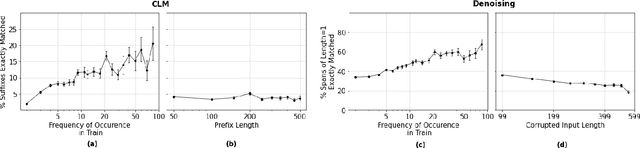
In this work, we demonstrate that multilingual large-scale sequence-to-sequence (seq2seq) models, pre-trained on a mixture of denoising and Causal Language Modeling (CLM) tasks, are more efficient few-shot learners than decoder-only models on various tasks. In particular, we train a 20 billion parameter multilingual seq2seq model called Alexa Teacher Model (AlexaTM 20B) and show that it achieves state-of-the-art (SOTA) performance on 1-shot summarization tasks, outperforming a much larger 540B PaLM decoder model. AlexaTM 20B also achieves SOTA in 1-shot machine translation, especially for low-resource languages, across almost all language pairs supported by the model (Arabic, English, French, German, Hindi, Italian, Japanese, Marathi, Portuguese, Spanish, Tamil, and Telugu) on Flores-101 dataset. We also show in zero-shot setting, AlexaTM 20B outperforms GPT3 (175B) on SuperGLUE and SQuADv2 datasets and provides SOTA performance on multilingual tasks such as XNLI, XCOPA, Paws-X, and XWinograd. Overall, our results present a compelling case for seq2seq models as a powerful alternative to decoder-only models for Large-scale Language Model (LLM) training.
Alexa Teacher Model: Pretraining and Distilling Multi-Billion-Parameter Encoders for Natural Language Understanding Systems
Jun 15, 2022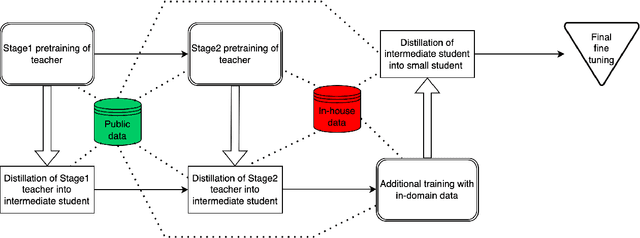
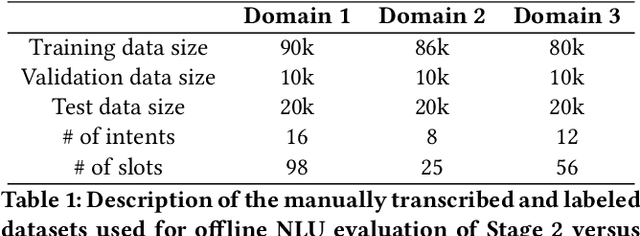
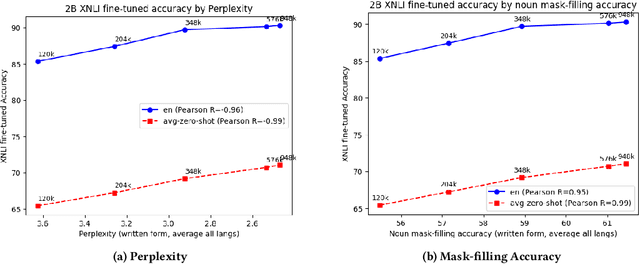
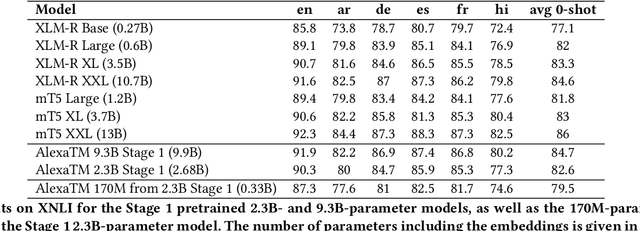
We present results from a large-scale experiment on pretraining encoders with non-embedding parameter counts ranging from 700M to 9.3B, their subsequent distillation into smaller models ranging from 17M-170M parameters, and their application to the Natural Language Understanding (NLU) component of a virtual assistant system. Though we train using 70% spoken-form data, our teacher models perform comparably to XLM-R and mT5 when evaluated on the written-form Cross-lingual Natural Language Inference (XNLI) corpus. We perform a second stage of pretraining on our teacher models using in-domain data from our system, improving error rates by 3.86% relative for intent classification and 7.01% relative for slot filling. We find that even a 170M-parameter model distilled from our Stage 2 teacher model has 2.88% better intent classification and 7.69% better slot filling error rates when compared to the 2.3B-parameter teacher trained only on public data (Stage 1), emphasizing the importance of in-domain data for pretraining. When evaluated offline using labeled NLU data, our 17M-parameter Stage 2 distilled model outperforms both XLM-R Base (85M params) and DistillBERT (42M params) by 4.23% to 6.14%, respectively. Finally, we present results from a full virtual assistant experimentation platform, where we find that models trained using our pretraining and distillation pipeline outperform models distilled from 85M-parameter teachers by 3.74%-4.91% on an automatic measurement of full-system user dissatisfaction.
* KDD 2022
Instilling Type Knowledge in Language Models via Multi-Task QA
Apr 28, 2022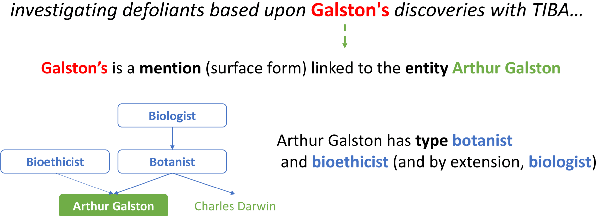
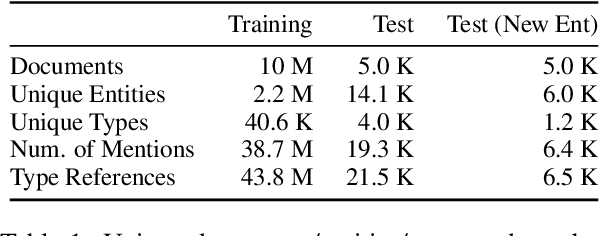
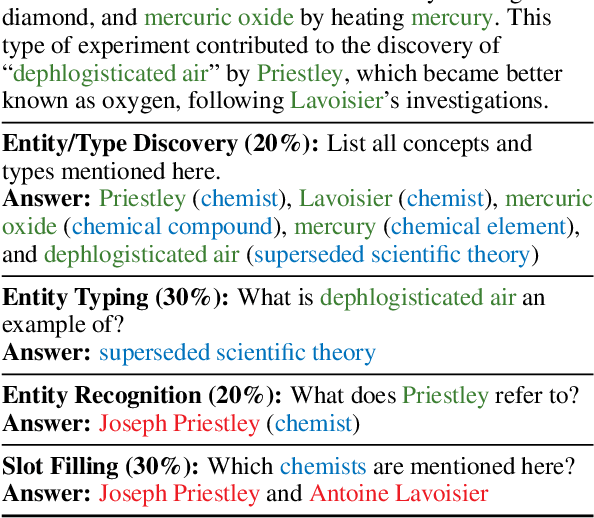
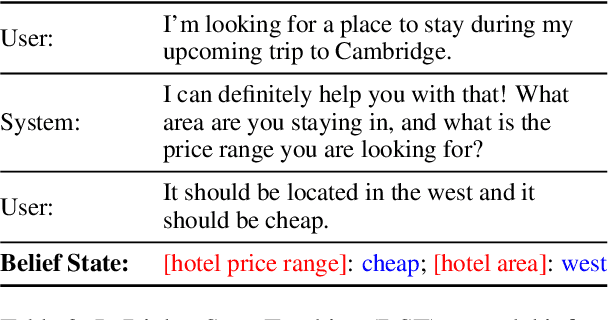
Understanding human language often necessitates understanding entities and their place in a taxonomy of knowledge -- their types. Previous methods to learn entity types rely on training classifiers on datasets with coarse, noisy, and incomplete labels. We introduce a method to instill fine-grained type knowledge in language models with text-to-text pre-training on type-centric questions leveraging knowledge base documents and knowledge graphs. We create the WikiWiki dataset: entities and passages from 10M Wikipedia articles linked to the Wikidata knowledge graph with 41K types. Models trained on WikiWiki achieve state-of-the-art performance in zero-shot dialog state tracking benchmarks, accurately infer entity types in Wikipedia articles, and can discover new types deemed useful by human judges.