 Add to Chrome
 Add to Firefox
 Add to Edge
SFBench: The SciFy Scientific Feasibility Benchmark
Jun 28, 2026
We present SFBench, a benchmark dataset for evaluating systems that assess the feasibility of scientific claims. SFBench includes 197 claims in materials science, each annotated with a ground-truth feasibility score on a five-point scale along with an explanation of that assessment. The collection differs from previous collections in several important ways: 1) it defines a complex task that requires reasoning over claims of varying scientific feasibility; 2) its claims are not extracted from existing scientific publications but are created de novo, greatly reducing the chances that LLMs have trained on them; 3) claims and ground truth are established by subject matter experts, not by artificial intelligence; and 4) unlike many benchmarks that ask about question/answer pairs, provide multiple choice answers, or ask questions requiring short, fixed answers, SFBench explanations are completely open-ended. We describe the benchmark design, data creation process, and evaluation metrics, and we report baseline results using recent GPT models.

Continual Reinforcement Learning with TELLA
Aug 08, 2022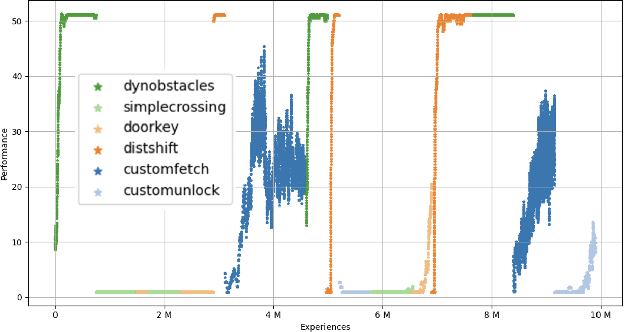
Training reinforcement learning agents that continually learn across multiple environments is a challenging problem. This is made more difficult by a lack of reproducible experiments and standard metrics for comparing different continual learning approaches. To address this, we present TELLA, a tool for the Test and Evaluation of Lifelong Learning Agents. TELLA provides specified, reproducible curricula to lifelong learning agents while logging detailed data for evaluation and standardized analysis. Researchers can define and share their own curricula over various learning environments or run against a curriculum created under the DARPA Lifelong Learning Machines (L2M) Program.
Patapasco: A Python Framework for Cross-Language Information Retrieval Experiments
Jan 24, 2022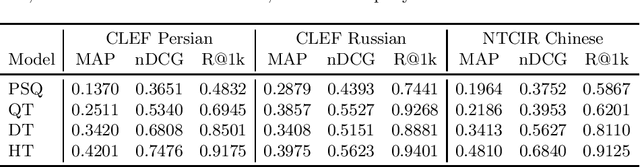
While there are high-quality software frameworks for information retrieval experimentation, they do not explicitly support cross-language information retrieval (CLIR). To fill this gap, we have created Patapsco, a Python CLIR framework. This framework specifically addresses the complexity that comes with running experiments in multiple languages. Patapsco is designed to be extensible to many language pairs, to be scalable to large document collections, and to support reproducible experiments driven by a configuration file. We include Patapsco results on standard CLIR collections using multiple settings.