 Add to Chrome
 Add to Firefox
 Add to Edge
SFBench: The SciFy Scientific Feasibility Benchmark
Jun 28, 2026
We present SFBench, a benchmark dataset for evaluating systems that assess the feasibility of scientific claims. SFBench includes 197 claims in materials science, each annotated with a ground-truth feasibility score on a five-point scale along with an explanation of that assessment. The collection differs from previous collections in several important ways: 1) it defines a complex task that requires reasoning over claims of varying scientific feasibility; 2) its claims are not extracted from existing scientific publications but are created de novo, greatly reducing the chances that LLMs have trained on them; 3) claims and ground truth are established by subject matter experts, not by artificial intelligence; and 4) unlike many benchmarks that ask about question/answer pairs, provide multiple choice answers, or ask questions requiring short, fixed answers, SFBench explanations are completely open-ended. We describe the benchmark design, data creation process, and evaluation metrics, and we report baseline results using recent GPT models.

SPLAIN: Augmenting CybersecurityWarnings with Reasons and Data
Nov 19, 2023Effective cyber threat recognition and prevention demand comprehensible forecasting systems, as prior approaches commonly offer limited and, ultimately, unconvincing information. We introduce Simplified Plaintext Language (SPLAIN), a natural language generator that converts warning data into user-friendly cyber threat explanations. SPLAIN is designed to generate clear, actionable outputs, incorporating hierarchically organized explanatory details about input data and system functionality. Given the inputs of individual sensor-induced forecasting signals and an overall warning from a fusion module, SPLAIN queries each signal for information on contributing sensors and data signals. This collected data is processed into a coherent English explanation, encompassing forecasting, sensing, and data elements for user review. SPLAIN's template-based approach ensures consistent warning structure and vocabulary. SPLAIN's hierarchical output structure allows each threat and its components to be expanded to reveal underlying explanations on demand. Our conclusions emphasize the need for designers to specify the "how" and "why" behind cyber warnings, advocate for simple structured templates in generating consistent explanations, and recognize that direct causal links in Machine Learning approaches may not always be identifiable, requiring some explanations to focus on general methodologies, such as model and training data.
* Presented at FLAIRS-2019 as poster (see ancillary files)
A Collective, Probabilistic Approach to Schema Mapping: Appendix
Feb 11, 2017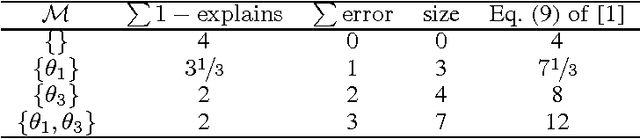
In this appendix we provide additional supplementary material to "A Collective, Probabilistic Approach to Schema Mapping." We include an additional extended example, supplementary experiment details, and proof for the complexity result stated in the main paper.