 Add to Chrome
 Add to Firefox
 Add to Edge
EditCtrl: Disentangled Local and Global Control for Real-Time Generative Video Editing
Feb 16, 2026
High-fidelity generative video editing has seen significant quality improvements by leveraging pre-trained video foundation models. However, their computational cost is a major bottleneck, as they are often designed to inefficiently process the full video context regardless of the inpainting mask's size, even for sparse, localized edits. In this paper, we introduce EditCtrl, an efficient video inpainting control framework that focuses computation only where it is needed. Our approach features a novel local video context module that operates solely on masked tokens, yielding a computational cost proportional to the edit size. This local-first generation is then guided by a lightweight temporal global context embedder that ensures video-wide context consistency with minimal overhead. Not only is EditCtrl 10 times more compute efficient than state-of-the-art generative editing methods, it even improves editing quality compared to methods designed with full-attention. Finally, we showcase how EditCtrl unlocks new capabilities, including multi-region editing with text prompts and autoregressive content propagation.

NeRF Analogies: Example-Based Visual Attribute Transfer for NeRFs
Feb 13, 2024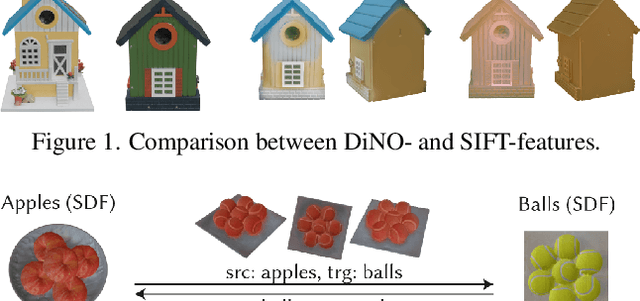


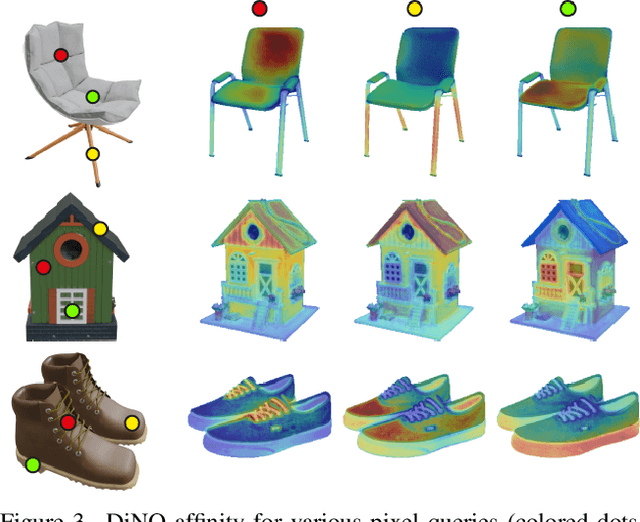
A Neural Radiance Field (NeRF) encodes the specific relation of 3D geometry and appearance of a scene. We here ask the question whether we can transfer the appearance from a source NeRF onto a target 3D geometry in a semantically meaningful way, such that the resulting new NeRF retains the target geometry but has an appearance that is an analogy to the source NeRF. To this end, we generalize classic image analogies from 2D images to NeRFs. We leverage correspondence transfer along semantic affinity that is driven by semantic features from large, pre-trained 2D image models to achieve multi-view consistent appearance transfer. Our method allows exploring the mix-and-match product space of 3D geometry and appearance. We show that our method outperforms traditional stylization-based methods and that a large majority of users prefer our method over several typical baselines.
Efficient Graphics Representation with Differentiable Indirection
Sep 12, 2023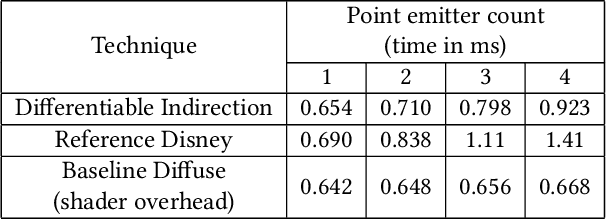


We introduce differentiable indirection -- a novel learned primitive that employs differentiable multi-scale lookup tables as an effective substitute for traditional compute and data operations across the graphics pipeline. We demonstrate its flexibility on a number of graphics tasks, i.e., geometric and image representation, texture mapping, shading, and radiance field representation. In all cases, differentiable indirection seamlessly integrates into existing architectures, trains rapidly, and yields both versatile and efficient results.
* Project website: https://sayan1an.github.io/din.html
Neural-PBIR Reconstruction of Shape, Material, and Illumination
Apr 26, 2023Reconstructing the shape and spatially varying surface appearances of a physical-world object as well as its surrounding illumination based on 2D images (e.g., photographs) of the object has been a long-standing problem in computer vision and graphics. In this paper, we introduce a robust object reconstruction pipeline combining neural based object reconstruction and physics-based inverse rendering (PBIR). Specifically, our pipeline firstly leverages a neural stage to produce high-quality but potentially imperfect predictions of object shape, reflectance, and illumination. Then, in the later stage, initialized by the neural predictions, we perform PBIR to refine the initial results and obtain the final high-quality reconstruction. Experimental results demonstrate our pipeline significantly outperforms existing reconstruction methods quality-wise and performance-wise.