 Add to Chrome
 Add to Firefox
 Add to Edge
Fast Length-Squared Sampling for Positive-Semidefinite Matrices
Aug 12, 2026
We describe a simple rejection-sampling-based algorithm to perform length-squared sampling on an $n \times n$ positive-semidefinite (psd) matrix: that is, to sample a column with probability proportional to its squared $\ell_2$-norm. The algorithm runs in just $O(n)$ expected time, which is significantly sublinear in the input matrix size. The runtime is optimal, even when the input is assumed to be diagonal. Our result has several applications. Length-squared sampling is used by a number of sublinear time algorithms for matrix problems, like low-rank approximation and eigenvalue approximation. Often, it is assumed that the algorithm is given access to the matrix column norms, and thus can perform length-squared sampling efficiently. Our result shows that, at least for psd matrices, we can remove this assumption. We also discuss an application to an asymptotically optimal algorithm for estimating the Frobenius norm of a psd matrix to relative error. Finally, we show that our sampling algorithm yields a very simple sublinear time algorithm for the robust psd low-rank approximation problem introduced by Bakshi et al. (FOCS, 2020), which nearly matches the more complex method developed there.

Quantifying and Expanding the Theoretical Capacity of Late-Interaction Retrieval Models
Jul 07, 2026Late-interaction retrieval models that use the MaxSim similarity function have shown strong empirical performance, often outperforming single-vector dense and sparse retrieval models. Despite these empirical findings, little is known about the theoretical representation power of MaxSim and how it compares to other retrieval approaches. This paper shows by construction that MaxSim similarity can exactly replicate the inner product between any two non-negative k-sparse vectors with possibly infinite dimension, requiring only O(k) representation space. Moreover, there exist similarities that MaxSim can express while standard vector inner products with the same representation space cannot. Leveraging our theoretical framework, we introduce Signed MaxSim which allows late-interaction models to exactly replicate any real-valued inner product, something we prove standard MaxSim is not capable of. We also show that MaxSim can act as an aggregation of soft-OR operations and as an evaluator of logical expressions in positive Conjunctive Normal Form. Our findings show that MaxSim is at least as capable as standard vector inner products for any non-negative vectors and our extension, Signed MaxSim, is as capable for any vectors. Both similarities possess additional capabilities that inner product cannot replicate, marking one of the first theoretical justifications and quantifications of late-interaction methods. Our theoretical findings are supported empirically: on a retrieval task featuring queries with negations, Signed MaxSim improves out-of-domain performance significantly over a standard ColBERT/MaxSim baseline with nDCG@10 increasing from 0.597 to 1.000 under a vocabulary shift and from 0.008 to 0.788 on negation-only queries.
Private Adaptive Covariance Estimation via Gaussian Graphical Models
May 22, 2026We propose PACE-GGM, a data-adaptive differentially private method for covariance estimation that concentrates its privacy budget on the most informative entries of the empirical covariance matrix, rather than perturbing all entries. This applies in the natural setting where the modeler supplies separate bounds for each variable, so that individual entries can be measured with less noise than the full matrix. In each round, our method selects a poorly approximated entry, measures it using the Gaussian mechanism, and then reconstructs a full covariance matrix using a maximum-entropy reconstruction objective, leading to a Gaussian graphical model structure. Experiments on diverse real-world datasets demonstrate consistent improvements in estimation error with respect to the Gaussian mechanism and other baselines, particularly in high-dimensional and low-to-moderate privacy regimes.
The Secretary Problem with Predictions and a Chosen Order
Jan 12, 2026We study a learning-augmented variant of the secretary problem, recently introduced by Fujii and Yoshida (2023), in which the decision-maker has access to machine-learned predictions of candidate values. The central challenge is to balance consistency and robustness: when predictions are accurate, the algorithm should select a near-optimal secretary, while under inaccurate predictions it should still guarantee a bounded competitive ratio. We consider both the classical Random Order Secretary Problem (ROSP), where candidates arrive in a uniformly random order, and a more natural learning-augmented model in which the decision-maker may choose the arrival order based on predicted values. We call this model the Chosen Order Secretary Problem (COSP), capturing scenarios such as interview schedules set in advance. We propose a new randomized algorithm applicable to both ROSP and COSP. Our method switches from fully trusting predictions to a threshold-based rule once a large prediction deviation is detected. Let $ε\in [0,1]$ denote the maximum multiplicative prediction error. For ROSP, our algorithm achieves a competitive ratio of $\max\{0.221, (1-ε)/(1+ε)\}$, improving upon the prior bound of $\max\{0.215, (1-ε)/(1+ε)\}$. For COSP, we achieve $\max\{0.262, (1-ε)/(1+ε)\}$, surpassing the $0.25$ worst-case bound for prior approaches and moving closer to the classical secretary benchmark of $1/e \approx 0.368$. These results highlight the benefit of combining predictions with arrival-order control in online decision-making.
Distance Adaptive Beam Search for Provably Accurate Graph-Based Nearest Neighbor Search
May 21, 2025Nearest neighbor search is central in machine learning, information retrieval, and databases. For high-dimensional datasets, graph-based methods such as HNSW, DiskANN, and NSG have become popular thanks to their empirical accuracy and efficiency. These methods construct a directed graph over the dataset and perform beam search on the graph to find nodes close to a given query. While significant work has focused on practical refinements and theoretical understanding of graph-based methods, many questions remain. We propose a new distance-based termination condition for beam search to replace the commonly used condition based on beam width. We prove that, as long as the search graph is navigable, our resulting Adaptive Beam Search method is guaranteed to approximately solve the nearest-neighbor problem, establishing a connection between navigability and the performance of graph-based search. We also provide extensive experiments on our new termination condition for both navigable graphs and approximately navigable graphs used in practice, such as HNSW and Vamana graphs. We find that Adaptive Beam Search outperforms standard beam search over a range of recall values, data sets, graph constructions, and target number of nearest neighbors. It thus provides a simple and practical way to improve the performance of popular methods.
Efficient and Private Marginal Reconstruction with Local Non-Negativity
Oct 01, 2024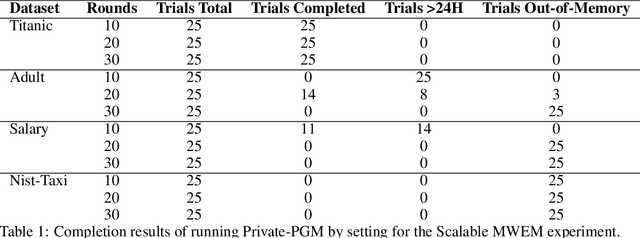
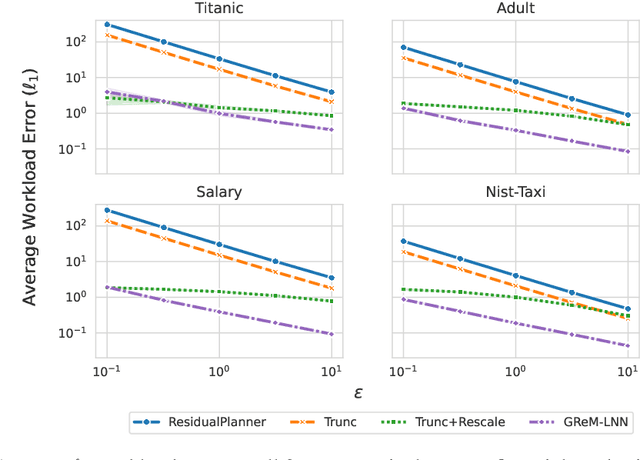
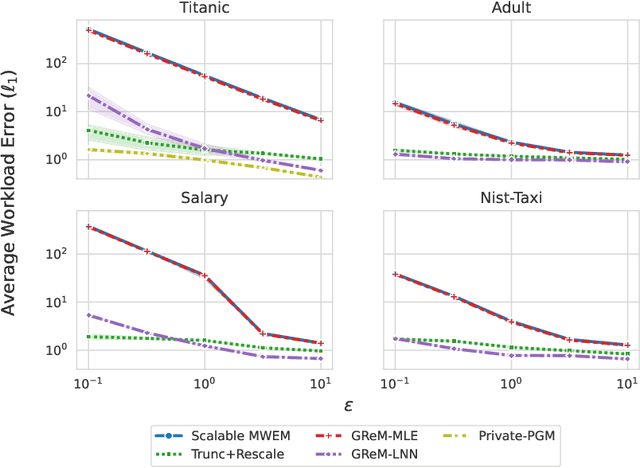
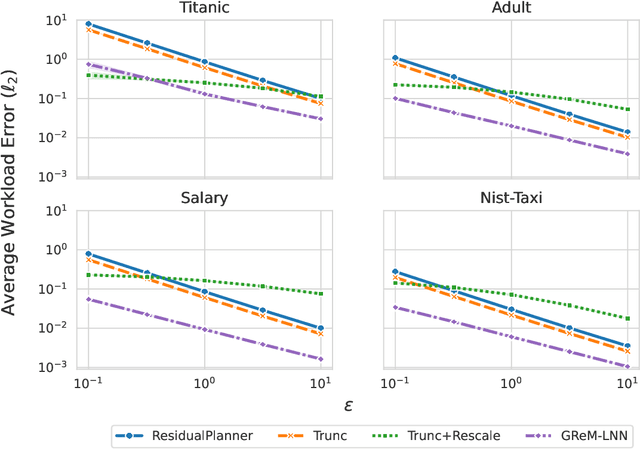
Differential privacy is the dominant standard for formal and quantifiable privacy and has been used in major deployments that impact millions of people. Many differentially private algorithms for query release and synthetic data contain steps that reconstruct answers to queries from answers to other queries measured by the mechanism. Reconstruction is an important subproblem for such mechanisms to economize the privacy budget, minimize error on reconstructed answers, and allow for scalability to high-dimensional datasets. In this paper, we introduce a principled and efficient postprocessing method ReM (Residuals-to-Marginals) for reconstructing answers to marginal queries. Our method builds on recent work on efficient mechanisms for marginal query release, based on making measurements using a residual query basis that admits efficient pseudoinversion, which is an important primitive used in reconstruction. An extension GReM-LNN (Gaussian Residuals-to-Marginals with Local Non-negativity) reconstructs marginals under Gaussian noise satisfying consistency and non-negativity, which often reduces error on reconstructed answers. We demonstrate the utility of ReM and GReM-LNN by applying them to improve existing private query answering mechanisms: ResidualPlanner and MWEM.
Sharper Bounds for Chebyshev Moment Matching with Applications to Differential Privacy and Beyond
Aug 22, 2024We study the problem of approximately recovering a probability distribution given noisy measurements of its Chebyshev polynomial moments. We sharpen prior work, proving that accurate recovery in the Wasserstein distance is possible with more noise than previously known. As a main application, our result yields a simple "linear query" algorithm for constructing a differentially private synthetic data distribution with Wasserstein-1 error $\tilde{O}(1/n)$ based on a dataset of $n$ points in $[-1,1]$. This bound is optimal up to log factors and matches a recent breakthrough of Boedihardjo, Strohmer, and Vershynin [Probab. Theory. Rel., 2024], which uses a more complex "superregular random walk" method to beat an $O(1/\sqrt{n})$ accuracy barrier inherent to earlier approaches. We illustrate a second application of our new moment-based recovery bound in numerical linear algebra: by improving an approach of Braverman, Krishnan, and Musco [STOC 2022], our result yields a faster algorithm for estimating the spectral density of a symmetric matrix up to small error in the Wasserstein distance.
Competitive Algorithms for Online Knapsack with Succinct Predictions
Jun 26, 2024


In the online knapsack problem, the goal is to pack items arriving online with different values and weights into a capacity-limited knapsack to maximize the total value of the accepted items. We study \textit{learning-augmented} algorithms for this problem, which aim to use machine-learned predictions to move beyond pessimistic worst-case guarantees. Existing learning-augmented algorithms for online knapsack consider relatively complicated prediction models that give an algorithm substantial information about the input, such as the total weight of items at each value. In practice, such predictions can be error-sensitive and difficult to learn. Motivated by this limitation, we introduce a family of learning-augmented algorithms for online knapsack that use \emph{succinct predictions}. In particular, the machine-learned prediction given to the algorithm is just a single value or interval that estimates the minimum value of any item accepted by an offline optimal solution. By leveraging a relaxation to online \emph{fractional} knapsack, we design algorithms that can leverage such succinct predictions in both the trusted setting (i.e., with perfect prediction) and the untrusted setting, where we prove that a simple meta-algorithm achieves a nearly optimal consistency-robustness trade-off. Empirically, we show that our algorithms significantly outperform baselines that do not use predictions and often outperform algorithms based on more complex prediction models.
Navigable Graphs for High-Dimensional Nearest Neighbor Search: Constructions and Limits
May 29, 2024There has been significant recent interest in graph-based nearest neighbor search methods, many of which are centered on the construction of navigable graphs over high-dimensional point sets. A graph is navigable if we can successfully move from any starting node to any target node using a greedy routing strategy where we always move to the neighbor that is closest to the destination according to a given distance function. The complete graph is navigable for any point set, but the important question for applications is if sparser graphs can be constructed. While this question is fairly well understood in low-dimensions, we establish some of the first upper and lower bounds for high-dimensional point sets. First, we give a simple and efficient way to construct a navigable graph with average degree $O(\sqrt{n \log n })$ for any set of $n$ points, in any dimension, for any distance function. We compliment this result with a nearly matching lower bound: even under the Euclidean metric in $O(\log n)$ dimensions, a random point set has no navigable graph with average degree $O(n^{\alpha})$ for any $\alpha < 1/2$. Our lower bound relies on sharp anti-concentration bounds for binomial random variables, which we use to show that the near-neighborhoods of a set of random points do not overlap significantly, forcing any navigable graph to have many edges.
On the Role of Edge Dependency in Graph Generative Models
Dec 06, 2023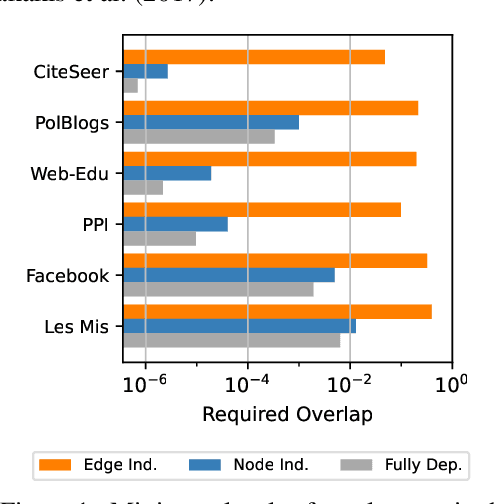

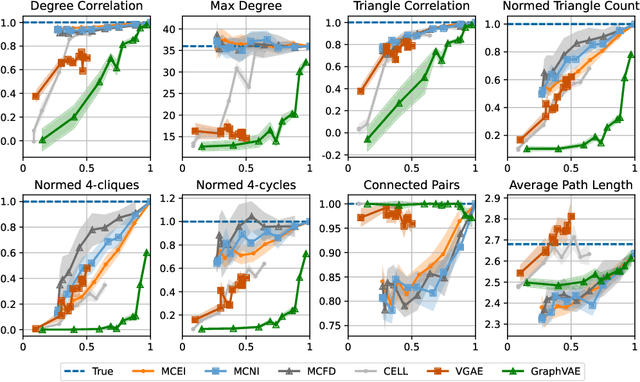
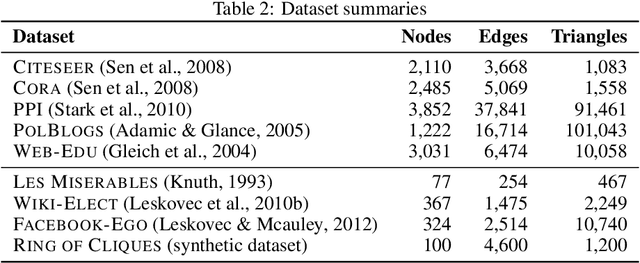
In this work, we introduce a novel evaluation framework for generative models of graphs, emphasizing the importance of model-generated graph overlap (Chanpuriya et al., 2021) to ensure both accuracy and edge-diversity. We delineate a hierarchy of graph generative models categorized into three levels of complexity: edge independent, node independent, and fully dependent models. This hierarchy encapsulates a wide range of prevalent methods. We derive theoretical bounds on the number of triangles and other short-length cycles producible by each level of the hierarchy, contingent on the model overlap. We provide instances demonstrating the asymptotic optimality of our bounds. Furthermore, we introduce new generative models for each of the three hierarchical levels, leveraging dense subgraph discovery (Gionis & Tsourakakis, 2015). Our evaluation, conducted on real-world datasets, focuses on assessing the output quality and overlap of our proposed models in comparison to other popular models. Our results indicate that our simple, interpretable models provide competitive baselines to popular generative models. Through this investigation, we aim to propel the advancement of graph generative models by offering a structured framework and robust evaluation metrics, thereby facilitating the development of models capable of generating accurate and edge-diverse graphs.