 Add to Chrome
 Add to Firefox
 Add to Edge
How Many Initial Points Does Bayesian Optimization Need?
Jul 05, 2026
Bayesian Optimization (BO) generally begins with an initialization phase: a batch of $n_0$ uninformed evaluations. The choice of $n_0$ remains largely heuristic, and we empirically observe that the total cost (random initial points plus BO iterations needed to find the global optimum) is U-shaped in $n_0$, i.e., a practitioner wastes resources by selecting either too low or too high a value of $n_0$. We find this tradeoff persists across MLE, Bayesian MCMC, and exact GP hyperparameters, as well as across acquisition functions. Toward the latter, Thompson Sampling appears an exception, with both total cost and simple regret essentially $n_0$-agnostic, though higher in our experiments. We attribute this U-shape to the known boundary issue of variance-driven BO: BO burns early budget on corners of the hypercube before turning inward. We demonstrate this effect using a 3D BO trajectory where the exact hyperparameters are known. We conclude with practical recommendations: use multi-step lookahead BO where possible; otherwise use Thompson Sampling when $n_0$ cannot be tuned, and a generously large $n_0$ when it can.

Addressing Terminal Constraints in Data-Driven Demand Response Scheduling
May 14, 2026Electrified chemical processes are incentivized by exposure to time-varying electricity markets to operate flexibly, but participating in demand response schemes can require satisfying terminal constraints over long horizons. Specifically, terminal constraints may be required when computing optimal schedules in order to preserve dynamic stability. Model-based optimization methods are computationally costly, and data-driven scheduling via reinforcement learning (RL) faces severe credit-assignment challenges. We integrate Goal-Space Planning (GSP) with Deep Deterministic Policy Gradient (DDPG), using learned temporally abstract models over discrete subgoals to propagate value across extended horizons. Using a simulated air separation benchmark, we demonstrate the proposed approach improves sample efficiency over standard DDPG while satisfying terminal storage constraints, mitigating myopic control behavior.
Relaxation-Informed Training of Neural Network Surrogate Models
Apr 24, 2026ReLU neural networks trained as surrogate models can be embedded exactly in mixed-integer linear programs (MILPs), enabling global optimization over the learned function. The tractability of the resulting MILP depends on structural properties of the network, i.e., the number of binary variables in associated formulations and the tightness of the continuous LP relaxation. These properties are determined during training, yet standard training objectives (prediction loss with classical weight regularization) offer no mechanism to directly control them. This work studies training regularizers that directly target downstream MILP tractability. Specifically, we propose simple bound-based regularizers that penalize the big-M constants of MILP formulations and/or the number of unstable neurons. Moreover, we introduce an LP relaxation gap regularizer that explicitly penalizes the per-sample gap of the continuous relaxation at training points. We derive its associated gradient and provide an implementation from LP dual variables without custom automatic differentiation tools. We show that combining the above regularizers can approximate the full total derivative of the LP gap with respect to the network parameters, capturing both direct and indirect sensitivities. Experiments on non-convex benchmark functions and a two-stage stochastic programming problem with quantile neural network surrogates demonstrate that the proposed regularizers can reduce MILP solve times by up to four orders of magnitude relative to an unregularized baseline, while maintaining competitive surrogate model accuracy.
Exact Certification of Data-Poisoning Attacks Using Mixed-Integer Programming
Feb 18, 2026This work introduces a verification framework that provides both sound and complete guarantees for data poisoning attacks during neural network training. We formulate adversarial data manipulation, model training, and test-time evaluation in a single mixed-integer quadratic programming (MIQCP) problem. Finding the global optimum of the proposed formulation provably yields worst-case poisoning attacks, while simultaneously bounding the effectiveness of all possible attacks on the given training pipeline. Our framework encodes both the gradient-based training dynamics and model evaluation at test time, enabling the first exact certification of training-time robustness. Experimental evaluation on small models confirms that our approach delivers a complete characterization of robustness against data poisoning.
Abstract Gradient Training: A Unified Certification Framework for Data Poisoning, Unlearning, and Differential Privacy
Nov 12, 2025The impact of inference-time data perturbation (e.g., adversarial attacks) has been extensively studied in machine learning, leading to well-established certification techniques for adversarial robustness. In contrast, certifying models against training data perturbations remains a relatively under-explored area. These perturbations can arise in three critical contexts: adversarial data poisoning, where an adversary manipulates training samples to corrupt model performance; machine unlearning, which requires certifying model behavior under the removal of specific training data; and differential privacy, where guarantees must be given with respect to substituting individual data points. This work introduces Abstract Gradient Training (AGT), a unified framework for certifying robustness of a given model and training procedure to training data perturbations, including bounded perturbations, the removal of data points, and the addition of new samples. By bounding the reachable set of parameters, i.e., establishing provable parameter-space bounds, AGT provides a formal approach to analyzing the behavior of models trained via first-order optimization methods.
The Catechol Benchmark: Time-series Solvent Selection Data for Few-shot Machine Learning
Jun 09, 2025Machine learning has promised to change the landscape of laboratory chemistry, with impressive results in molecular property prediction and reaction retro-synthesis. However, chemical datasets are often inaccessible to the machine learning community as they tend to require cleaning, thorough understanding of the chemistry, or are simply not available. In this paper, we introduce a novel dataset for yield prediction, providing the first-ever transient flow dataset for machine learning benchmarking, covering over 1200 process conditions. While previous datasets focus on discrete parameters, our experimental set-up allow us to sample a large number of continuous process conditions, generating new challenges for machine learning models. We focus on solvent selection, a task that is particularly difficult to model theoretically and therefore ripe for machine learning applications. We showcase benchmarking for regression algorithms, transfer-learning approaches, feature engineering, and active learning, with important applications towards solvent replacement and sustainable manufacturing.
Global optimization of graph acquisition functions for neural architecture search
May 29, 2025Graph Bayesian optimization (BO) has shown potential as a powerful and data-efficient tool for neural architecture search (NAS). Most existing graph BO works focus on developing graph surrogates models, i.e., metrics of networks and/or different kernels to quantify the similarity between networks. However, the acquisition optimization, as a discrete optimization task over graph structures, is not well studied due to the complexity of formulating the graph search space and acquisition functions. This paper presents explicit optimization formulations for graph input space including properties such as reachability and shortest paths, which are used later to formulate graph kernels and the acquisition function. We theoretically prove that the proposed encoding is an equivalent representation of the graph space and provide restrictions for the NAS domain with either node or edge labels. Numerical results over several NAS benchmarks show that our method efficiently finds the optimal architecture for most cases, highlighting its efficacy.
Training Neural ODEs Using Fully Discretized Simultaneous Optimization
Feb 21, 2025Neural Ordinary Differential Equations (Neural ODEs) represent continuous-time dynamics with neural networks, offering advancements for modeling and control tasks. However, training Neural ODEs requires solving differential equations at each epoch, leading to high computational costs. This work investigates simultaneous optimization methods as a faster training alternative. In particular, we employ a collocation-based, fully discretized formulation and use IPOPT--a solver for large-scale nonlinear optimization--to simultaneously optimize collocation coefficients and neural network parameters. Using the Van der Pol Oscillator as a case study, we demonstrate faster convergence compared to traditional training methods. Furthermore, we introduce a decomposition framework utilizing Alternating Direction Method of Multipliers (ADMM) to effectively coordinate sub-models among data batches. Our results show significant potential for (collocation-based) simultaneous Neural ODE training pipelines.
EARL-BO: Reinforcement Learning for Multi-Step Lookahead, High-Dimensional Bayesian Optimization
Oct 31, 2024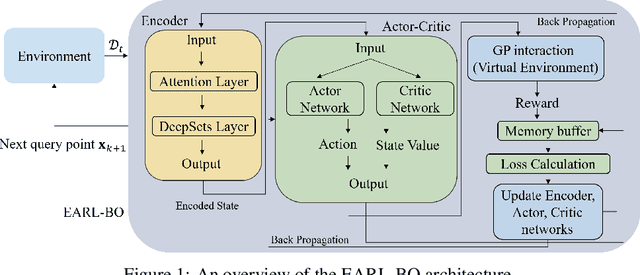
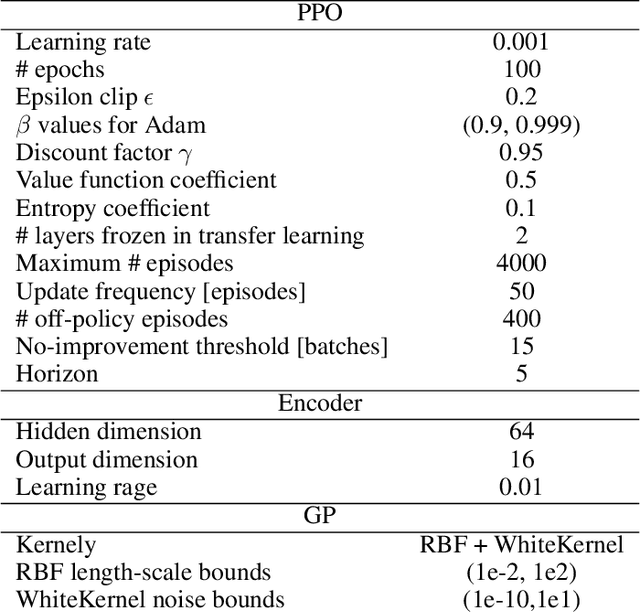

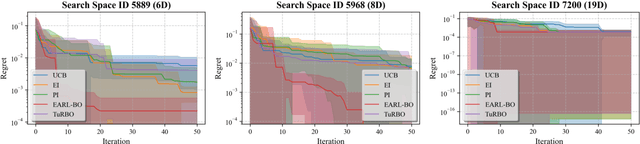
Conventional methods for Bayesian optimization (BO) primarily involve one-step optimal decisions (e.g., maximizing expected improvement of the next step). To avoid myopic behavior, multi-step lookahead BO algorithms such as rollout strategies consider the sequential decision-making nature of BO, i.e., as a stochastic dynamic programming (SDP) problem, demonstrating promising results in recent years. However, owing to the curse of dimensionality, most of these methods make significant approximations or suffer scalability issues, e.g., being limited to two-step lookahead. This paper presents a novel reinforcement learning (RL)-based framework for multi-step lookahead BO in high-dimensional black-box optimization problems. The proposed method enhances the scalability and decision-making quality of multi-step lookahead BO by efficiently solving the SDP of the BO process in a near-optimal manner using RL. We first introduce an Attention-DeepSets encoder to represent the state of knowledge to the RL agent and employ off-policy learning to accelerate its initial training. We then propose a multi-task, fine-tuning procedure based on end-to-end (encoder-RL) on-policy learning. We evaluate the proposed method, EARL-BO (Encoder Augmented RL for Bayesian Optimization), on both synthetic benchmark functions and real-world hyperparameter optimization problems, demonstrating significantly improved performance compared to existing multi-step lookahead and high-dimensional BO methods.
Global Optimization of Gaussian Process Acquisition Functions Using a Piecewise-Linear Kernel Approximation
Oct 22, 2024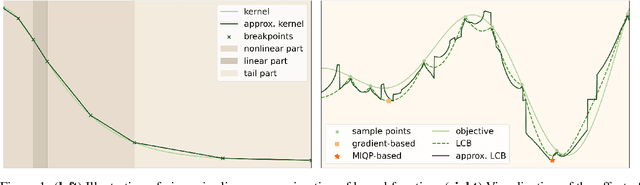
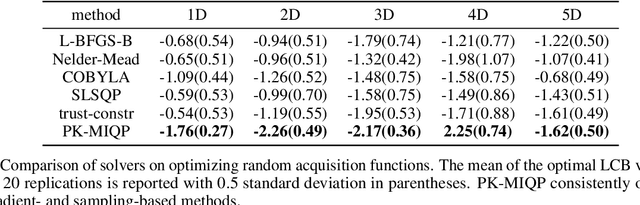
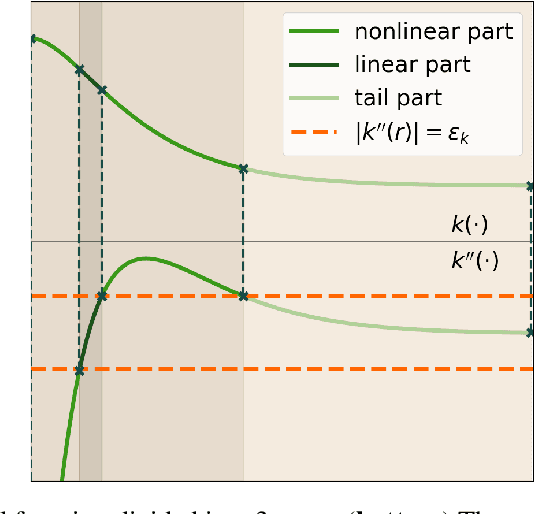
Bayesian optimization relies on iteratively constructing and optimizing an acquisition function. The latter turns out to be a challenging, non-convex optimization problem itself. Despite the relative importance of this step, most algorithms employ sampling- or gradient-based methods, which do not provably converge to global optima. This work investigates mixed-integer programming (MIP) as a paradigm for \textit{global} acquisition function optimization. Specifically, our Piecewise-linear Kernel Mixed Integer Quadratic Programming (PK-MIQP) formulation introduces a piecewise-linear approximation for Gaussian process kernels and admits a corresponding MIQP representation for acquisition functions. We analyze the theoretical regret bounds of the proposed approximation, and empirically demonstrate the framework on synthetic functions, constrained benchmarks, and a hyperparameter tuning task.