 Add to Chrome
 Add to Firefox
 Add to Edge
How Many Initial Points Does Bayesian Optimization Need?
Jul 05, 2026
Bayesian Optimization (BO) generally begins with an initialization phase: a batch of $n_0$ uninformed evaluations. The choice of $n_0$ remains largely heuristic, and we empirically observe that the total cost (random initial points plus BO iterations needed to find the global optimum) is U-shaped in $n_0$, i.e., a practitioner wastes resources by selecting either too low or too high a value of $n_0$. We find this tradeoff persists across MLE, Bayesian MCMC, and exact GP hyperparameters, as well as across acquisition functions. Toward the latter, Thompson Sampling appears an exception, with both total cost and simple regret essentially $n_0$-agnostic, though higher in our experiments. We attribute this U-shape to the known boundary issue of variance-driven BO: BO burns early budget on corners of the hypercube before turning inward. We demonstrate this effect using a 3D BO trajectory where the exact hyperparameters are known. We conclude with practical recommendations: use multi-step lookahead BO where possible; otherwise use Thompson Sampling when $n_0$ cannot be tuned, and a generously large $n_0$ when it can.

EARL-BO: Reinforcement Learning for Multi-Step Lookahead, High-Dimensional Bayesian Optimization
Oct 31, 2024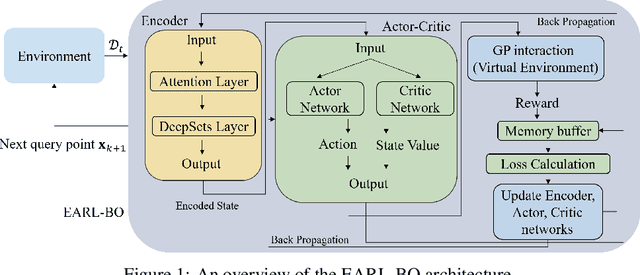
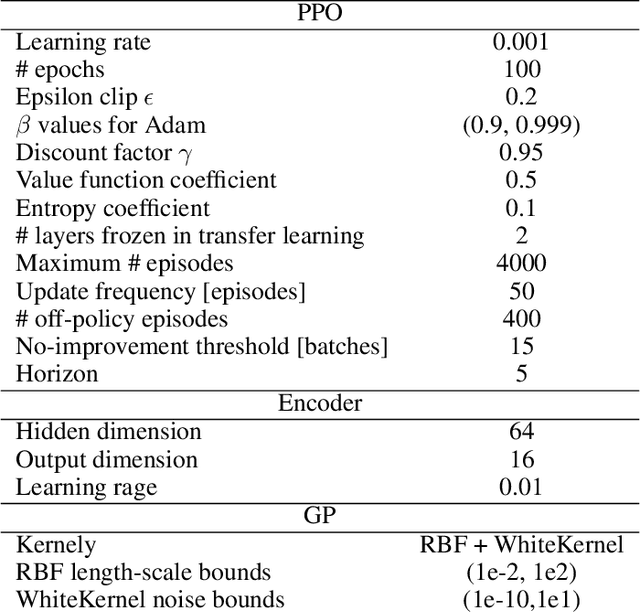

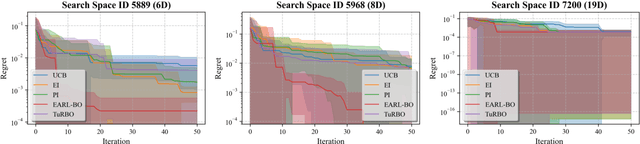
Conventional methods for Bayesian optimization (BO) primarily involve one-step optimal decisions (e.g., maximizing expected improvement of the next step). To avoid myopic behavior, multi-step lookahead BO algorithms such as rollout strategies consider the sequential decision-making nature of BO, i.e., as a stochastic dynamic programming (SDP) problem, demonstrating promising results in recent years. However, owing to the curse of dimensionality, most of these methods make significant approximations or suffer scalability issues, e.g., being limited to two-step lookahead. This paper presents a novel reinforcement learning (RL)-based framework for multi-step lookahead BO in high-dimensional black-box optimization problems. The proposed method enhances the scalability and decision-making quality of multi-step lookahead BO by efficiently solving the SDP of the BO process in a near-optimal manner using RL. We first introduce an Attention-DeepSets encoder to represent the state of knowledge to the RL agent and employ off-policy learning to accelerate its initial training. We then propose a multi-task, fine-tuning procedure based on end-to-end (encoder-RL) on-policy learning. We evaluate the proposed method, EARL-BO (Encoder Augmented RL for Bayesian Optimization), on both synthetic benchmark functions and real-world hyperparameter optimization problems, demonstrating significantly improved performance compared to existing multi-step lookahead and high-dimensional BO methods.