 Add to Chrome
 Add to Firefox
 Add to Edge
Exact Certification of Data-Poisoning Attacks Using Mixed-Integer Programming
Feb 18, 2026
This work introduces a verification framework that provides both sound and complete guarantees for data poisoning attacks during neural network training. We formulate adversarial data manipulation, model training, and test-time evaluation in a single mixed-integer quadratic programming (MIQCP) problem. Finding the global optimum of the proposed formulation provably yields worst-case poisoning attacks, while simultaneously bounding the effectiveness of all possible attacks on the given training pipeline. Our framework encodes both the gradient-based training dynamics and model evaluation at test time, enabling the first exact certification of training-time robustness. Experimental evaluation on small models confirms that our approach delivers a complete characterization of robustness against data poisoning.

Detection of AI Generated Images Using Combined Uncertainty Measures and Particle Swarm Optimised Rejection Mechanism
Dec 20, 2025As AI-generated images become increasingly photorealistic, distinguishing them from natural images poses a growing challenge. This paper presents a robust detection framework that leverages multiple uncertainty measures to decide whether to trust or reject a model's predictions. We focus on three complementary techniques: Fisher Information, which captures the sensitivity of model parameters to input variations; entropy-based uncertainty from Monte Carlo Dropout, which reflects predictive variability; and predictive variance from a Deep Kernel Learning framework using a Gaussian Process classifier. To integrate these diverse uncertainty signals, Particle Swarm Optimisation is used to learn optimal weightings and determine an adaptive rejection threshold. The model is trained on Stable Diffusion-generated images and evaluated on GLIDE, VQDM, Midjourney, BigGAN, and StyleGAN3, each introducing significant distribution shifts. While standard metrics such as prediction probability and Fisher-based measures perform well in distribution, their effectiveness degrades under shift. In contrast, the Combined Uncertainty measure consistently achieves an incorrect rejection rate of approximately 70 percent on unseen generators, successfully filtering most misclassified AI samples. Although the system occasionally rejects correct predictions from newer generators, this conservative behaviour is acceptable, as rejected samples can support retraining. The framework maintains high acceptance of accurate predictions for natural images and in-domain AI data. Under adversarial attacks using FGSM and PGD, the Combined Uncertainty method rejects around 61 percent of successful attacks, while GP-based uncertainty alone achieves up to 80 percent. Overall, the results demonstrate that multi-source uncertainty fusion provides a resilient and adaptive solution for AI-generated image detection.
Abstract Gradient Training: A Unified Certification Framework for Data Poisoning, Unlearning, and Differential Privacy
Nov 12, 2025The impact of inference-time data perturbation (e.g., adversarial attacks) has been extensively studied in machine learning, leading to well-established certification techniques for adversarial robustness. In contrast, certifying models against training data perturbations remains a relatively under-explored area. These perturbations can arise in three critical contexts: adversarial data poisoning, where an adversary manipulates training samples to corrupt model performance; machine unlearning, which requires certifying model behavior under the removal of specific training data; and differential privacy, where guarantees must be given with respect to substituting individual data points. This work introduces Abstract Gradient Training (AGT), a unified framework for certifying robustness of a given model and training procedure to training data perturbations, including bounded perturbations, the removal of data points, and the addition of new samples. By bounding the reachable set of parameters, i.e., establishing provable parameter-space bounds, AGT provides a formal approach to analyzing the behavior of models trained via first-order optimization methods.
FASER: Binary Code Similarity Search through the use of Intermediate Representations
Oct 06, 2023

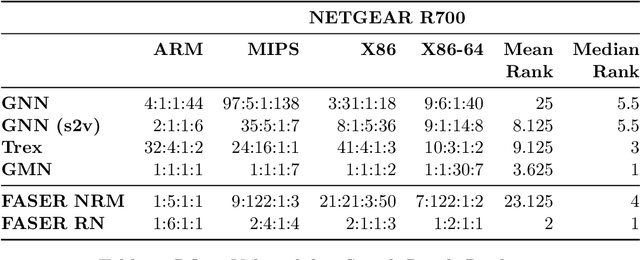
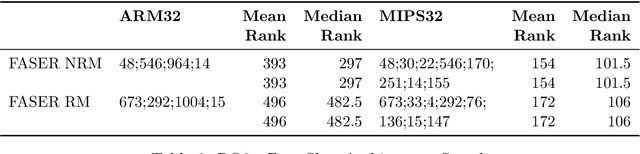
Being able to identify functions of interest in cross-architecture software is useful whether you are analysing for malware, securing the software supply chain or conducting vulnerability research. Cross-Architecture Binary Code Similarity Search has been explored in numerous studies and has used a wide range of different data sources to achieve its goals. The data sources typically used draw on common structures derived from binaries such as function control flow graphs or binary level call graphs, the output of the disassembly process or the outputs of a dynamic analysis approach. One data source which has received less attention is binary intermediate representations. Binary Intermediate representations possess two interesting properties: they are cross architecture by their very nature and encode the semantics of a function explicitly to support downstream usage. Within this paper we propose Function as a String Encoded Representation (FASER) which combines long document transformers with the use of intermediate representations to create a model capable of cross architecture function search without the need for manual feature engineering, pre-training or a dynamic analysis step. We compare our approach against a series of baseline approaches for two tasks; A general function search task and a targeted vulnerability search task. Our approach demonstrates strong performance across both tasks, performing better than all baseline approaches.