 Add to Chrome
 Add to Firefox
 Add to Edge
Wall-OSS-0.5 Technical Report
Jun 01, 2026
Large-scale Vision-Language-Action (VLA) pretraining is increasingly adopted as the foundation for robot policies, yet the evidence for pretrained VLAs is almost invariably reported after task-specific fine-tuning. This leaves a foundational question unanswered: does VLA pretraining itself yield executable robot behavior, or does it merely furnish a better initialization for downstream policy learning? We present Wall-OSS-0.5, an open-source 4B VLA built upon a 3B VLM backbone augmented with action-generation components, designed so that pretrained robotic capability is directly measurable on physical hardware. The model is pretrained across more than 20 embodiments, processing over one million robot trajectories per epoch alongside a grounded multimodal corpus. We adopt a gradient-bridged co-training recipe in which three objectives play distinct and complementary roles: discrete action prediction routes strong VLM-native gradients into the backbone, multimodal prediction preserves grounded vision-language understanding, and continuous flow matching serves as the deployment-time action interface. Before task-specific fine-tuning, the pretrained checkpoint achieves non-trivial zero-shot real-robot behavior, completing several tasks, including a held-out deformable manipulation task, at high task progress on a 17-task suite. After fine-tuning, the same checkpoint serves as a stronger adaptation prior, reaching 60.5% average task progress on 15 real-robot tasks and outperforming π_0.5 by 17.5%. Multimodal evaluations further confirm that action training does not erode grounded vision-language competence: the model preserves broad vision-language ability while strengthening embodied grounding. Together, these results reposition VLA pretraining from an initialization strategy to a directly testable, already useful source of robot capability.

Comparing Abstraction in Humans and Large Language Models Using Multimodal Serial Reproduction
Feb 06, 2024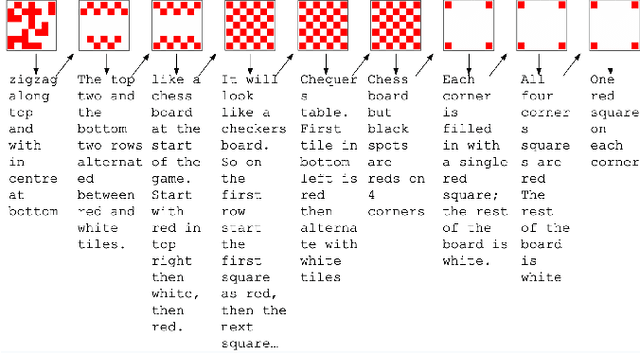
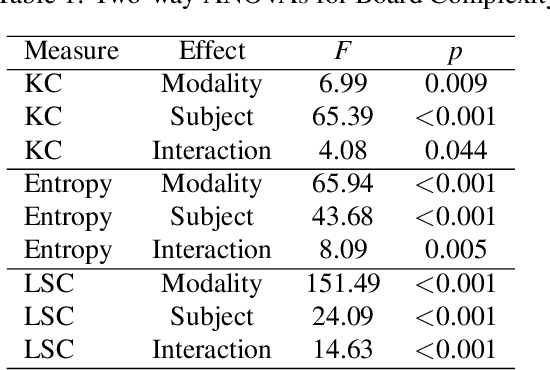
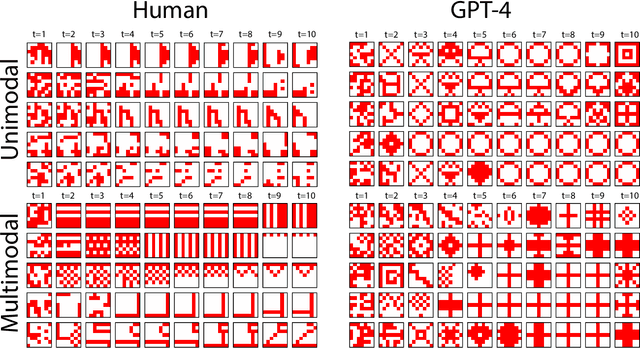
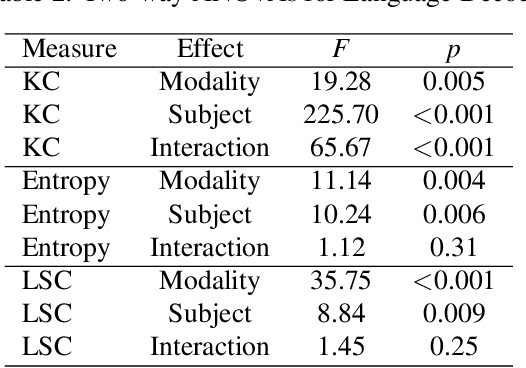
Humans extract useful abstractions of the world from noisy sensory data. Serial reproduction allows us to study how people construe the world through a paradigm similar to the game of telephone, where one person observes a stimulus and reproduces it for the next to form a chain of reproductions. Past serial reproduction experiments typically employ a single sensory modality, but humans often communicate abstractions of the world to each other through language. To investigate the effect language on the formation of abstractions, we implement a novel multimodal serial reproduction framework by asking people who receive a visual stimulus to reproduce it in a linguistic format, and vice versa. We ran unimodal and multimodal chains with both humans and GPT-4 and find that adding language as a modality has a larger effect on human reproductions than GPT-4's. This suggests human visual and linguistic representations are more dissociable than those of GPT-4.
ImageNet-OOD: Deciphering Modern Out-of-Distribution Detection Algorithms
Oct 03, 2023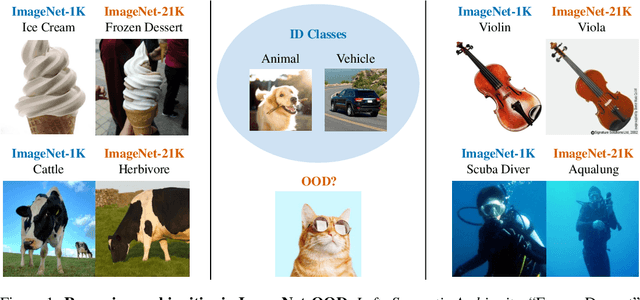
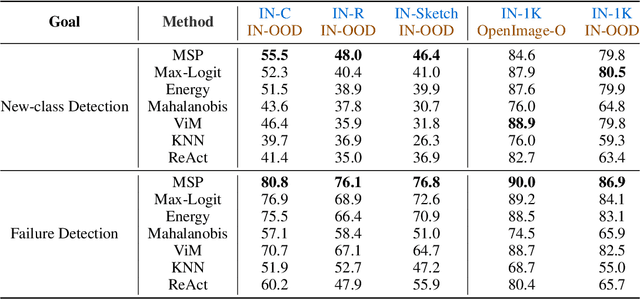
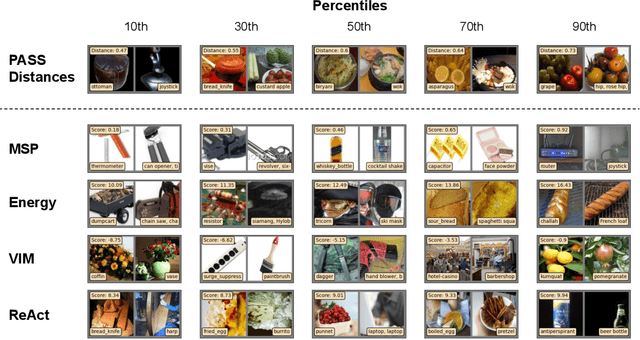

The task of out-of-distribution (OOD) detection is notoriously ill-defined. Earlier works focused on new-class detection, aiming to identify label-altering data distribution shifts, also known as "semantic shift." However, recent works argue for a focus on failure detection, expanding the OOD evaluation framework to account for label-preserving data distribution shifts, also known as "covariate shift." Intriguingly, under this new framework, complex OOD detectors that were previously considered state-of-the-art now perform similarly to, or even worse than the simple maximum softmax probability baseline. This raises the question: what are the latest OOD detectors actually detecting? Deciphering the behavior of OOD detection algorithms requires evaluation datasets that decouples semantic shift and covariate shift. To aid our investigations, we present ImageNet-OOD, a clean semantic shift dataset that minimizes the interference of covariate shift. Through comprehensive experiments, we show that OOD detectors are more sensitive to covariate shift than to semantic shift, and the benefits of recent OOD detection algorithms on semantic shift detection is minimal. Our dataset and analyses provide important insights for guiding the design of future OOD detectors.