 Add to Chrome
 Add to Firefox
 Add to Edge
Belief Consistency Between Foundation-Model Evidence and Geometric Perception in Persistent Robotic Maps
May 29, 2026
Persistent maps used by autonomous robots increasingly fuse a geometric perception stack whose assertions are well-characterized with a foundation-model channel that produces semantic claims without calibrated reliability about the same scene. Contemporary mapping systems integrate the two channels by treating the foundation-model channel as an additional voter into a per-element posterior, uncalibrated for its own per-class reliability and without machinery to flag when the two channels contradict each other at a given moment. We propose an update operator with two cooperating mechanisms: a per-class calibrated commit gate, and a per-event conflict-drop window that refuses to commit foundation-model claims contradicted by the geometric channel at the moment of the claim. We evaluate on KITTI-360 and ScanNet, with an oracle geometric channel (panoptic ground truth) and an off-the-shelf online semantic segmenter (Mask2Former) to demonstrate real-world performance. The operator produces substantially more accurate committed maps (KITTI is car commit precision 99.7% vs. 43.9% for the calibration-only operator; mean per-class IoU 0.522 vs. 0.180), retains more compositional true positives at higher precision than a monolithic compositional VLM prompt. The framework operates at deployment quality across both oracle and off-the-shelf-segmenter geometric channels, and is invariant under foundation-model substitution.

SceneGraphGrounder: Zero-Shot 3D Visual Grounding via Structured Scene Graph Matching
May 20, 2026Zero-shot 3D visual grounding requires localizing objects in unstructured environments from free-form natural language. Recent vision-language model (VLM) approaches achieve promising results but rely on view-dependent reasoning or implicit representations, limiting spatial consistency and interpretability for compositional queries. We propose SceneGraphGrounder, a framework that reformulates 3D grounding as structured graph matching over a reconstructed 3D scene graph. To enable this formulation, we introduce a visual marker prompting strategy that enables a VLM to infer object-object relationships from 2D views, which are subsequently lifted into a persistent 3D scene graph encoding both spatial and semantic relations. Given a query, we construct a query graph and perform constrained alignment with the scene graph, ensuring multi-view consistency and interpretable reasoning. Experiments on the ScanRefer benchmark demonstrate that our method achieves competitive performance among zero-shot approaches, using only RGB-D inputs. We further validate our framework through real-world deployment on a mobile robot, demonstrating robust spatial reasoning in long-horizon physical environments. We will make our code publicly available upon acceptance.
Online Diffusion-Based 3D Occupancy Prediction at the Frontier with Probabilistic Map Reconciliation
Sep 16, 2024
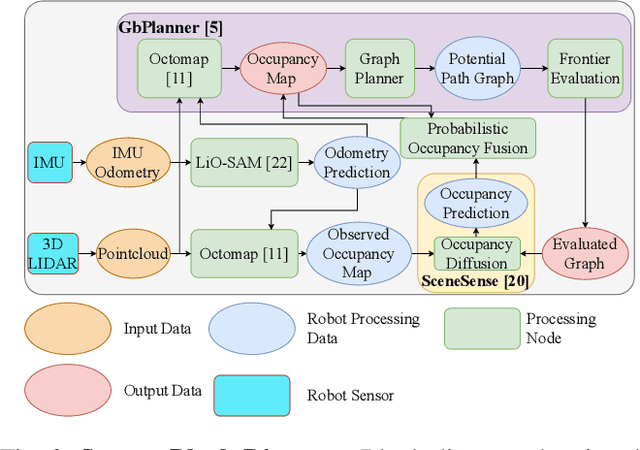


Autonomous navigation and exploration in unmapped environments remains a significant challenge in robotics due to the difficulty robots face in making commonsense inference of unobserved geometries. Recent advancements have demonstrated that generative modeling techniques, particularly diffusion models, can enable systems to infer these geometries from partial observation. In this work, we present implementation details and results for real-time, online occupancy prediction using a modified diffusion model. By removing attention-based visual conditioning and visual feature extraction components, we achieve a 73$\%$ reduction in runtime with minimal accuracy reduction. These modifications enable occupancy prediction across the entire map, rather than being limited to the area around the robot where camera data can be collected. We introduce a probabilistic update method for merging predicted occupancy data into running occupancy maps, resulting in a 71$\%$ improvement in predicting occupancy at map frontiers compared to previous methods. Finally, we release our code and a ROS node for on-robot operation <upon publication> at github.com/arpg/sceneSense_ws.
SceneSense: Diffusion Models for 3D Occupancy Synthesis from Partial Observation
Mar 18, 2024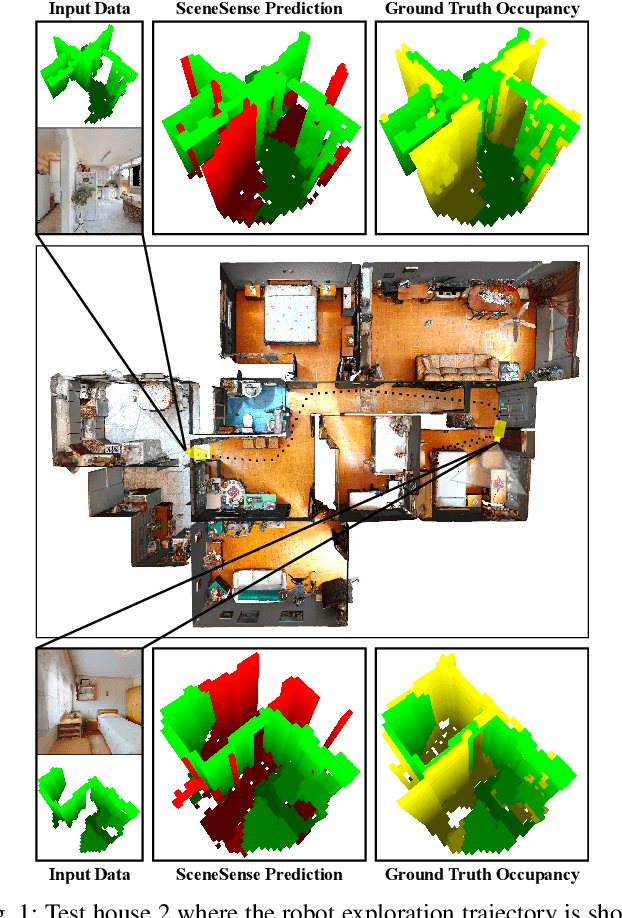
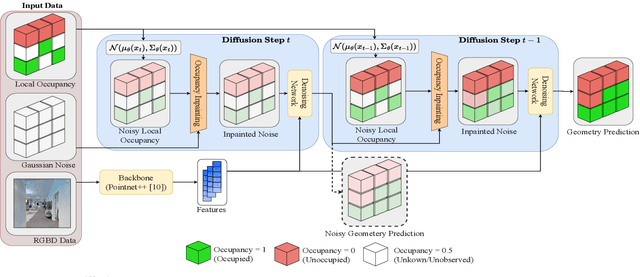
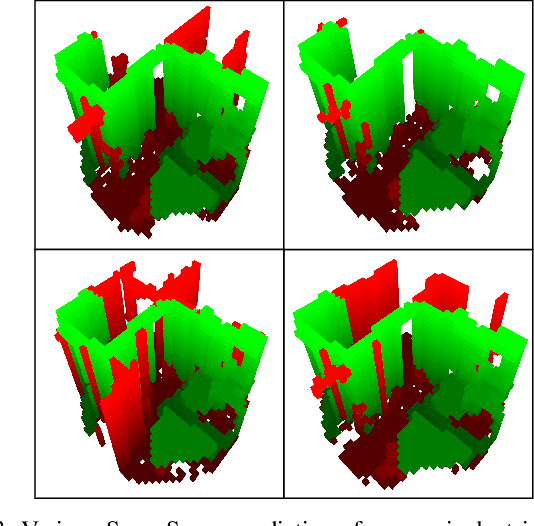
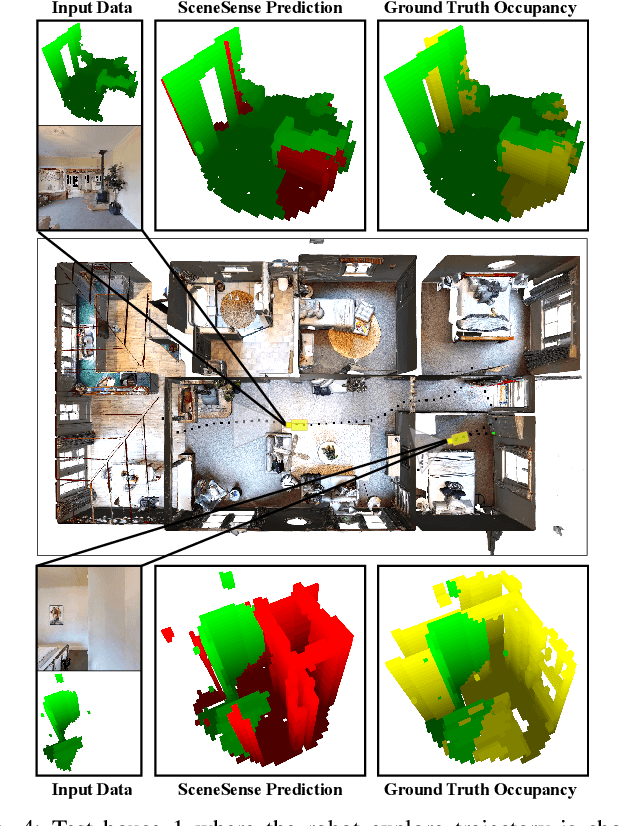
When exploring new areas, robotic systems generally exclusively plan and execute controls over geometry that has been directly measured. When entering space that was previously obstructed from view such as turning corners in hallways or entering new rooms, robots often pause to plan over the newly observed space. To address this we present SceneScene, a real-time 3D diffusion model for synthesizing 3D occupancy information from partial observations that effectively predicts these occluded or out of view geometries for use in future planning and control frameworks. SceneSense uses a running occupancy map and a single RGB-D camera to generate predicted geometry around the platform at runtime, even when the geometry is occluded or out of view. Our architecture ensures that SceneSense never overwrites observed free or occupied space. By preserving the integrity of the observed map, SceneSense mitigates the risk of corrupting the observed space with generative predictions. While SceneSense is shown to operate well using a single RGB-D camera, the framework is flexible enough to extend to additional modalities. SceneSense operates as part of any system that generates a running occupancy map `out of the box', removing conditioning from the framework. Alternatively, for maximum performance in new modalities, the perception backbone can be replaced and the model retrained for inference in new applications. Unlike existing models that necessitate multiple views and offline scene synthesis, or are focused on filling gaps in observed data, our findings demonstrate that SceneSense is an effective approach to estimating unobserved local occupancy information at runtime. Local occupancy predictions from SceneSense are shown to better represent the ground truth occupancy distribution during the test exploration trajectories than the running occupancy map.
Robust Maximum Entropy Behavior Cloning
Jan 04, 2021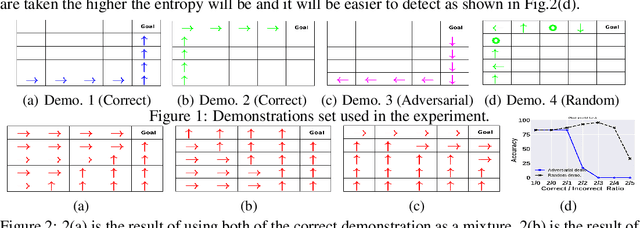
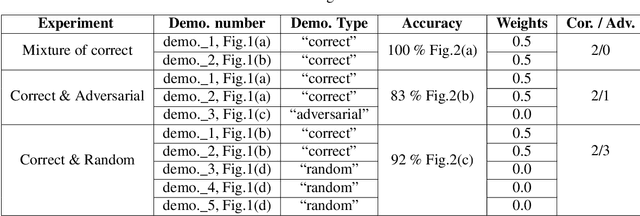

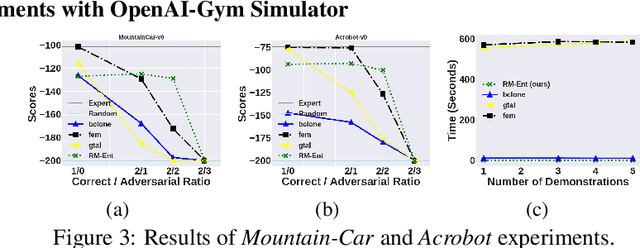
Imitation learning (IL) algorithms use expert demonstrations to learn a specific task. Most of the existing approaches assume that all expert demonstrations are reliable and trustworthy, but what if there exist some adversarial demonstrations among the given data-set? This may result in poor decision-making performance. We propose a novel general frame-work to directly generate a policy from demonstrations that autonomously detect the adversarial demonstrations and exclude them from the data set. At the same time, it's sample, time-efficient, and does not require a simulator. To model such adversarial demonstration we propose a min-max problem that leverages the entropy of the model to assign weights for each demonstration. This allows us to learn the behavior using only the correct demonstrations or a mixture of correct demonstrations.