 Add to Chrome
 Add to Firefox
 Add to Edge
Connect the Dots: Training LLMs for Long-Lifecycle Agents with Cross-Domain Generalization Via Reinforcement Learning
Jun 18, 2026
This work presents a general framework for training large language models (LLMs) to "Connect the Dots" (CoD), a meta-capability required by long-lifecycle agents: as an LLM-based AI agent gets deployed in an environment, it solves a long sequence of tasks while continuously exploring the environment, learning from its own experiences, and iteratively self-updating its context about the environment, thereby achieving progressively better performance on future tasks conditioned on the updated context. Major components of the CoD framework include: (1) algorithm design and infrastructure for end-to-end reinforcement learning (RL) with long rollout sequences interleaving solve-task and update-context episodes; (2) tasks and environments for incentivizing and eliciting the targeted meta-capability in LLMs during training, as well as for faithfully measuring progress during evaluation. We present proof-of-concept implementations of the CoD framework, including a GRPO-style RL algorithm with fine-grained credit assignment, as well as tasks and environments tailored to the targeted meta-capability (rather than domain-specific LLM capabilities or standard task-by-task RL). Empirical results validate the efficacy of end-to-end RL training in the CoD setting, and demonstrate the potential for out-of-distribution generalization -- within the training domains, across different domains, and from CoD to Ralph-loop settings -- of the elicited meta-capability. Our investigation of CoD connects several lines of prior works, and opens up new opportunities for advancing LLMs and AI agents. To facilitate further research and applications, we release our implementations at \url{https://github.com/agentscope-ai/Trinity-RFT/tree/research/cod/examples/research_cod}.

A Recurrent Neural Network Enhanced Unscented Kalman Filter for Human Motion Prediction
Feb 20, 2024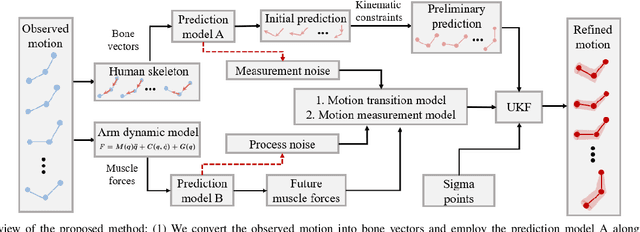
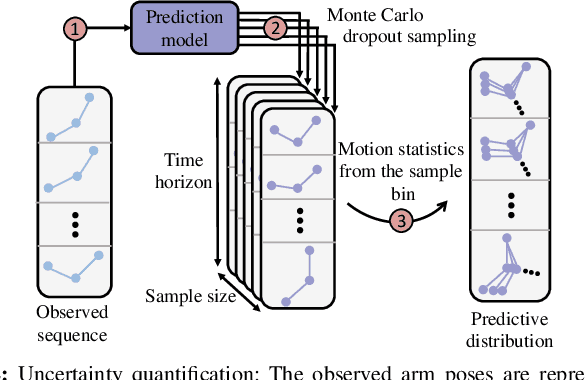
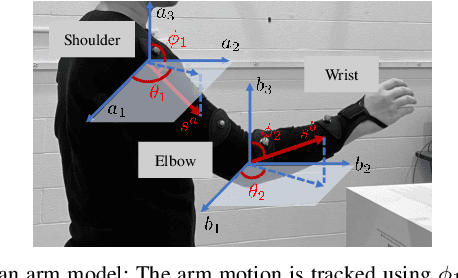
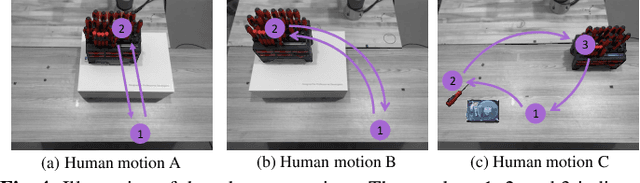
This paper presents a deep learning enhanced adaptive unscented Kalman filter (UKF) for predicting human arm motion in the context of manufacturing. Unlike previous network-based methods that solely rely on captured human motion data, which is represented as bone vectors in this paper, we incorporate a human arm dynamic model into the motion prediction algorithm and use the UKF to iteratively forecast human arm motions. Specifically, a Lagrangian-mechanics-based physical model is employed to correlate arm motions with associated muscle forces. Then a Recurrent Neural Network (RNN) is integrated into the framework to predict future muscle forces, which are transferred back to future arm motions based on the dynamic model. Given the absence of measurement data for future human motions that can be input into the UKF to update the state, we integrate another RNN to directly predict human future motions and treat the prediction as surrogate measurement data fed into the UKF. A noteworthy aspect of this study involves the quantification of uncertainties associated with both the data-driven and physical models in one unified framework. These quantified uncertainties are used to dynamically adapt the measurement and process noises of the UKF over time. This adaption, driven by the uncertainties of the RNN models, addresses inaccuracies stemming from the data-driven model and mitigates discrepancies between the assumed and true physical models, ultimately enhancing the accuracy and robustness of our predictions. Compared to the traditional RNN-based prediction, our method demonstrates improved accuracy and robustness in extensive experimental validations of various types of human motions.
A Review of Prospects and Opportunities in Disassembly with Human-Robot Collaboration
Oct 20, 2023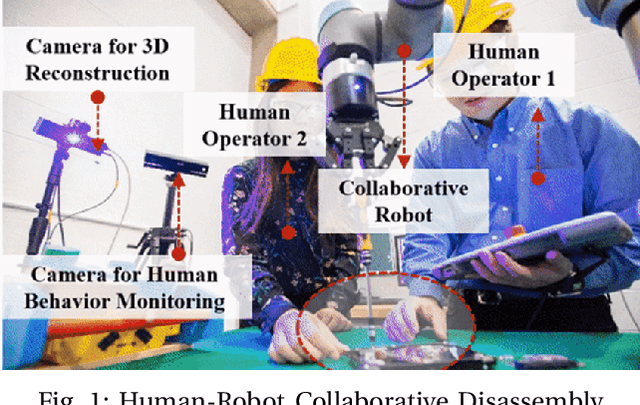
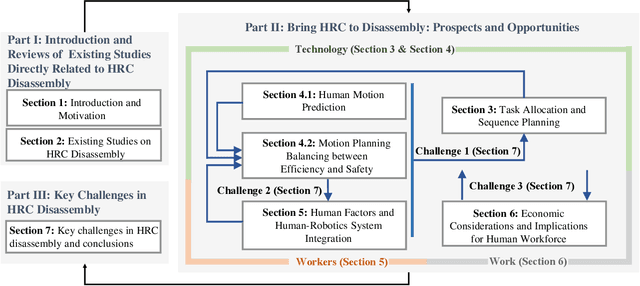
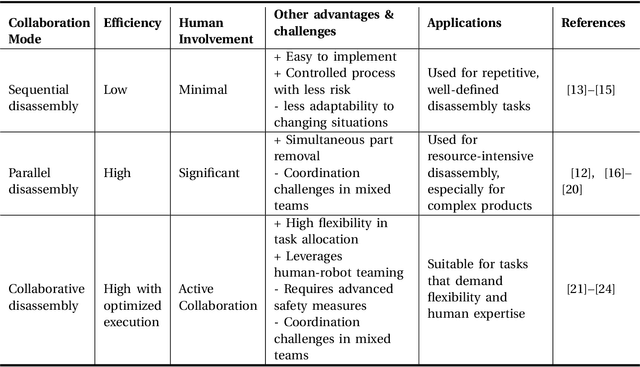
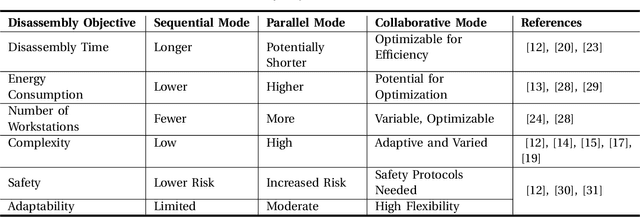
Product disassembly plays a crucial role in the recycling, remanufacturing, and reuse of end-of-use (EoU) products. However, the current manual disassembly process is inefficient due to the complexity and variation of EoU products. While fully automating disassembly is not economically viable given the intricate nature of the task, there is potential in using human-robot collaboration (HRC) to enhance disassembly operations. HRC combines the flexibility and problem-solving abilities of humans with the precise repetition and handling of unsafe tasks by robots. Nevertheless, numerous challenges persist in technology, human workers, and remanufacturing work, that require comprehensive multidisciplinary research to bridge critical gaps. These challenges have motivated the authors to provide a detailed discussion on the opportunities and obstacles associated with introducing HRC to disassembly. In this regard, the authors have conducted a thorough review of the recent progress in HRC disassembly and present the insights gained from this analysis from three distinct perspectives: technology, workers, and work.