 Add to Chrome
 Add to Firefox
 Add to Edge
EchoChange: A Diffusion Language Model with Dual Pass Remasking for Factual Remote Sensing Disaster Change Captioning
Aug 03, 2026
Bi-temporal remote-sensing disaster change captioning often needs to identify sparse and spatially localized changes across large pre- and post-event scenes and then translate them into coherent, factual descriptions. However, existing change captioning methods always follow an autoregressive decoding paradigm to generate the change description and thus an early misinterpretation of the changed object, event, or spatial relation becomes an irreversible premise for subsequent text, amplifying visual ambiguity into cascading factual errors. To address this limitation, we propose EchoChange, a multimodal discrete diffusion language model that formulates change captioning as iterative masked-token denoising rather than left-to-right generation. By repeatedly revising the entire caption while conditioning on the image pair, EchoChange can reconsider uncertain content and correct imperfect intermediate predictions. We further introduce draft-aware dual-pass training, a progressive masking curriculum, and confidence-guided remasking to align training with iterative inference. Extensive experiments on the RSCC benchmark show that EchoChange substantially outperforms both general-purpose and remote-sensing-specific baselines across lexical and semantic metrics. The EchoChange Project is at https://github.com/sundongwei/EchoChange_Project

The Sampling-Gaussian for stereo matching
Oct 09, 2024


The soft-argmax operation is widely adopted in neural network-based stereo matching methods to enable differentiable regression of disparity. However, network trained with soft-argmax is prone to being multimodal due to absence of explicit constraint to the shape of the probability distribution. Previous methods leverages Laplacian distribution and cross-entropy for training but failed to effectively improve the accuracy and even compromises the efficiency of the network. In this paper, we conduct a detailed analysis of the previous distribution-based methods and propose a novel supervision method for stereo matching, Sampling-Gaussian. We sample from the Gaussian distribution for supervision. Moreover, we interpret the training as minimizing the distance in vector space and propose a combined loss of L1 loss and cosine similarity loss. Additionally, we leveraged bilinear interpolation to upsample the cost volume. Our method can be directly applied to any soft-argmax-based stereo matching method without a reduction in efficiency. We have conducted comprehensive experiments to demonstrate the superior performance of our Sampling-Gaussian. The experimental results prove that we have achieved better accuracy on five baseline methods and two datasets. Our method is easy to implement, and the code is available online.
NoMAD-Attention: Efficient LLM Inference on CPUs Through Multiply-add-free Attention
Mar 02, 2024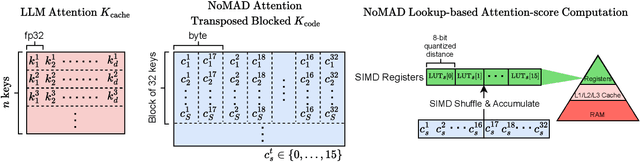
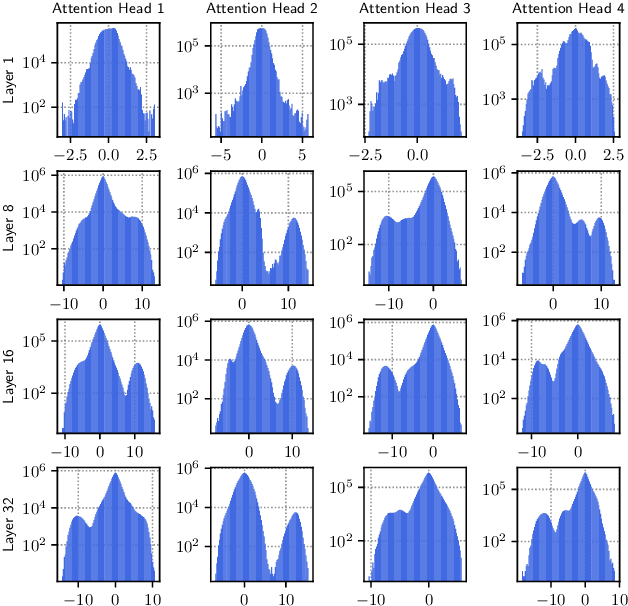
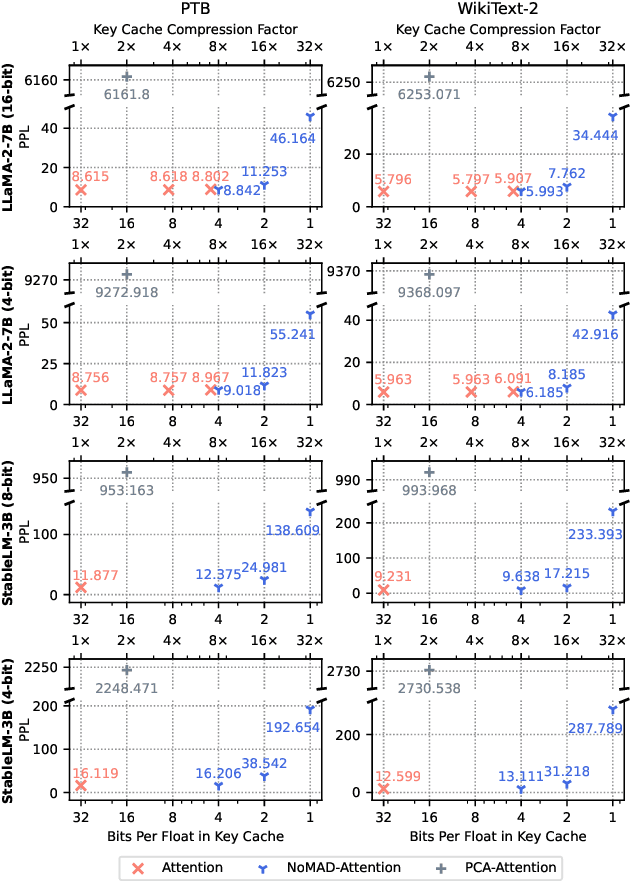
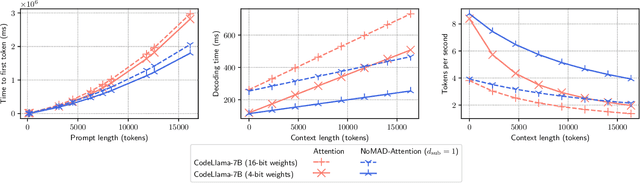
Large language model inference on Central Processing Units (CPU) is challenging due to the vast quantities of expensive Multiply-Add (MAD) matrix operations in the attention computations. In this paper, we argue that there is a rare gem in modern CPUs, Single-Instruction-Multiple-Data (SIMD) registers, which allow for ultra-low-latency lookups in batch. We leverage this unique capability of CPUs to propose NoMAD-Attention, an efficient attention algorithm that replaces MAD operations with in-register lookups. Through hardware-aware algorithmic designs, NoMAD-Attention achieves the computation of attention scores using repeated fast accesses to SIMD registers despite their highly limited sizes. Moreover, NoMAD-Attention works with pre-trained attention-based LLMs without model finetuning. Empirical evaluations demonstrate that NoMAD-Attention maintains the quality of the original LLMs well, and speeds up the 4-bit quantized LLaMA-7B-based model by up to 2$\times$ at 16k context length. Our results are reproducible at https://github.com/tonyzhang617/nomad-dist.