 Add to Chrome
 Add to Firefox
 Add to Edge
WildCity: A Real-World City-Scale Testbed for Rendering, Simulation, and Spatial Intelligence
Jul 07, 2026
Humans can navigate an unfamiliar city and gradually form a coherent spatial mental map spanning tens of square kilometers. Can AI build spatial representations at a comparable scale? Although recent foundation models have advanced scene reconstruction and embodied intelligence, scaling to entire cities remains an open challenge, primarily due to the lack of city-scale data. To bridge the gap, we introduce WildCity, a real-world multimodal dataset collected by autonomous fleets traversing complex urban environments. Our dataset includes 18 trajectories, each averaging 83.7 kilometers in length, and preserves the core challenges of in-the-wild perception, e.g., dynamic objects, lighting variations, and imperfect camera poses. We further establish an urban-tailored reconstruction baseline and convert the reconstructed environments into a closed-loop simulator. Beyond the dataset and baseline, we systematically analyze the key challenges on the path to simulation-ready urban digital twins: scalability, extrapolation, and uncertainty. Ultimately, WildCity aims to catalyze progress not only in city-scale rendering, but more broadly in the pursuit of AI that can perceive, remember, and reason across space at a scale comparable to human cognition. Project page: https://han-xiangyu.github.io/Wild-City/

Unleashing the Power of Data Synthesis in Visual Localization
Nov 28, 2024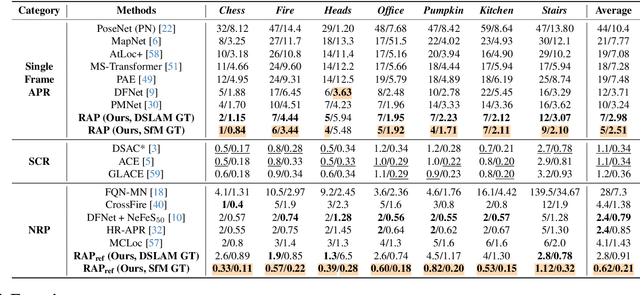

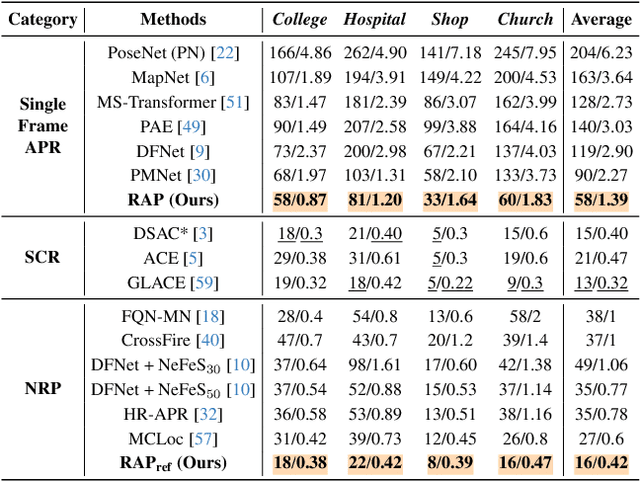
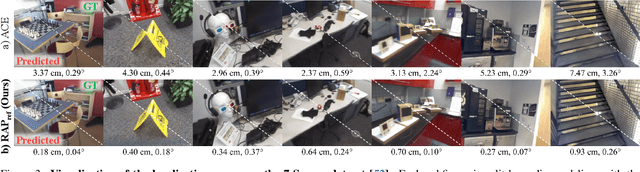
Visual localization, which estimates a camera's pose within a known scene, is a long-standing challenge in vision and robotics. Recent end-to-end methods that directly regress camera poses from query images have gained attention for fast inference. However, existing methods often struggle to generalize to unseen views. In this work, we aim to unleash the power of data synthesis to promote the generalizability of pose regression. Specifically, we lift real 2D images into 3D Gaussian Splats with varying appearance and deblurring abilities, which are then used as a data engine to synthesize more posed images. To fully leverage the synthetic data, we build a two-branch joint training pipeline, with an adversarial discriminator to bridge the syn-to-real gap. Experiments on established benchmarks show that our method outperforms state-of-the-art end-to-end approaches, reducing translation and rotation errors by 50% and 21.6% on indoor datasets, and 35.56% and 38.7% on outdoor datasets. We also validate the effectiveness of our method in dynamic driving scenarios under varying weather conditions. Notably, as data synthesis scales up, our method exhibits a growing ability to interpolate and extrapolate training data for localizing unseen views. Project Page: https://ai4ce.github.io/RAP/