 Add to Chrome
 Add to Firefox
 Add to Edge
DVFace: Spatio-Temporal Dual-Prior Diffusion for Video Face Restoration
Apr 16, 2026
Video face restoration aims to enhance degraded face videos into high-quality results with realistic facial details, stable identity, and temporal coherence. Recent diffusion-based methods have brought strong generative priors to restoration and enabled more realistic detail synthesis. However, existing approaches for face videos still rely heavily on generic diffusion priors and multi-step sampling, which limit both facial adaptation and inference efficiency. These limitations motivate the use of one-step diffusion for video face restoration, yet achieving faithful facial recovery alongside temporally stable outputs remains challenging. In this paper, we propose, DVFace, a one-step diffusion framework for real-world video face restoration. Specifically, we introduce a spatio-temporal dual-codebook design to extract complementary spatial and temporal facial priors from degraded videos. We further propose an asymmetric spatio-temporal fusion module to inject these priors into the diffusion backbone according to their distinct roles. Evaluation on various benchmarks shows that DVFace delivers superior restoration quality, temporal consistency, and identity preservation compared to recent methods. Code: https://github.com/zhengchen1999/DVFace.

LSGQuant: Layer-Sensitivity Guided Quantization for One-Step Diffusion Real-World Video Super-Resolution
Feb 03, 2026One-Step Diffusion Models have demonstrated promising capability and fast inference in video super-resolution (VSR) for real-world. Nevertheless, the substantial model size and high computational cost of Diffusion Transformers (DiTs) limit downstream applications. While low-bit quantization is a common approach for model compression, the effectiveness of quantized models is challenged by the high dynamic range of input latent and diverse layer behaviors. To deal with these challenges, we introduce LSGQuant, a layer-sensitivity guided quantizing approach for one-step diffusion-based real-world VSR. Our method incorporates a Dynamic Range Adaptive Quantizer (DRAQ) to fit video token activations. Furthermore, we estimate layer sensitivity and implement a Variance-Oriented Layer Training Strategy (VOLTS) by analyzing layer-wise statistics in calibration. We also introduce Quantization-Aware Optimization (QAO) to jointly refine the quantized branch and a retained high-precision branch. Extensive experiments demonstrate that our method has nearly performance to origin model with full-precision and significantly exceeds existing quantization techniques. Code is available at: https://github.com/zhengchen1999/LSGQuant.
QuantVSR: Low-Bit Post-Training Quantization for Real-World Video Super-Resolution
Aug 06, 2025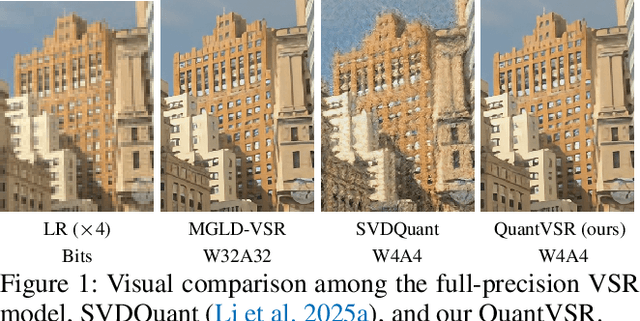

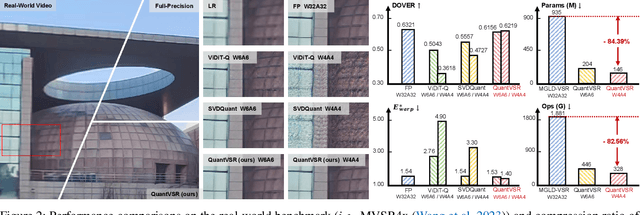
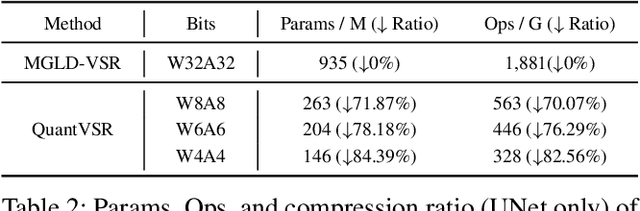
Diffusion models have shown superior performance in real-world video super-resolution (VSR). However, the slow processing speeds and heavy resource consumption of diffusion models hinder their practical application and deployment. Quantization offers a potential solution for compressing the VSR model. Nevertheless, quantizing VSR models is challenging due to their temporal characteristics and high fidelity requirements. To address these issues, we propose QuantVSR, a low-bit quantization model for real-world VSR. We propose a spatio-temporal complexity aware (STCA) mechanism, where we first utilize the calibration dataset to measure both spatial and temporal complexities for each layer. Based on these statistics, we allocate layer-specific ranks to the low-rank full-precision (FP) auxiliary branch. Subsequently, we jointly refine the FP and low-bit branches to achieve simultaneous optimization. In addition, we propose a learnable bias alignment (LBA) module to reduce the biased quantization errors. Extensive experiments on synthetic and real-world datasets demonstrate that our method obtains comparable performance with the FP model and significantly outperforms recent leading low-bit quantization methods. Code is available at: https://github.com/bowenchai/QuantVSR.