 Add to Chrome
 Add to Firefox
 Add to Edge
Compiler-Grounded Hierarchical Diagnosis for LLM-Based Triton Kernel Optimization
Jul 25, 2026
Recent advances in large language models (LLMs) have enabled automated kernel generation and optimization, but most existing approaches rely on surface signals such as compilation feedback and profiling metrics. These signals reveal that a kernel is slow, but not why the backend compiler fails to realize a profitable optimization, especially on emerging accelerators such as NPUs. We therefore formulate kernel optimization as a progressive cross-layer diagnosis problem that links runtime symptoms to IR structure and compiler behavior before rewriting source. Based on this insight, we present our system, a compiler-grounded and hierarchical optimization framework for Triton kernels. the system escalates from lightweight pattern triage and profiling diagnosis to IR attribution and compiler-grounded analysis only when deeper evidence is needed, then proposes evidence-backed source-level rewrites. We implement the system on Triton for Ascend NPUs and evaluate it on 37 successfully converted entries from a standardized NPUKernelBench-derived Ascend 950 benchmark. Across these entries, the system attains a geometric-mean speedup of 4.35$\times$ and a median speedup of 2.73$\times$ from the initial to optimized Triton kernel; 22/37 exceed 2$\times$ and 13/37 exceed 5$\times$. The complete distribution ranges from near-baseline entries to large wins, motivating transparent reporting of the current system's scope and limitations.

Compression of enumerations and gain
Apr 06, 2023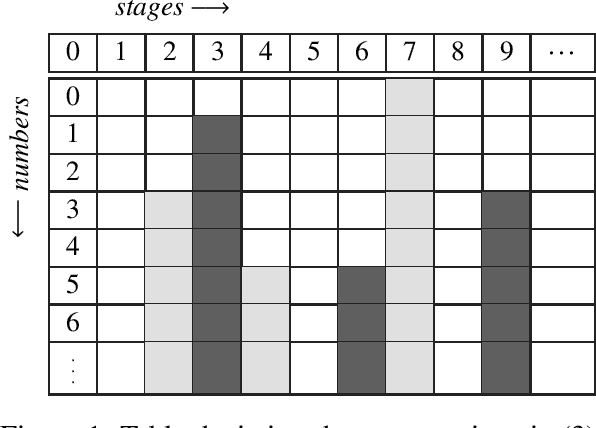
We study the compressibility of enumerations, and its role in the relative Kolmogorov complexity of computably enumerable sets, with respect to density. With respect to a strong and a weak form of compression, we examine the gain: the amount of auxiliary information embedded in the compressed enumeration. Strong compression and weak gainless compression is shown for any computably enumerable set, and a positional game is studied toward understanding strong gainless compression.
NIL: Learning Nonlinear Interpolants
May 28, 2019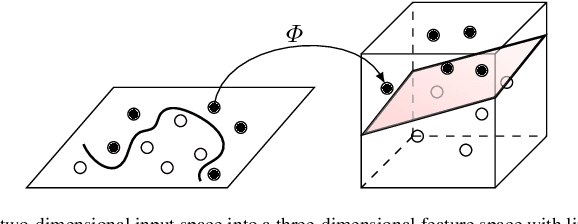
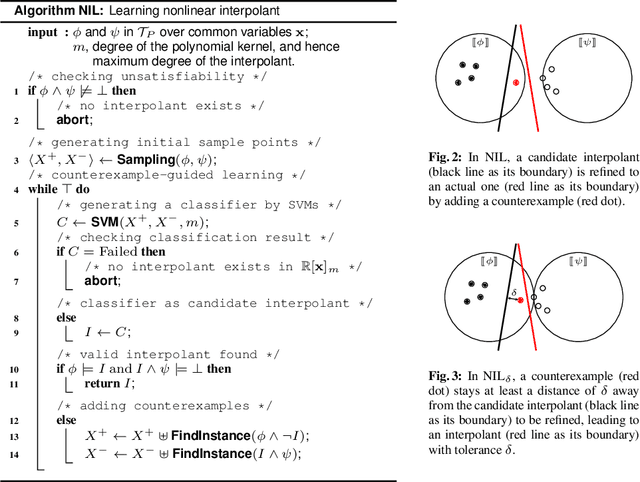
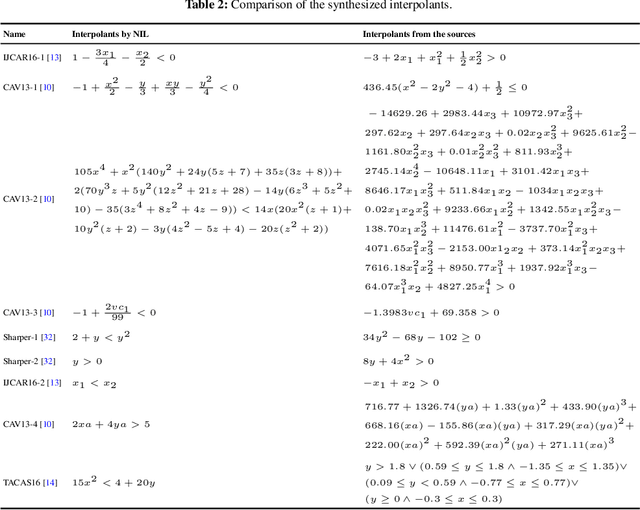
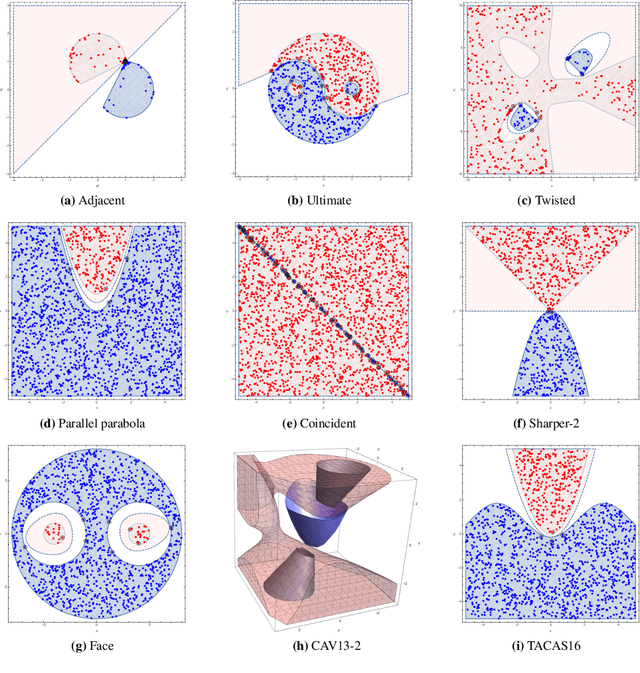
Nonlinear interpolants have been shown useful for the verification of programs and hybrid systems in contexts of theorem proving, model checking, abstract interpretation, etc. The underlying synthesis problem, however, is challenging and existing methods have limitations on the form of formulae to be interpolated. We leverage classification techniques with space transformations and kernel tricks as established in the realm of machine learning, and present a counterexample-guided method named NIL for synthesizing polynomial interpolants, thereby yielding a unified framework tackling the interpolation problem for the general quantifier-free theory of nonlinear arithmetic, possibly involving transcendental functions. We prove the soundness of NIL and propose sufficient conditions under which NIL is guaranteed to converge, i.e., the derived sequence of candidate interpolants converges to an actual interpolant, and is complete, namely the algorithm terminates by producing an interpolant if there exists one. The applicability and effectiveness of our technique are demonstrated experimentally on a collection of representative benchmarks from the literature, where in particular, our method suffices to address more interpolation tasks, including those with perturbations in parameters, and in many cases synthesizes simpler interpolants compared with existing approaches.