 Add to Chrome
 Add to Firefox
 Add to Edge
MINDGAMES: A Live Arena for Evaluating Social and Strategic Reasoning in Multi-Agent LLMs
May 28, 2026
Large language models (LLMs) are increasingly deployed as interactive agents, yet their capacity for social and strategic reasoning over extended interaction remains poorly understood. Existing evaluations rely on static vignettes or single-game benchmarks that cannot capture the sustained, multi-faceted reasoning that real-world multi-agent settings demand. We introduce Mindgames, a multi-game arena and evaluation platform for LLM agents that operationalizes complementary reasoning demands relevant to ``theory of mind'': belief attribution under hidden information, opponent modeling through repeated strategic interaction, cooperative inference under knowledge asymmetries, and sustained deception in social deduction. Built on TextArena, Mindgames provides a unified interaction interface, TrueSkill-based rating, and full trajectory logging across four game environments. We instantiate Mindgames through a 2025 competition cycle hosted at a major AI conference, which assessed 944 submitted agents from 76 teams across four games: Colonel Blotto, Iterated Prisoner's Dilemma, Codenames, and Secret Mafia. Our analysis surfaces both agent-level and evaluation-level limitations: brittle rule adherence remains a major bottleneck, top-performing systems repeatedly rely on explicit structural scaffolding, and leaderboard validity differs sharply across environments. In particular, failure-heavy environments can reward robustness to opponent errors as much as strategic ability, with Secret Mafia exhibiting a pronounced error-survival confound in this cycle. We release a dataset of 29,571 multi-agent games with turn-level observations, actions, and rewards, together with MG-Ref, a deterministic offline tournament protocol that scores new agents against a frozen reference pool of top-ranked, low-error Stage~II submissions under the same error-attribution lens used in this analysis.

InfluenceNet: AI Models for Banzhaf and Shapley Value Prediction
Mar 11, 2025Power indices are essential in assessing the contribution and influence of individual agents in multi-agent systems, providing crucial insights into collaborative dynamics and decision-making processes. While invaluable, traditional computational methods for exact or estimated power indices values require significant time and computational constraints, especially for large $(n\ge10)$ coalitions. These constraints have historically limited researchers' ability to analyse complex multi-agent interactions comprehensively. To address this limitation, we introduce a novel Neural Networks-based approach that efficiently estimates power indices for voting games, demonstrating comparable and often superiour performance to existing tools in terms of both speed and accuracy. This method not only addresses existing computational bottlenecks, but also enables rapid analysis of large coalitions, opening new avenues for multi-agent system research by overcoming previous computational limitations and providing researchers with a more accessible, scalable analytical tool.This increased efficiency will allow for the analysis of more complex and realistic multi-agent scenarios.
Using Cooperative Game Theory to Prune Neural Networks
Nov 17, 2023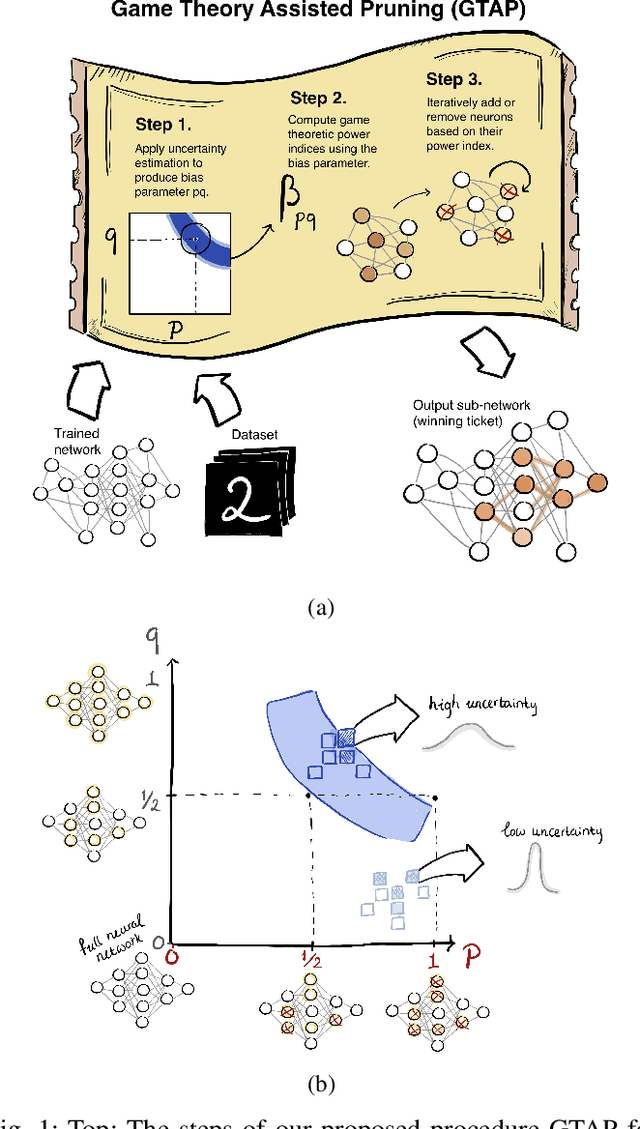
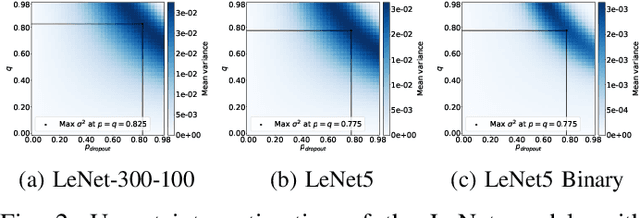
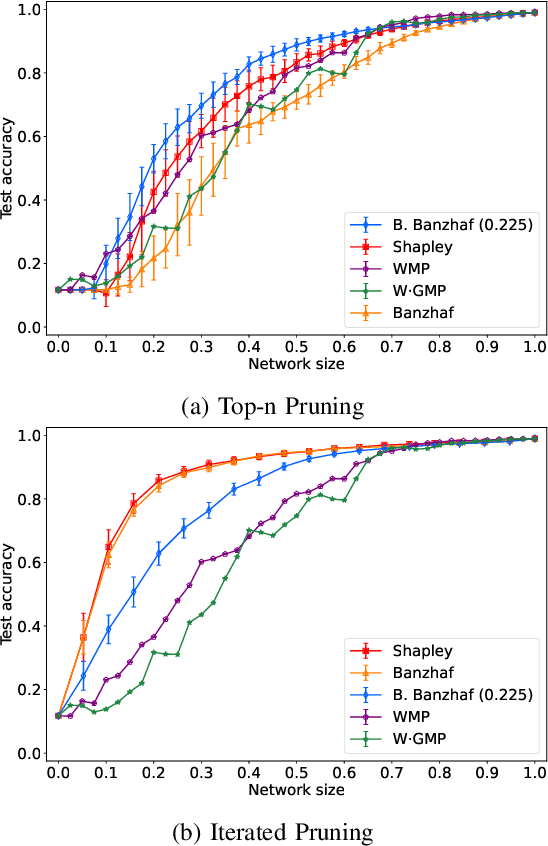
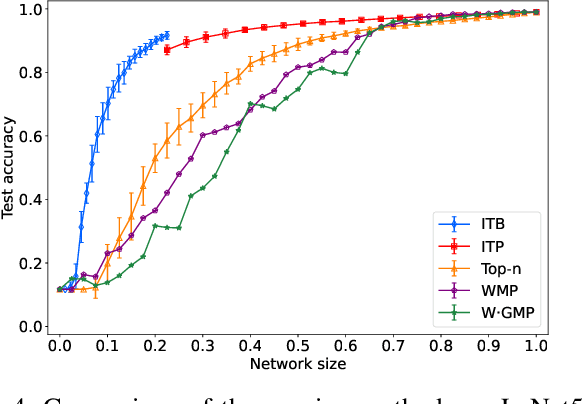
We show how solution concepts from cooperative game theory can be used to tackle the problem of pruning neural networks. The ever-growing size of deep neural networks (DNNs) increases their performance, but also their computational requirements. We introduce a method called Game Theory Assisted Pruning (GTAP), which reduces the neural network's size while preserving its predictive accuracy. GTAP is based on eliminating neurons in the network based on an estimation of their joint impact on the prediction quality through game theoretic solutions. Specifically, we use a power index akin to the Shapley value or Banzhaf index, tailored using a procedure similar to Dropout (commonly used to tackle overfitting problems in machine learning). Empirical evaluation of both feedforward networks and convolutional neural networks shows that this method outperforms existing approaches in the achieved tradeoff between the number of parameters and model accuracy.