 Add to Chrome
 Add to Firefox
 Add to Edge
Findings of the First Teaching Monster Challenge: A Benchmark of Pedagogical Content Knowledge in AI Agents
Aug 09, 2026
AI agents can now solve problems, answer like subject experts, and generate long-form multimodal content. However, whether they can adapt a lesson to fit a specified learner, which education calls Pedagogical Content Knowledge (PCK), has not been benchmarked. To measure it, we introduce the Teaching Monster Challenge, the first instructional video generation benchmark to treat the learner persona as an explicit evaluation criterion. Each system is given a topic and a learner persona and must generate a complete instructional video. Every video is screened by an LLM-judge, ranked by crowd pairwise voting, and finalized by an expert panel. The first edition shows that today's systems handle the content well but are far weaker at presenting it and adapting it to the learner. The same process exposes a limit of automatic judging. The LLM-judge separates a clear low-performing tail but ranks the strongest systems poorly. The strongest systems receive nearly identical scores from the judge, so its ranking of them does not match human preference. Progress therefore requires not only better teaching systems but also better automatic judges, and we release the benchmark, rubric, and human judgments as a testbed for both.

Audio Jailbreaks in Large Audio-Language Models: Taxonomy, Attack-Defense Analysis, and Cost-Aware Evaluation
May 28, 2026Large Audio Language Models (LALMs) expand jailbreak risks from token-level prompting to the full speech perception-to-reasoning pipeline, where unsafe behavior can be induced through semantics, acoustic style, signal artifacts, or internal representations. Existing work studies these risks under heterogeneous threat models and evaluation protocols, making it difficult to compare attack practicality or defense utility. This paper provides a unified taxonomy and a controlled empirical evaluation of LALM jailbreak attacks and defenses. We organize prior work into semantic, acoustic, signal, and embedding-layer attacks; guard-based, training-free, and training-based defenses; and cross-modal, audio-native, and interactive benchmarks. We then evaluate representative attacks and defenses across ten open-source LALMs, measuring not only attack success rate but also benign refusal and latency. Our results show that Acoustic Best-of-N reveals strong worst-case audio-space vulnerabilities, Narrative Framing is an effective low-latency semantic threat, and current defenses trade robustness against benign usability. These findings support cost- and utility-aware evaluation as a necessary complement to success-rate-only LALM safety benchmarks.
ToxicTone: A Mandarin Audio Dataset Annotated for Toxicity and Toxic Utterance Tonality
May 21, 2025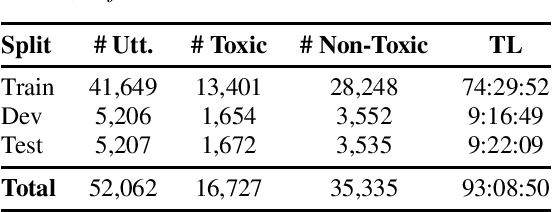
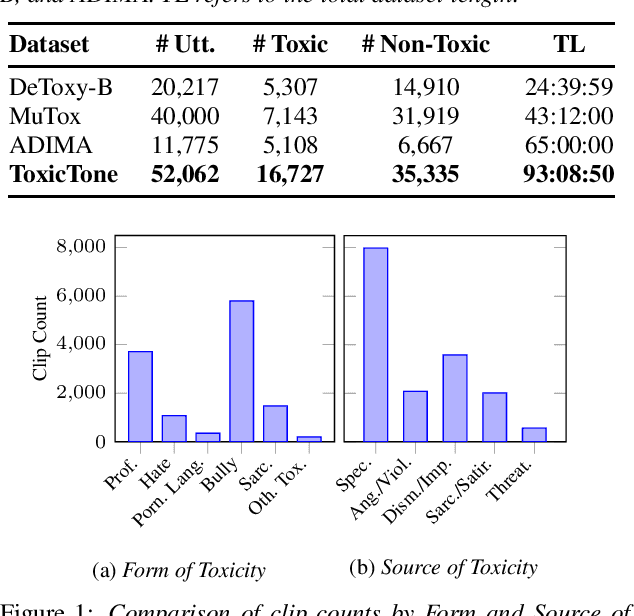
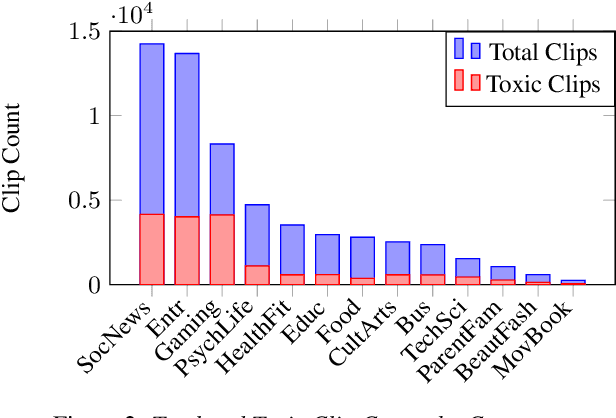
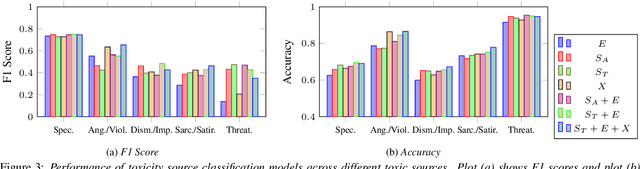
Despite extensive research on toxic speech detection in text, a critical gap remains in handling spoken Mandarin audio. The lack of annotated datasets that capture the unique prosodic cues and culturally specific expressions in Mandarin leaves spoken toxicity underexplored. To address this, we introduce ToxicTone -- the largest public dataset of its kind -- featuring detailed annotations that distinguish both forms of toxicity (e.g., profanity, bullying) and sources of toxicity (e.g., anger, sarcasm, dismissiveness). Our data, sourced from diverse real-world audio and organized into 13 topical categories, mirrors authentic communication scenarios. We also propose a multimodal detection framework that integrates acoustic, linguistic, and emotional features using state-of-the-art speech and emotion encoders. Extensive experiments show our approach outperforms text-only and baseline models, underscoring the essential role of speech-specific cues in revealing hidden toxic expressions.