 Add to Chrome
 Add to Firefox
 Add to Edge
MoVE: Translating Laughter and Tears via Mixture of Vocalization Experts in Speech-to-Speech Translation
Apr 19, 2026
Recent Speech-to-Speech Translation (S2ST) systems achieve strong semantic accuracy yet consistently strip away non-verbal vocalizations (NVs), such as laughter and crying that convey pragmatic intent, which severely limits real-world utility. We address this via three contributions. First, we propose a synthesis pipeline for building scalable expressive datasets to overcome the data scarcity limitation. Second, we propose MoVE, a Mixture-of-LoRA-Experts architecture with expressive-specialized adapters and a soft-weighting router that blends experts for capturing hybrid expressive states. Third, we show pretrained AudioLLMs enable striking data efficiency: 30 minutes of curated data is enough for strong performance. On English-Chinese S2ST, while comparing with strong baselines, MoVE reproduces target NVs in 76% of cases and achieves the highest human-rated naturalness and emotional fidelity among all compared systems, where existing S2ST systems preserve at most 14% of NVs.

ToxicTone: A Mandarin Audio Dataset Annotated for Toxicity and Toxic Utterance Tonality
May 21, 2025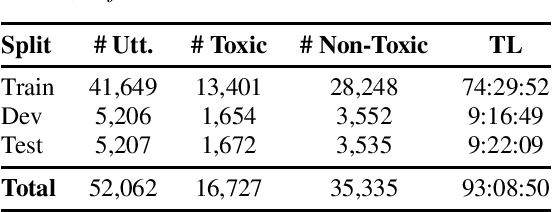
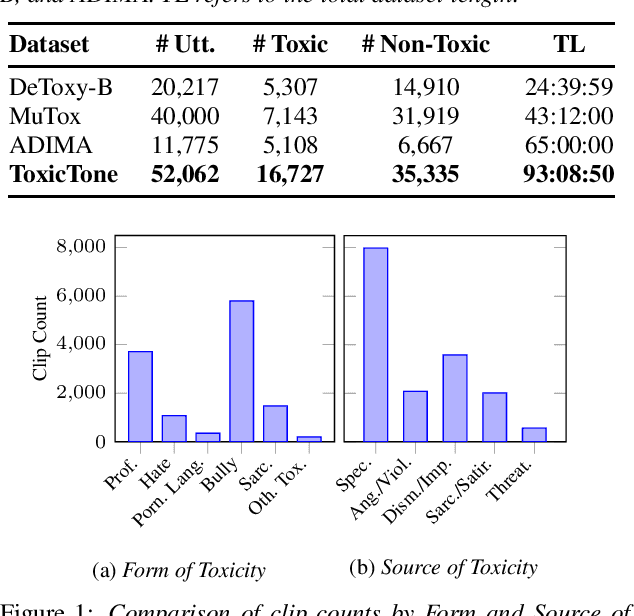
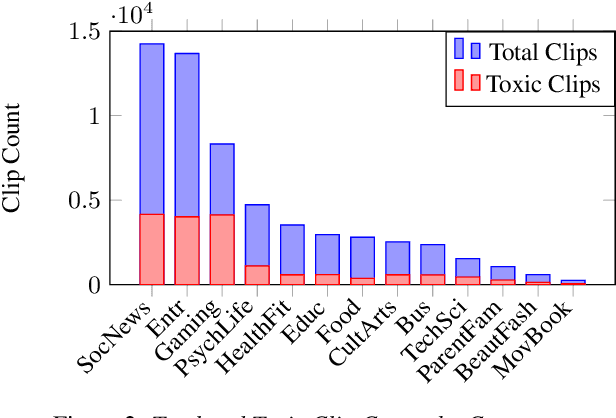
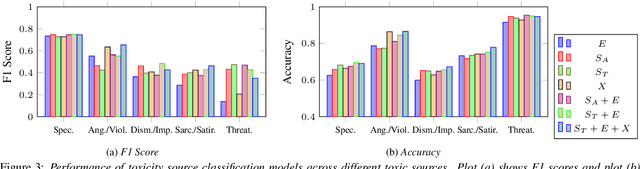
Despite extensive research on toxic speech detection in text, a critical gap remains in handling spoken Mandarin audio. The lack of annotated datasets that capture the unique prosodic cues and culturally specific expressions in Mandarin leaves spoken toxicity underexplored. To address this, we introduce ToxicTone -- the largest public dataset of its kind -- featuring detailed annotations that distinguish both forms of toxicity (e.g., profanity, bullying) and sources of toxicity (e.g., anger, sarcasm, dismissiveness). Our data, sourced from diverse real-world audio and organized into 13 topical categories, mirrors authentic communication scenarios. We also propose a multimodal detection framework that integrates acoustic, linguistic, and emotional features using state-of-the-art speech and emotion encoders. Extensive experiments show our approach outperforms text-only and baseline models, underscoring the essential role of speech-specific cues in revealing hidden toxic expressions.