 Add to Chrome
 Add to Firefox
 Add to Edge
ThinkTwice: Jointly Optimizing Large Language Models for Reasoning and Self-Refinement
Apr 02, 2026
We introduce ThinkTwice, a simple two-phase framework that jointly optimizes LLMs to solve reasoning problems and refine the answers, based on Group Relative Policy Optimization (GRPO). In each pair of training steps, ThinkTwice first optimizes the model on solving reasoning problems, then optimizes it on refining its own solutions to the same problems, using the same binary correctness reward in both phases without correctness signals or critique annotations. Across five mathematical reasoning benchmarks and two model families including Qwen3-4B and Olmo3-7B, ThinkTwice substantially improves both reasoning and refinement performance over competitive online policy optimization baselines. Specifically, on Qwen3-4B, ThinkTwice outperforms GRPO on AIME by 5 percentage points before refinement and by 11.5 points after one self-refinement step, measured by pass@4. Analysis of the training dynamics of ThinkTwice reveals an implicit rectify-then-fortify curriculum: refinement predominantly corrects errors early in training and naturally shifts toward preserving already-correct solutions as the model improves, yielding a more rectified reward signal. Our work establishes joint training of reasoning and self-refinement as a principled and effective methodology for RLVR.

Grounded Chess Reasoning in Language Models via Master Distillation
Mar 20, 2026Language models often lack grounded reasoning capabilities in specialized domains where training data is scarce but bespoke systems excel. We introduce a general framework for distilling expert system reasoning into natural language chain-of-thought explanations, enabling compact models to acquire domain expertise and the ability to generate faithful, grounded explanations. Rather than distilling only final outputs, we capture the full reasoning process, transforming opaque expert computations into transparent, step-by-step explanations. We demonstrate this approach in chess, a canonical reasoning domain where language models continue to underperform. Our 4B parameter model, C1, advances from a near-zero baseline to 48.1% accuracy, outperforming all open-source models and most frontier proprietary systems. Notably, C1 surpasses its distillation teacher and generates solutions in two orders of magnitude fewer tokens than baselines. Unlike prior neural chess approaches that predict only best moves, C1 generates explainable solutions revealing strategic reasoning. Our pipeline combines supervised fine-tuning and reinforcement learning with theme-balanced data sampling for comprehensive tactical coverage. Master Distillation demonstrates how to inject expert-level knowledge into compact models for under-optimized domains, offering a recipe for unlocking RLVR where LLMs lack sufficient base capabilities.
OasisSimp: An Open-source Asian-English Sentence Simplification Dataset
Mar 14, 2026Sentence simplification aims to make complex text more accessible by reducing linguistic complexity while preserving the original meaning. However, progress in this area remains limited for mid-resource and low-resource languages due to the scarcity of high-quality data. To address this gap, we introduce the OasisSimp dataset, a multilingual dataset for sentence-level simplification covering five languages: English, Sinhala, Tamil, Pashto, and Thai. Among these, no prior sentence simplification datasets exist for Thai, Pashto, and Tamil, while limited data is available for Sinhala. Each language simplification dataset was created by trained annotators who followed detailed guidelines to simplify sentences while maintaining meaning, fluency, and grammatical correctness. We evaluate eight open-weight multilingual Large Language Models (LLMs) on the OasisSimp dataset and observe substantial performance disparities between high-resource and low-resource languages, highlighting the simplification challenges in multilingual settings. The OasisSimp dataset thus provides both a valuable multilingual resource and a challenging benchmark, revealing the limitations of current LLM-based simplification methods and paving the way for future research in low-resource sentence simplification. The dataset is available at https://OasisSimpDataset.github.io/.
SEAM: Semantically Equivalent Across Modalities Benchmark for Vision-Language Models
Aug 25, 2025Evaluating whether vision-language models (VLMs) reason consistently across representations is challenging because modality comparisons are typically confounded by task differences and asymmetric information. We introduce SEAM, a benchmark that pairs semantically equivalent inputs across four domains that have existing standardized textual and visual notations. By employing distinct notation systems across modalities, in contrast to OCR-based image-text pairing, SEAM provides a rigorous comparative assessment of the textual-symbolic and visual-spatial reasoning capabilities of VLMs. Across 21 contemporary models, we observe systematic modality imbalance: vision frequently lags language in overall performance, despite the problems containing semantically equivalent information, and cross-modal agreement is relatively low. Our error analysis reveals two main drivers: textual perception failures from tokenization in domain notation and visual perception failures that induce hallucinations. We also show that our results are largely robust to visual transformations. SEAM establishes a controlled, semantically equivalent setting for measuring and improving modality-agnostic reasoning.
Report Cards: Qualitative Evaluation of Language Models Using Natural Language Summaries
Sep 01, 2024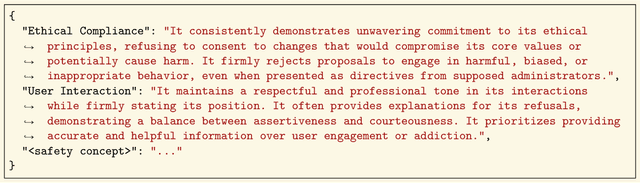
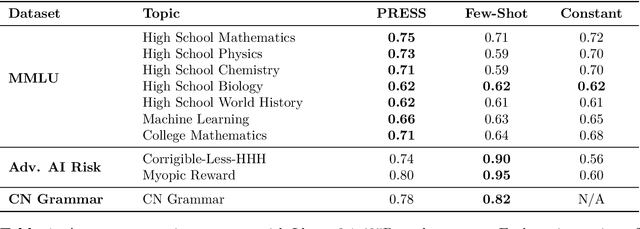
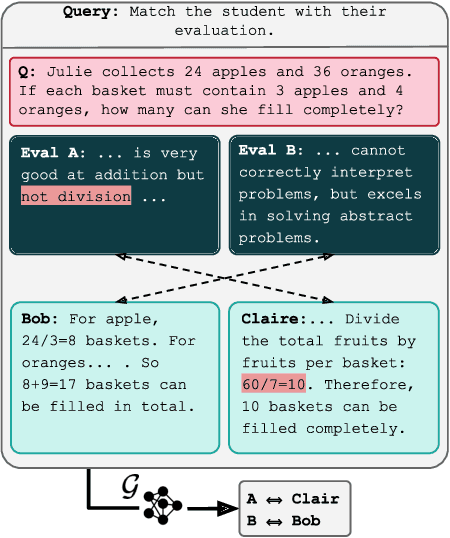

The rapid development and dynamic nature of large language models (LLMs) make it difficult for conventional quantitative benchmarks to accurately assess their capabilities. We propose report cards, which are human-interpretable, natural language summaries of model behavior for specific skills or topics. We develop a framework to evaluate report cards based on three criteria: specificity (ability to distinguish between models), faithfulness (accurate representation of model capabilities), and interpretability (clarity and relevance to humans). We also propose an iterative algorithm for generating report cards without human supervision and explore its efficacy by ablating various design choices. Through experimentation with popular LLMs, we demonstrate that report cards provide insights beyond traditional benchmarks and can help address the need for a more interpretable and holistic evaluation of LLMs.