 Add to Chrome
 Add to Firefox
 Add to Edge
FAIR^2 Drones: An AI-Ready Standard for Cross-Domain Wildlife Drone Datasets
May 29, 2026
Animal ecology data collection using drones represents a substantial investment of time, expertise, and financial resources. Yet most existing datasets serve only a single research community, limiting interdisciplinary reuse. We propose a unified drone dataset standard, FAIR^2 Drones, that bridges ecology, robotics, and computer vision by building on existing FAIR and AI-ready data frameworks while adding essential platform metadata and annotation specifications. Our standard enables datasets to simultaneously support ecological analysis, robotics algorithm development, and computer vision benchmarking. We provide open-source validation tools, reference implementations, and multimodal extensions linking drone imagery with complementary sensors such as camera traps, GPS, and acoustics. By standardizing metadata across disciplines, this framework maximizes the scientific return on investment for costly field deployments and accelerates cross-domain collaboration in environmental monitoring.

WildLIFT: Lifting monocular drone video to 3D for species-agnostic wildlife monitoring
Apr 27, 2026Monocular RGB cameras mounted on drones are widely used for wildlife monitoring, yet most analytical pipelines remain confined to two-dimensional image space, leaving geometric information in video underexploited. We present WildLIFT, a computational framework that integrates three-dimensional scene geometry from monocular drone video with open-vocabulary 2D instance segmentation to enable species-agnostic 3D detection and tracking. Oriented 3D bounding box labels with semantic face information enable quantitative assessment of viewpoint coverage and inter-animal occlusion, producing structured metadata for downstream ecological analyses. We validate the framework on 2,581 manually curated frames comprising over 6,700 3D detections across four large mammal species. WildLIFT maintains high identity consistency in multi-animal scenes and substantially reduces manual 3D annotation effort through keyframe-based refinement. By transforming standard drone footage into structured 3D and viewpoint-aware representations, WildLIFT extends the analytical utility of aerial wildlife datasets for behavioural research and population monitoring.
MMLA: Multi-Environment, Multi-Species, Low-Altitude Aerial Footage Dataset
Apr 10, 2025Real-time wildlife detection in drone imagery is critical for numerous applications, including animal ecology, conservation, and biodiversity monitoring. Low-altitude drone missions are effective for collecting fine-grained animal movement and behavior data, particularly if missions are automated for increased speed and consistency. However, little work exists on evaluating computer vision models on low-altitude aerial imagery and generalizability across different species and settings. To fill this gap, we present a novel multi-environment, multi-species, low-altitude aerial footage (MMLA) dataset. MMLA consists of drone footage collected across three diverse environments: Ol Pejeta Conservancy and Mpala Research Centre in Kenya, and The Wilds Conservation Center in Ohio, which includes five species: Plains zebras, Grevy's zebras, giraffes, onagers, and African Painted Dogs. We comprehensively evaluate three YOLO models (YOLOv5m, YOLOv8m, and YOLOv11m) for detecting animals. Results demonstrate significant performance disparities across locations and species-specific detection variations. Our work highlights the importance of evaluating detection algorithms across different environments for robust wildlife monitoring applications using drones.
MammalNet: A Large-scale Video Benchmark for Mammal Recognition and Behavior Understanding
Jun 01, 2023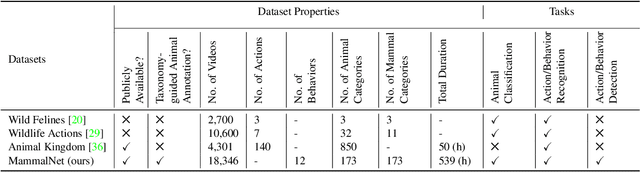
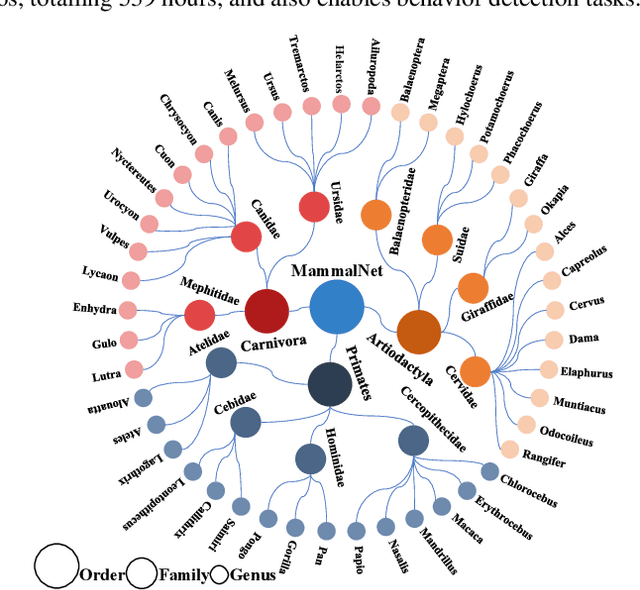


Monitoring animal behavior can facilitate conservation efforts by providing key insights into wildlife health, population status, and ecosystem function. Automatic recognition of animals and their behaviors is critical for capitalizing on the large unlabeled datasets generated by modern video devices and for accelerating monitoring efforts at scale. However, the development of automated recognition systems is currently hindered by a lack of appropriately labeled datasets. Existing video datasets 1) do not classify animals according to established biological taxonomies; 2) are too small to facilitate large-scale behavioral studies and are often limited to a single species; and 3) do not feature temporally localized annotations and therefore do not facilitate localization of targeted behaviors within longer video sequences. Thus, we propose MammalNet, a new large-scale animal behavior dataset with taxonomy-guided annotations of mammals and their common behaviors. MammalNet contains over 18K videos totaling 539 hours, which is ~10 times larger than the largest existing animal behavior dataset. It covers 17 orders, 69 families, and 173 mammal categories for animal categorization and captures 12 high-level animal behaviors that received focus in previous animal behavior studies. We establish three benchmarks on MammalNet: standard animal and behavior recognition, compositional low-shot animal and behavior recognition, and behavior detection. Our dataset and code have been made available at: https://mammal-net.github.io.