 Add to Chrome
 Add to Firefox
 Add to Edge
FAIR^2 Drones: An AI-Ready Standard for Cross-Domain Wildlife Drone Datasets
May 29, 2026
Animal ecology data collection using drones represents a substantial investment of time, expertise, and financial resources. Yet most existing datasets serve only a single research community, limiting interdisciplinary reuse. We propose a unified drone dataset standard, FAIR^2 Drones, that bridges ecology, robotics, and computer vision by building on existing FAIR and AI-ready data frameworks while adding essential platform metadata and annotation specifications. Our standard enables datasets to simultaneously support ecological analysis, robotics algorithm development, and computer vision benchmarking. We provide open-source validation tools, reference implementations, and multimodal extensions linking drone imagery with complementary sensors such as camera traps, GPS, and acoustics. By standardizing metadata across disciplines, this framework maximizes the scientific return on investment for costly field deployments and accelerates cross-domain collaboration in environmental monitoring.

WildLIFT: Lifting monocular drone video to 3D for species-agnostic wildlife monitoring
Apr 27, 2026Monocular RGB cameras mounted on drones are widely used for wildlife monitoring, yet most analytical pipelines remain confined to two-dimensional image space, leaving geometric information in video underexploited. We present WildLIFT, a computational framework that integrates three-dimensional scene geometry from monocular drone video with open-vocabulary 2D instance segmentation to enable species-agnostic 3D detection and tracking. Oriented 3D bounding box labels with semantic face information enable quantitative assessment of viewpoint coverage and inter-animal occlusion, producing structured metadata for downstream ecological analyses. We validate the framework on 2,581 manually curated frames comprising over 6,700 3D detections across four large mammal species. WildLIFT maintains high identity consistency in multi-animal scenes and substantially reduces manual 3D annotation effort through keyframe-based refinement. By transforming standard drone footage into structured 3D and viewpoint-aware representations, WildLIFT extends the analytical utility of aerial wildlife datasets for behavioural research and population monitoring.
Adding Another Dimension to Image-based Animal Detection
Apr 10, 2026Monocular imaging of animals inherently reduces 3D structures to 2D projections. Detection algorithms lead to 2D bounding boxes that lack information about animal's orientation relative to the camera. To build 3D detection methods for RGB animal images, there is a lack of labeled datasets; such labeling processes require 3D input streams along with RGB data. We present a pipeline that utilises Skinned Multi Animal Linear models to estimate 3D bounding boxes and to project them as robust labels into 2D image space using a dedicated camera pose refinement algorithm. To assess which sides of the animal are captured, cuboid face visibility metrics are computed. These 3D bounding boxes and metrics form a crucial step toward developing and benchmarking future monocular 3D animal detection algorithms. We evaluate our method on the Animal3D dataset, demonstrating accurate performance across species and settings.
FixationFormer: Direct Utilization of Expert Gaze Trajectories for Chest X-Ray Classification
Mar 24, 2026Expert eye movements provide a rich, passive source of domain knowledge in radiology, offering a powerful cue for integrating diagnostic reasoning into computer-aided analysis. However, direct integration into CNN-based systems, which historically have dominated the medical image analysis domain, is challenging: gaze recordings are sequential, temporally dense yet spatially sparse, noisy, and variable across experts. As a consequence, most existing image-based models utilize reduced representations such as heatmaps. In contrast, gaze naturally aligns with transformer architectures, as both are sequential in nature and rely on attention to highlight relevant input regions. In this work, we introduce FixationFormer, a transformer-based architecture that represents expert gaze trajectories as sequences of tokens, thereby preserving their temporal and spatial structure. By modeling gaze sequences jointly with image features, our approach addresses sparsity and variability in gaze data while enabling a more direct and fine-grained integration of expert diagnostic cues through explicit cross-attention between the image and gaze token sequences. We evaluate our method on three publicly available benchmark chest X-ray datasets and demonstrate that it achieves state-of-the-art classification performance, highlighting the value of representing gaze as a sequence in transformer-based medical image analysis.
Dynamic Personality Adaptation in Large Language Models via State Machines
Feb 25, 2026The inability of Large Language Models (LLMs) to modulate their personality expression in response to evolving dialogue dynamics hinders their performance in complex, interactive contexts. We propose a model-agnostic framework for dynamic personality simulation that employs state machines to represent latent personality states, where transition probabilities are dynamically adapted to the conversational context. Part of our architecture is a modular pipeline for continuous personality scoring that evaluates dialogues along latent axes while remaining agnostic to the specific personality models, their dimensions, transition mechanisms, or LLMs used. These scores function as dynamic state variables that systematically reconfigure the system prompt, steering behavioral alignment throughout the interaction.We evaluate this framework by operationalizing the Interpersonal Circumplex (IPC) in a medical education setting. Results demonstrate that the system successfully adapts its personality state to user inputs, but also influences user behavior, thereby facilitating de-escalation training. Notably, the scoring pipeline maintains comparable precision even when utilizing lightweight, fine-tuned classifiers instead of large-scale LLMs. This work demonstrates the feasibility of modular, personality-adaptive architectures for education, customer support, and broader human-computer interaction.
ShelfOcc: Native 3D Supervision beyond LiDAR for Vision-Based Occupancy Estimation
Nov 19, 2025Recent progress in self- and weakly supervised occupancy estimation has largely relied on 2D projection or rendering-based supervision, which suffers from geometric inconsistencies and severe depth bleeding. We thus introduce ShelfOcc, a vision-only method that overcomes these limitations without relying on LiDAR. ShelfOcc brings supervision into native 3D space by generating metrically consistent semantic voxel labels from video, enabling true 3D supervision without any additional sensors or manual 3D annotations. While recent vision-based 3D geometry foundation models provide a promising source of prior knowledge, they do not work out of the box as a prediction due to sparse or noisy and inconsistent geometry, especially in dynamic driving scenes. Our method introduces a dedicated framework that mitigates these issues by filtering and accumulating static geometry consistently across frames, handling dynamic content and propagating semantic information into a stable voxel representation. This data-centric shift in supervision for weakly/shelf-supervised occupancy estimation allows the use of essentially any SOTA occupancy model architecture without relying on LiDAR data. We argue that such high-quality supervision is essential for robust occupancy learning and constitutes an important complementary avenue to architectural innovation. On the Occ3D-nuScenes benchmark, ShelfOcc substantially outperforms all previous weakly/shelf-supervised methods (up to a 34% relative improvement), establishing a new data-driven direction for LiDAR-free 3D scene understanding.
GaussianFlowOcc: Sparse and Weakly Supervised Occupancy Estimation using Gaussian Splatting and Temporal Flow
Feb 25, 2025
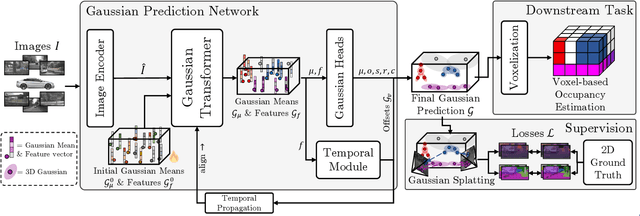
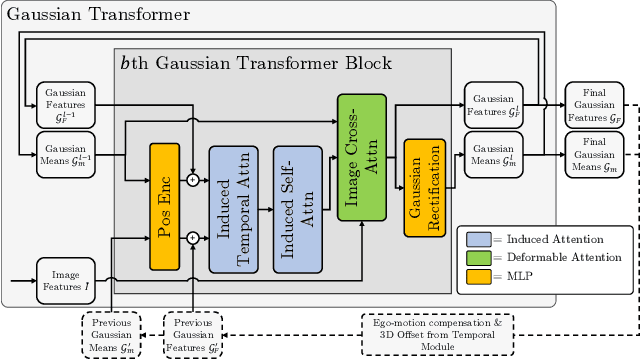
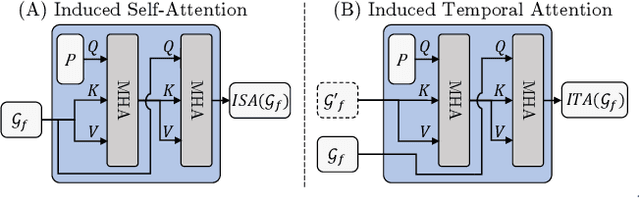
Occupancy estimation has become a prominent task in 3D computer vision, particularly within the autonomous driving community. In this paper, we present a novel approach to occupancy estimation, termed GaussianFlowOcc, which is inspired by Gaussian Splatting and replaces traditional dense voxel grids with a sparse 3D Gaussian representation. Our efficient model architecture based on a Gaussian Transformer significantly reduces computational and memory requirements by eliminating the need for expensive 3D convolutions used with inefficient voxel-based representations that predominantly represent empty 3D spaces. GaussianFlowOcc effectively captures scene dynamics by estimating temporal flow for each Gaussian during the overall network training process, offering a straightforward solution to a complex problem that is often neglected by existing methods. Moreover, GaussianFlowOcc is designed for scalability, as it employs weak supervision and does not require costly dense 3D voxel annotations based on additional data (e.g., LiDAR). Through extensive experimentation, we demonstrate that GaussianFlowOcc significantly outperforms all previous methods for weakly supervised occupancy estimation on the nuScenes dataset while featuring an inference speed that is 50 times faster than current SOTA.
Learned Random Label Predictions as a Neural Network Complexity Metric
Nov 29, 2024We empirically investigate the impact of learning randomly generated labels in parallel to class labels in supervised learning on memorization, model complexity, and generalization in deep neural networks. To this end, we introduce a multi-head network architecture as an extension of standard CNN architectures. Inspired by methods used in fair AI, our approach allows for the unlearning of random labels, preventing the network from memorizing individual samples. Based on the concept of Rademacher complexity, we first use our proposed method as a complexity metric to analyze the effects of common regularization techniques and challenge the traditional understanding of feature extraction and classification in CNNs. Second, we propose a novel regularizer that effectively reduces sample memorization. However, contrary to the predictions of classical statistical learning theory, we do not observe improvements in generalization.
Hatching-Box: Monitoring the Rearing Process of Drosophila Using an Embedded Imaging and in-vial Detection System
Nov 23, 2024


In this paper we propose the Hatching-Box, a novel imaging and analysis system to automatically monitor and quantify the developmental behavior of Drosophila in standard rearing vials and during regular rearing routines, rendering explicit experiments obsolete. This is achieved by combining custom tailored imaging hardware with dedicated detection and tracking algorithms, enabling the quantification of larvae, filled/empty pupae and flies over multiple days. Given the affordable and reproducible design of the Hatching-Box in combination with our generic client/server-based software, the system can easily be scaled to monitor an arbitrary amount of rearing vials simultaneously. We evaluated our system on a curated image dataset comprising nearly 470,000 annotated objects and performed several studies on real world experiments. We successfully reproduced results from well-established circadian experiments by comparing the eclosion periods of wild type flies to the clock mutants $\textit{per}^{short}$, $\textit{per}^{long}$ and $\textit{per}^0$ without involvement of any manual labor. Furthermore we show, that the Hatching-Box is able to extract additional information about group behavior as well as to reconstruct the whole life-cycle of the individual specimens. These results not only demonstrate the applicability of our system for long-term experiments but also indicate its benefits for automated monitoring in the general cultivation process.
Towards Population Scale Testis Volume Segmentation in DIXON MRI
Oct 30, 2024Testis size is known to be one of the main predictors of male fertility, usually assessed in clinical workup via palpation or imaging. Despite its potential, population-level evaluation of testicular volume using imaging remains underexplored. Previous studies, limited by small and biased datasets, have demonstrated the feasibility of machine learning for testis volume segmentation. This paper presents an evaluation of segmentation methods for testicular volume using Magnet Resonance Imaging data from the UKBiobank. The best model achieves a median dice score of $0.87$, compared to median dice score of $0.83$ for human interrater reliability on the same dataset, enabling large-scale annotation on a population scale for the first time. Our overall aim is to provide a trained model, comparative baseline methods, and annotated training data to enhance accessibility and reproducibility in testis MRI segmentation research.