 Add to Chrome
 Add to Firefox
 Add to Edge
C-MOP: Integrating Momentum and Boundary-Aware Clustering for Enhanced Prompt Evolution
Feb 11, 2026
Automatic prompt optimization is a promising direction to boost the performance of Large Language Models (LLMs). However, existing methods often suffer from noisy and conflicting update signals. In this research, we propose C-MOP (Cluster-based Momentum Optimized Prompting), a framework that stabilizes optimization via Boundary-Aware Contrastive Sampling (BACS) and Momentum-Guided Semantic Clustering (MGSC). Specifically, BACS utilizes batch-level information to mine tripartite features--Hard Negatives, Anchors, and Boundary Pairs--to precisely characterize the typical representation and decision boundaries of positive and negative prompt samples. To resolve semantic conflicts, MGSC introduces a textual momentum mechanism with temporal decay that distills persistent consensus from fluctuating gradients across iterations. Extensive experiments demonstrate that C-MOP consistently outperforms SOTA baselines like PromptWizard and ProTeGi, yielding average gains of 1.58% and 3.35%. Notably, C-MOP enables a general LLM with 3B activated parameters to surpass a 70B domain-specific dense LLM, highlighting its effectiveness in driving precise prompt evolution. The code is available at https://github.com/huawei-noah/noah-research/tree/master/C-MOP.

MoRAgent: Parameter Efficient Agent Tuning with Mixture-of-Roles
Dec 25, 2025Despite recent advancements of fine-tuning large language models (LLMs) to facilitate agent tasks, parameter-efficient fine-tuning (PEFT) methodologies for agent remain largely unexplored. In this paper, we introduce three key strategies for PEFT in agent tasks: 1) Inspired by the increasingly dominant Reason+Action paradigm, we first decompose the capabilities necessary for the agent tasks into three distinct roles: reasoner, executor, and summarizer. The reasoner is responsible for comprehending the user's query and determining the next role based on the execution trajectory. The executor is tasked with identifying the appropriate functions and parameters to invoke. The summarizer conveys the distilled information from conversations back to the user. 2) We then propose the Mixture-of-Roles (MoR) framework, which comprises three specialized Low-Rank Adaptation (LoRA) groups, each designated to fulfill a distinct role. By focusing on their respective specialized capabilities and engaging in collaborative interactions, these LoRAs collectively accomplish the agent task. 3) To effectively fine-tune the framework, we develop a multi-role data generation pipeline based on publicly available datasets, incorporating role-specific content completion and reliability verification. We conduct extensive experiments and thorough ablation studies on various LLMs and agent benchmarks, demonstrating the effectiveness of the proposed method. This project is publicly available at https://mor-agent.github.io.
CFinBench: A Comprehensive Chinese Financial Benchmark for Large Language Models
Jul 02, 2024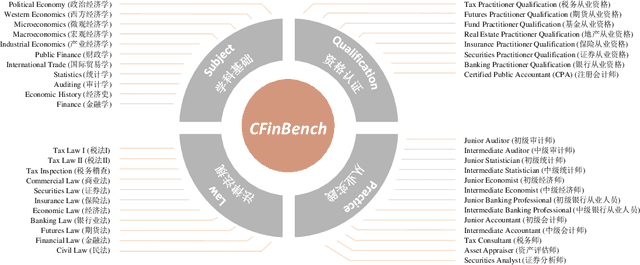
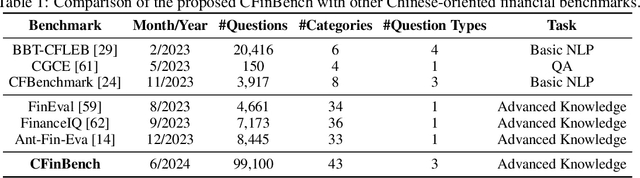
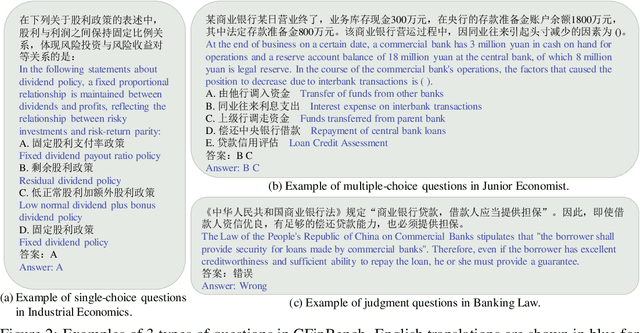
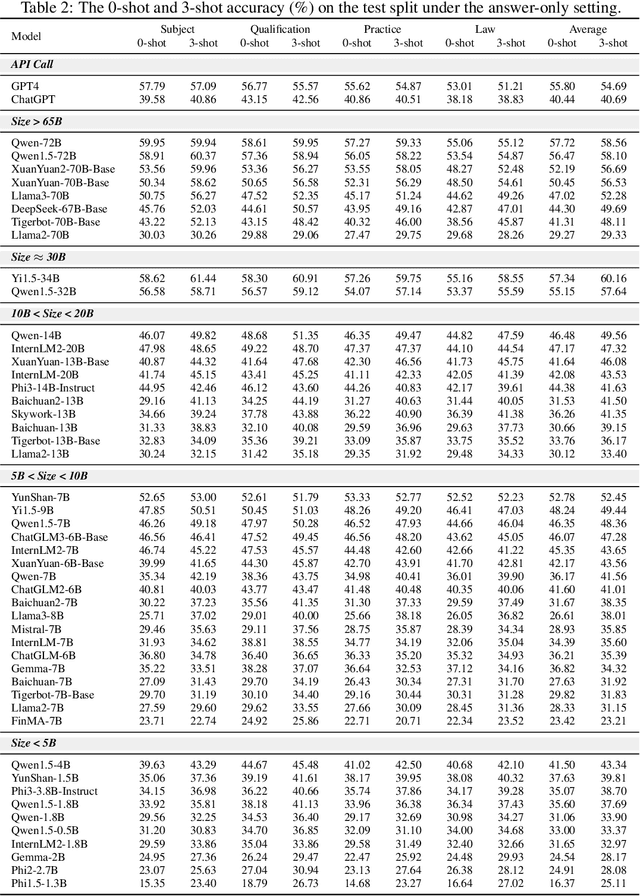
Large language models (LLMs) have achieved remarkable performance on various NLP tasks, yet their potential in more challenging and domain-specific task, such as finance, has not been fully explored. In this paper, we present CFinBench: a meticulously crafted, the most comprehensive evaluation benchmark to date, for assessing the financial knowledge of LLMs under Chinese context. In practice, to better align with the career trajectory of Chinese financial practitioners, we build a systematic evaluation from 4 first-level categories: (1) Financial Subject: whether LLMs can memorize the necessary basic knowledge of financial subjects, such as economics, statistics and auditing. (2) Financial Qualification: whether LLMs can obtain the needed financial qualified certifications, such as certified public accountant, securities qualification and banking qualification. (3) Financial Practice: whether LLMs can fulfill the practical financial jobs, such as tax consultant, junior accountant and securities analyst. (4) Financial Law: whether LLMs can meet the requirement of financial laws and regulations, such as tax law, insurance law and economic law. CFinBench comprises 99,100 questions spanning 43 second-level categories with 3 question types: single-choice, multiple-choice and judgment. We conduct extensive experiments of 50 representative LLMs with various model size on CFinBench. The results show that GPT4 and some Chinese-oriented models lead the benchmark, with the highest average accuracy being 60.16%, highlighting the challenge presented by CFinBench. The dataset and evaluation code are available at https://cfinbench.github.io/.