 Add to Chrome
 Add to Firefox
 Add to Edge
SATMapTR: Satellite Image Enhanced Online HD Map Construction
Dec 12, 2025
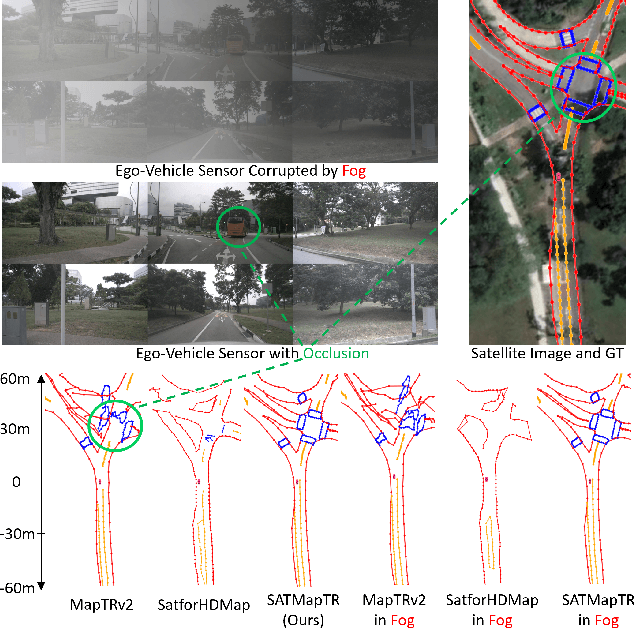
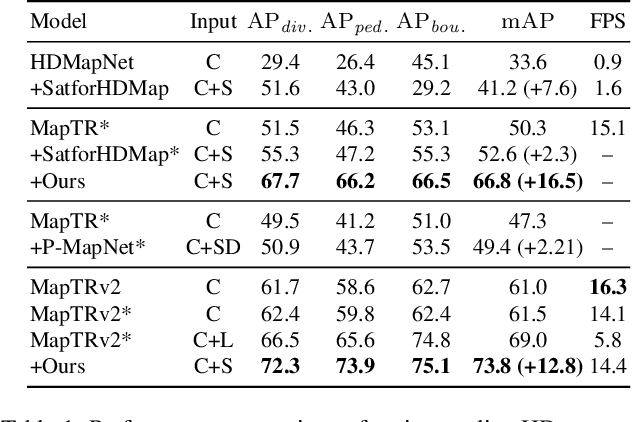
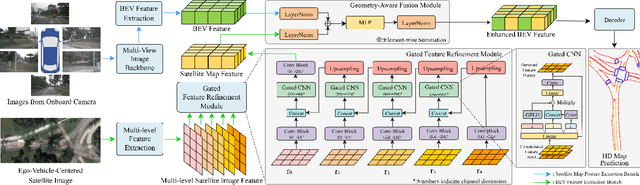
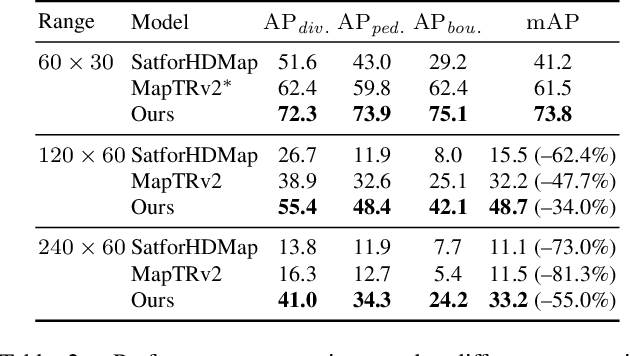
High-definition (HD) maps are evolving from pre-annotated to real-time construction to better support autonomous driving in diverse scenarios. However, this process is hindered by low-quality input data caused by onboard sensors limited capability and frequent occlusions, leading to incomplete, noisy, or missing data, and thus reduced mapping accuracy and robustness. Recent efforts have introduced satellite images as auxiliary input, offering a stable, wide-area view to complement the limited ego perspective. However, satellite images in Bird's Eye View are often degraded by shadows and occlusions from vegetation and buildings. Prior methods using basic feature extraction and fusion remain ineffective. To address these challenges, we propose SATMapTR, a novel online map construction model that effectively fuses satellite image through two key components: (1) a gated feature refinement module that adaptively filters satellite image features by integrating high-level semantics with low-level structural cues to extract high signal-to-noise ratio map-relevant representations; and (2) a geometry-aware fusion module that consistently fuse satellite and BEV features at a grid-to-grid level, minimizing interference from irrelevant regions and low-quality inputs. Experimental results on the nuScenes dataset show that SATMapTR achieves the highest mean average precision (mAP) of 73.8, outperforming state-of-the-art satellite-enhanced models by up to 14.2 mAP. It also shows lower mAP degradation under adverse weather and sensor failures, and achieves nearly 3 times higher mAP at extended perception ranges.

SlimSeiz: Efficient Channel-Adaptive Seizure Prediction Using a Mamba-Enhanced Network
Oct 13, 2024Epileptic seizures cause abnormal brain activity, and their unpredictability can lead to accidents, underscoring the need for long-term seizure prediction. Although seizures can be predicted by analyzing electroencephalogram (EEG) signals, existing methods often require too many electrode channels or larger models, limiting mobile usability. This paper introduces a SlimSeiz framework that utilizes adaptive channel selection with a lightweight neural network model. SlimSeiz operates in two states: the first stage selects the optimal channel set for seizure prediction using machine learning algorithms, and the second stage employs a lightweight neural network based on convolution and Mamba for prediction. On the Children's Hospital Boston-MIT (CHB-MIT) EEG dataset, SlimSeiz can reduce channels from 22 to 8 while achieving a satisfactory result of 94.8% accuracy, 95.5% sensitivity, and 94.0% specificity with only 21.2K model parameters, matching or outperforming larger models' performance. We also validate SlimSeiz on a new EEG dataset, SRH-LEI, collected from Shanghai Renji Hospital, demonstrating its effectiveness across different patients. The code and SRH-LEI dataset are available at https://github.com/guoruilu/SlimSeiz.