 Add to Chrome
 Add to Firefox
 Add to Edge
Yuvion LLM: An Adversarially-Aware Large Language Model for Content And AI Safety
Jun 26, 2026
As large language models are increasingly deployed in real-world systems, safety failures can still lead to harmful outputs and dangerous misuse. We argue that the essence of safety is adversarial: many failures arise not from natural inputs alone, but from strategic attempts to evade model policies and safeguards. However, existing general-purpose model development largely overlook this adversarial nature, and often remain insufficient for realistic safety scenarios involving planning, tool use, and multi-step reasoning, causing measured safety performance to overestimate real deployment robustness. To address this gap, we present Yuvion LLM, a large language model built for adversarially robust content safety and broader AI safety. Yuvion LLM treats adversarial robustness and agentic capability as first-class objectives. Its pipeline combines adversarially aware data construction, knowledge-enhanced continued pretraining, and policy-grounded multi-task safety post-training, including risk-aware supervised fine-tuning and reinforcement learning-based policy optimization, together with safety-aware agentic reinforcement learning for tool use and multi-step reasoning in complex safety scenarios. We further introduce the Yuvion LLM RiskEval (YLRE), a collection of 93 benchmarks across four evaluation categories, covering diverse open and internal evaluations with a focus on safety, adversarial robustness, and real-world capability requirements. Across these evaluations, Yuvion LLM demonstrates clear advantages on safety-focused benchmarks and particularly strong robustness under adversarial conditions, while maintaining solid overall capability. Notably, Yuvion-8B outperforms most state-of-the-art baselines, including substantially larger models such as GPT-5.4 and Qwen3-MAX, on several safety tasks.

Yuvion VL: A Multimodal Foundation Model for Adversarial Content and AI Safety
Jun 23, 2026General-purpose models often struggle to reliably identify and understand real-world multimodal risks, largely due to the inherent multimodal adversarial nature of content and AI safety. We present Yuvion VL, a family of multimodal large language models purpose-built for content and AI safety, with both instruction-tuned and reasoning-oriented variants. Yuvion VL addresses this gap by treating safety as an inherently adversarial and multimodal problem and designing the entire pipeline around adversarial robustness. For data construction, we develop an automated pipeline integrating adversarial-aware data synthesis with multi-stage quality control, producing large-scale, high-quality multimodal samples augmented with domain knowledge and reasoning annotations. For training, we adopt a three-stage pipeline that includes continued pretraining for risk-concept cross-modal alignment, instruct post-training for production-grade safety tasks, and reasoning post-training for enhanced interpretability and performance in complex tasks. We further introduce Confuse-then-Contrast Fine-Tuning, a contrastive framework that mines model-specific confusions and constructs multi-image contrastive groups to enforce explicit discrimination of fine-grained visual-semantic elements, enabling the model to distinguish between visually similar cases with different safety implications in adversarial safety tasks. To support rigorous evaluation, we further introduce Yuvion VL RiskEval (YVRE), a collection of benchmarks covering diverse open and internal evaluations, with a focus on content and AI safety, adversarial robustness, and real-world capability requirements. Experiments show that Yuvion VL-32B achieves industry-leading safety performance, surpassing comparably sized open-source models and best closed-source commercial models, while maintaining comparable general capabilities.
From Context-Aware to Conflict-Aware: Generalizing Contrastive Decoding for Knowledge Conflict in LLMs
Jun 09, 2026When large language models generate from retrieved or augmented contexts, conflicts between external context and parametric priors remain a central reliability bottleneck. Existing contrastive decoding methods follow a \emph{context-aware} paradigm that unilaterally amplifies context over parametric priors, overwriting correct priors when the context is erroneous. We generalize this to the \textbf{conflict-aware} paradigm that dynamically allocates authority between prior and context based on conflict signals, rather than presupposing context trustworthiness. We show that the affine combination of prior and context logits yields a \textbf{power family} with an inherent \textbf{regime asymmetry}: extrapolation amplifies errors unboundedly when the prior is correct, interpolation under-corrects when the context is correct, and no static regime covers both. Existing contrastive decoding methods are instances of this family, mostly extrapolative. To evaluate both conflict directions, we propose TriState-Bench, a model-aware evaluation protocol that calibrates per-model prior knowledge to measure three conflict states: correction, resistance, and agreement. To resolve the asymmetry, we propose Adaptive Regime Routing (ARR), which routes between regimes at each step, lifting resistance EM from below 6 to 16--33 without sacrificing correction or agreement. Our code is available at https://github.com/keith-Jiang/conflict-aware-decoding.
ConsisGuard: Aligning Safety Deliberation with Policy Enforcement in LLM Guardrails
May 29, 2026Reasoning-based LLM guardrails improve safety moderation by generating explicit rationales before issuing final decisions. However, their rationales do not always lead to faithful enforcement: a model may recognize a harmful intent in its reasoning but still predict a safe label, or issue an unsafe decision without policy-grounded justification. We identify this safety-critical failure mode as the deliberation-to-enforcement gap. Unlike general chain-of-thought faithfulness, guardrail reliability requires policy execution consistency: the generated reasoning should be grounded in the safety policy, and the final decision should be entailed by that reasoning. We propose ConsisGuard, a consistency-aware framework for reasoning-based LLM guardrails. ConsisGuard performs Policy-to-Decision Trajectory Distillation and Functional Coupling Alignment, aligning the internal coupling between safety deliberation and decision enforcement. Experiments on prompt and response harmfulness detection benchmarks show that ConsisGuard improves detection performance while reducing policy execution failures. These results suggest that reliable reasoning-based guardrails require accurate faithful execution of safety policies.
Make LLM Learn to Synthesize from Streaming Experiences through Feedback
May 28, 2026Large language models (LLMs) have been widely adopted for synthetic data generation, significantly reducing annotation costs. However, most existing studies treat synthesis as a set of isolated tasks and overlook a more fundamental question: whether a model can learn to synthesize by accumulating experience from past tasks and transferring it to future ones. In this work, we introduce StreamSynth, a new setting in which synthesis tasks arrive sequentially and experience from historical tasks provides informative signals for future synthesis. To address this setting, we propose SynLearner, a general framework that enables synthesis models to acquire reusable synthesis experience over a task stream. Instead of generating data independently for each task, SynLearner encourages the model to explore diverse synthesis patterns, learn from feedback, and balance sample quality with set-level diversity as tasks evolve. Extensive experiments across multiple benchmarks show that SynLearner effectively leverages experience from earlier tasks to improve synthesis performance on later ones, exhibiting consistent cross-task transferability. These findings provide evidence for the feasibility of StreamSynth and highlight synthetic data generation as an experience-driven process that can benefit from task streams.
Robust and Generalizable Safety Steering for Text-to-Image Diffusion Transformers
May 28, 2026Diffusion Transformers have become a powerful backbone for text-to-image generation, but their layered and cross-modal generation process makes safety control fundamentally different from prompt-level filtering or output-level detection. Harmful semantics may be weakly expressed in text representations, progressively bound to visual latents, and finally entangled with rendering dynamics. As a result, safety steering at a fixed layer can be unstable, and a steering mechanism learned from known risks may not transfer reliably to a shifted target risk domain. We propose SafeDIG, a safety steering framework that formulates DiT safety adaptation as position-aware sparse feature transfer. SafeDIG first constructs Sparse Autoencoders over functionally distinct DiT intervention positions and uses robustness-aware pre-training routing to prioritize intervention sites that are expected to remain stable under source-target risk shift. It then separates transferable safety features from domain-specific activation geometry by freezing the SAE encoder as a reusable sparse safety dictionary and adapting only the decoder to the target-domain activation manifold. During inference, SafeDIG combines Blend and Repel operations to steer unsafe activations toward transferred safety manifolds or away from harmful sparse directions. Experiments on FLUX.1 Dev and Stable Diffusion 3.5 Large show that SafeDIG consistently reduces target-domain and overall unsafe generation rates while preserving source-domain safety and image quality.
Counterfactual Adversarial Learning with Representation Interpolation
Sep 10, 2021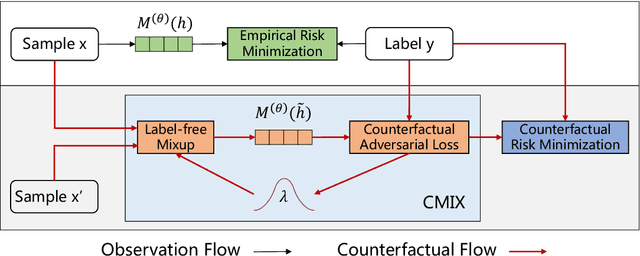
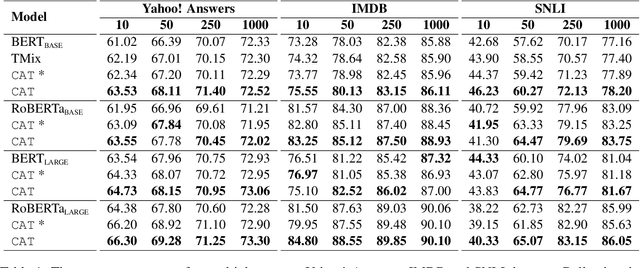
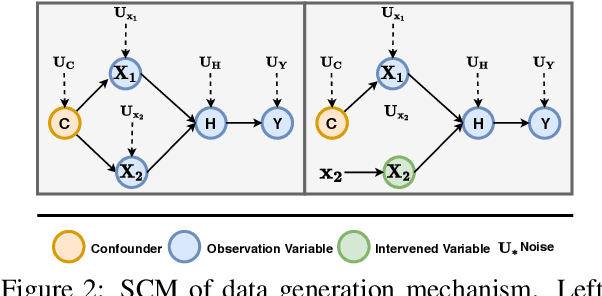
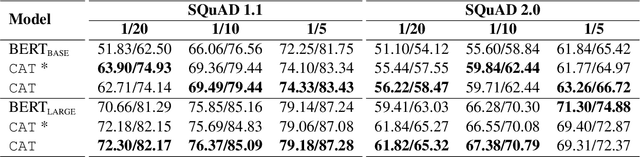
Deep learning models exhibit a preference for statistical fitting over logical reasoning. Spurious correlations might be memorized when there exists statistical bias in training data, which severely limits the model performance especially in small data scenarios. In this work, we introduce Counterfactual Adversarial Training framework (CAT) to tackle the problem from a causality perspective. Particularly, for a specific sample, CAT first generates a counterfactual representation through latent space interpolation in an adversarial manner, and then performs Counterfactual Risk Minimization (CRM) on each original-counterfactual pair to adjust sample-wise loss weight dynamically, which encourages the model to explore the true causal effect. Extensive experiments demonstrate that CAT achieves substantial performance improvement over SOTA across different downstream tasks, including sentence classification, natural language inference and question answering.