 Add to Chrome
 Add to Firefox
 Add to Edge
Unlocking the Pre-Trained Model as a Dual-Alignment Calibrator for Post-Trained LLMs
Jan 07, 2026
Post-training improves large language models (LLMs) but often worsens confidence calibration, leading to systematic overconfidence. Recent unsupervised post-hoc methods for post-trained LMs (PoLMs) mitigate this by aligning PoLM confidence to that of well-calibrated pre-trained counterparts. However, framing calibration as static output-distribution matching overlooks the inference-time dynamics introduced by post-training. In particular, we show that calibration errors arise from two regimes: (i) confidence drift, where final confidence inflates despite largely consistent intermediate decision processes, and (ii) process drift, where intermediate inference pathways diverge. Guided by this diagnosis, we propose Dual-Align, an unsupervised post-hoc framework for dual alignment in confidence calibration. Dual-Align performs confidence alignment to correct confidence drift via final-distribution matching, and introduces process alignment to address process drift by locating the layer where trajectories diverge and realigning the stability of subsequent inference. This dual strategy learns a single temperature parameter that corrects both drift types without sacrificing post-training performance gains. Experiments show consistent improvements over baselines, reducing calibration errors and approaching a supervised oracle.

CaveAgent: Transforming LLMs into Stateful Runtime Operators
Jan 04, 2026LLM-based agents are increasingly capable of complex task execution, yet current agentic systems remain constrained by text-centric paradigms. Traditional approaches rely on procedural JSON-based function calling, which often struggles with long-horizon tasks due to fragile multi-turn dependencies and context drift. In this paper, we present CaveAgent, a framework that transforms the paradigm from "LLM-as-Text-Generator" to "LLM-as-Runtime-Operator." We introduce a Dual-stream Context Architecture that decouples state management into a lightweight semantic stream for reasoning and a persistent, deterministic Python Runtime stream for execution. In addition to leveraging code generation to efficiently resolve interdependent sub-tasks (e.g., loops, conditionals) in a single step, we introduce \textit{Stateful Runtime Management} in CaveAgent. Distinct from existing code-based approaches that remain text-bound and lack the support for external object injection and retrieval, CaveAgent injects, manipulates, and retrieves complex Python objects (e.g., DataFrames, database connections) that persist across turns. This persistence mechanism acts as a high-fidelity external memory to eliminate context drift, avoid catastrophic forgetting, while ensuring that processed data flows losslessly to downstream applications. Comprehensive evaluations on Tau$^2$-bench, BFCL and various case studies across representative SOTA LLMs demonstrate CaveAgent's superiority. Specifically, our framework achieves a 10.5\% success rate improvement on retail tasks and reduces total token consumption by 28.4\% in multi-turn scenarios. On data-intensive tasks, direct variable storage and retrieval reduces token consumption by 59\%, allowing CaveAgent to handle large-scale data that causes context overflow failures in both JSON-based and Code-based agents.
Your Pre-trained LLM is Secretly an Unsupervised Confidence Calibrator
May 22, 2025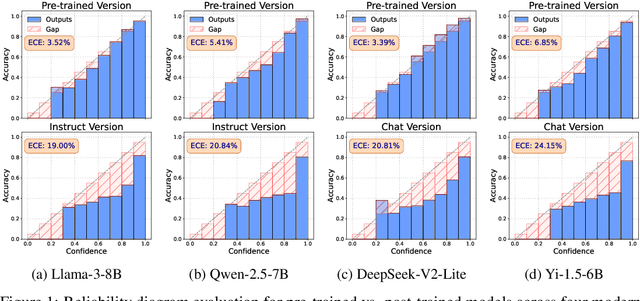
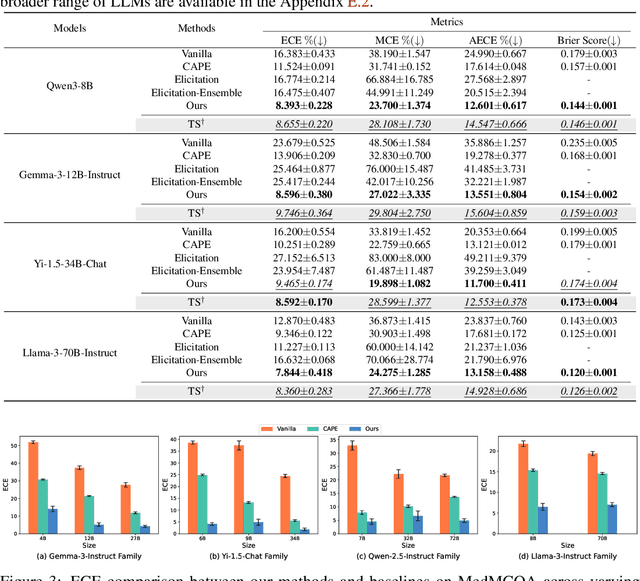
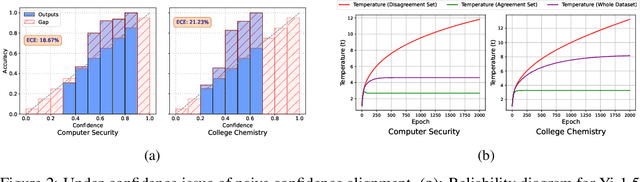

Post-training of large language models is essential for adapting pre-trained language models (PLMs) to align with human preferences and downstream tasks. While PLMs typically exhibit well-calibrated confidence, post-trained language models (PoLMs) often suffer from over-confidence, assigning high confidence to both correct and incorrect outputs, which can undermine reliability in critical applications. A major obstacle in calibrating PoLMs is the scarcity of labeled data for individual downstream tasks. To address this, we propose Disagreement-Aware Confidence Alignment (DACA), a novel unsupervised method to optimize the parameters (e.g., temperature $\tau$) in post-hoc confidence calibration. Our method is motivated by the under-confidence issue caused by prediction disagreement between the PLM and PoLM while aligning their confidence via temperature scaling. Theoretically, the PLM's confidence underestimates PoLM's prediction accuracy on disagreement examples, causing a larger $\tau$ and producing under-confident predictions. DACA mitigates this by selectively using only agreement examples for calibration, effectively decoupling the influence of disagreement. In this manner, our method avoids an overly large $\tau$ in temperature scaling caused by disagreement examples, improving calibration performance. Extensive experiments demonstrate the effectiveness of our method, improving the average ECE of open-sourced and API-based LLMs (e.g. GPT-4o) by up to 15.08$\%$ on common benchmarks.