 Add to Chrome
 Add to Firefox
 Add to Edge
MVP-Nav: Multi-layer Value Map Planner Navigator
Jun 30, 2026
Zero-shot Object Goal Navigation (ZSON) with RGB-only perception poses a fundamental challenge for embodied agents, as the absence of explicit depth information introduces severe physical uncertainty and semantic-physical misalignment. Existing approaches either rely on high-level semantic reasoning without geometric grounding or learn end-to-end policies that lack explicit physical constraints, often resulting in semantically plausible but physically unsafe behaviors. In this paper, we propose MVP-Nav, a physical-aware RGB-only navigation framework that aligns perception, planning, and control with the real 3D world. MVP-Nav reconstructs explicit physical occupancy from monocular observations by leveraging 3D foundation models to project 2D semantic instances into 3D oriented bounding boxes, forming a global spatial semantic representation. To unify high-level semantic reasoning and low-level physical constraints, we introduce a Multi-layer Value Map (MVM) that integrates semantic priorities and reconstructed geometry into a shared cost space, enabling physically grounded geometric planning. Extensive experiments on zero-shot object navigation benchmarks demonstrate that MVP-Nav significantly outperforms existing depth-free methods, achieving state-of-the-art performance and validating that structured physical priors can effectively compensate for the absence of active depth sensors.

RelAfford6D: Relational 6D Affordance Graphs for Constraint-Driven Robotic Manipulation
Jun 25, 2026Bridging abstract semantics and precise physical control remains a fundamental challenge in open-world robotic manipulation. While recent data-driven policies show promise, their reliance on isolated contact points or latent affordance embeddings lacks the rigorous kinematic constraints necessary for complex articulated objects.To overcome the limitation, we introduce RelAfford6D, a novel training-free framework centered on a Relational 6D Affordance Graph. Given a free-form instruction, our system deduces a semantic topology linking a primary interacting part to its physical anchor. By elevating these topological nodes into precise metric $SE(3)$ poses via vision foundation models, we analytically formulate downstream execution as a kinematic constraint satisfaction problem. The robot synthesizes continuous trajectories by tracking strictly defined physical manifolds (e.g., revolute or prismatic orbits). Coupled with a closed-loop tracking mechanism for dynamic replanning against disturbances, our physically grounded approach achieves superior zero-shot success rates, cross-category generalization and execution robustness in both simulation and the real world environments, outperforming existing data-driven baselines.
Task Indicating Transformer for Task-conditional Dense Predictions
Mar 01, 2024
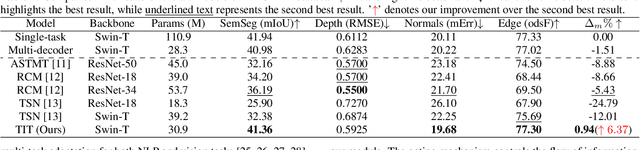


The task-conditional model is a distinctive stream for efficient multi-task learning. Existing works encounter a critical limitation in learning task-agnostic and task-specific representations, primarily due to shortcomings in global context modeling arising from CNN-based architectures, as well as a deficiency in multi-scale feature interaction within the decoder. In this paper, we introduce a novel task-conditional framework called Task Indicating Transformer (TIT) to tackle this challenge. Our approach designs a Mix Task Adapter module within the transformer block, which incorporates a Task Indicating Matrix through matrix decomposition, thereby enhancing long-range dependency modeling and parameter-efficient feature adaptation by capturing intra- and inter-task features. Moreover, we propose a Task Gate Decoder module that harnesses a Task Indicating Vector and gating mechanism to facilitate adaptive multi-scale feature refinement guided by task embeddings. Experiments on two public multi-task dense prediction benchmarks, NYUD-v2 and PASCAL-Context, demonstrate that our approach surpasses state-of-the-art task-conditional methods.
RAFT-MSF: Self-Supervised Monocular Scene Flow using Recurrent Optimizer
May 03, 2022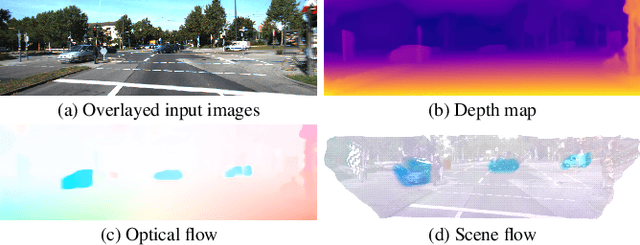
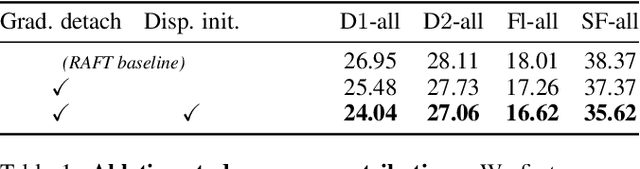
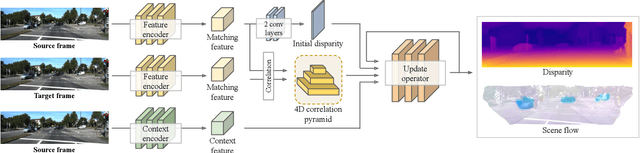
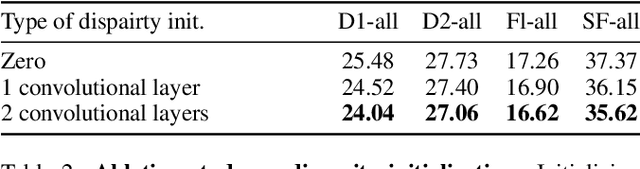
Learning scene flow from a monocular camera still remains a challenging task due to its ill-posedness as well as lack of annotated data. Self-supervised methods demonstrate learning scene flow estimation from unlabeled data, yet their accuracy lags behind (semi-)supervised methods. In this paper, we introduce a self-supervised monocular scene flow method that substantially improves the accuracy over the previous approaches. Based on RAFT, a state-of-the-art optical flow model, we design a new decoder to iteratively update 3D motion fields and disparity maps simultaneously. Furthermore, we propose an enhanced upsampling layer and a disparity initialization technique, which overall further improves accuracy up to 7.2%. Our method achieves state-of-the-art accuracy among all self-supervised monocular scene flow methods, improving accuracy by 34.2%. Our fine-tuned model outperforms the best previous semi-supervised method with 228 times faster runtime. Code will be publicly available.
Temporal Continuity Based Unsupervised Learning for Person Re-Identification
Sep 01, 2020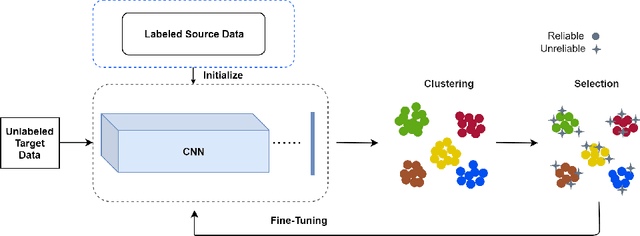
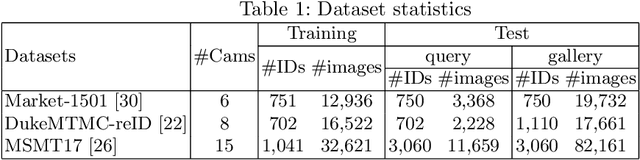
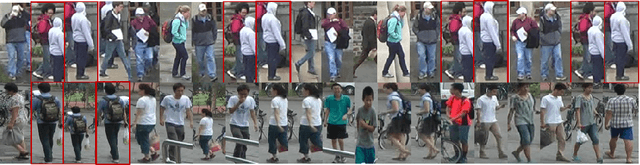
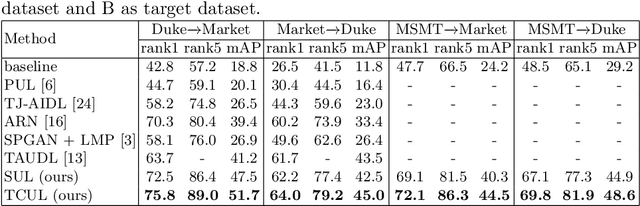
Person re-identification (re-id) aims to match the same person from images taken across multiple cameras. Most existing person re-id methods generally require a large amount of identity labeled data to act as discriminative guideline for representation learning. Difficulty in manually collecting identity labeled data leads to poor adaptability in practical scenarios. To overcome this problem, we propose an unsupervised center-based clustering approach capable of progressively learning and exploiting the underlying re-id discriminative information from temporal continuity within a camera. We call our framework Temporal Continuity based Unsupervised Learning (TCUL). Specifically, TCUL simultaneously does center based clustering of unlabeled (target) dataset and fine-tunes a convolutional neural network (CNN) pre-trained on irrelevant labeled (source) dataset to enhance discriminative capability of the CNN for the target dataset. Furthermore, it exploits temporally continuous nature of images within-camera jointly with spatial similarity of feature maps across-cameras to generate reliable pseudo-labels for training a re-identification model. As the training progresses, number of reliable samples keep on growing adaptively which in turn boosts representation ability of the CNN. Extensive experiments on three large-scale person re-id benchmark datasets are conducted to compare our framework with state-of-the-art techniques, which demonstrate superiority of TCUL over existing methods.
FH-GAN: Face Hallucination and Recognition using Generative Adversarial Network
May 16, 2019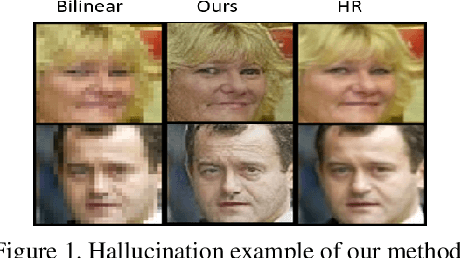
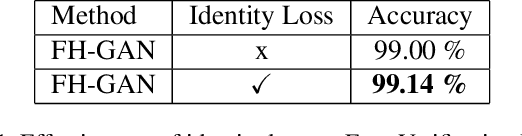
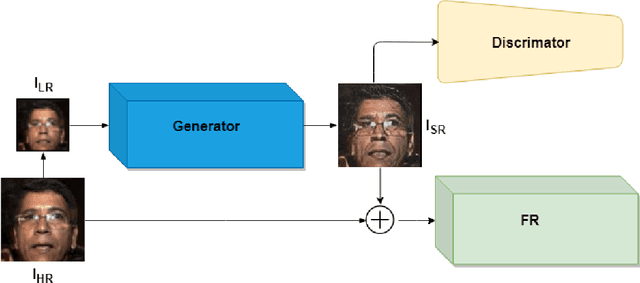
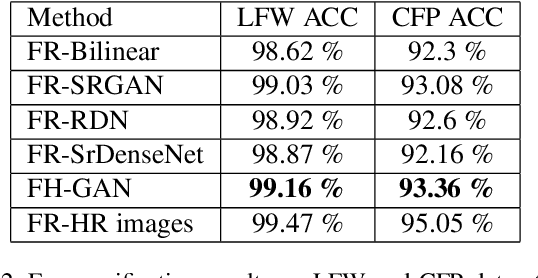
There are many factors affecting visual face recognition, such as low resolution images, aging, illumination and pose variance, etc. One of the most important problem is low resolution face images which can result in bad performance on face recognition. Most of the general face recognition algorithms usually assume a sufficient resolution for the face images. However, in practice many applications often do not have sufficient image resolutions. The modern face hallucination models demonstrate reasonable performance to reconstruct high-resolution images from its corresponding low resolution images. However, they do not consider identity level information during hallucination which directly affects results of the recognition of low resolution faces. To address this issue, we propose a Face Hallucination Generative Adversarial Network (FH-GAN) which improves the quality of low resolution face images and accurately recognize those low quality images. Concretely, we make the following contributions: 1) we propose FH-GAN network, an end-to-end system, that improves both face hallucination and face recognition simultaneously. The novelty of this proposed network depends on incorporating identity information in a GAN-based face hallucination algorithm via combining a face recognition network for identity preserving. 2) We also propose a new face hallucination network, namely Dense Sparse Network (DSNet), which improves upon the state-of-art in face hallucination. 3) We demonstrate benefits of training the face recognition and GAN-based DSNet jointly by reporting good result on face hallucination and recognition.
Spatial Shortcut Network for Human Pose Estimation
Apr 05, 2019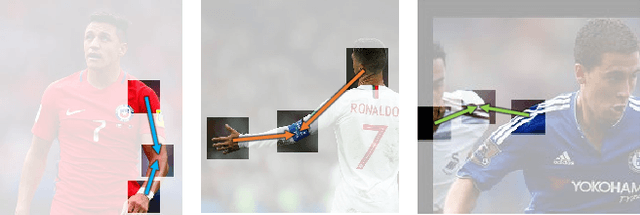
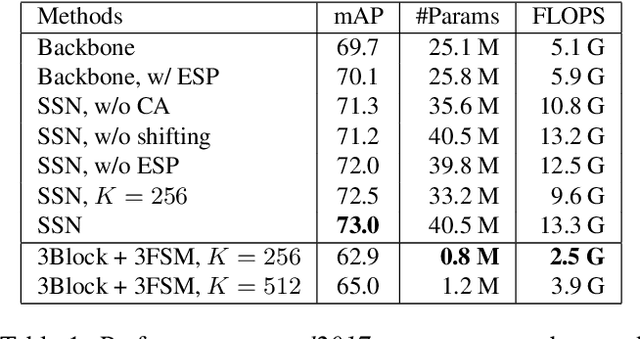
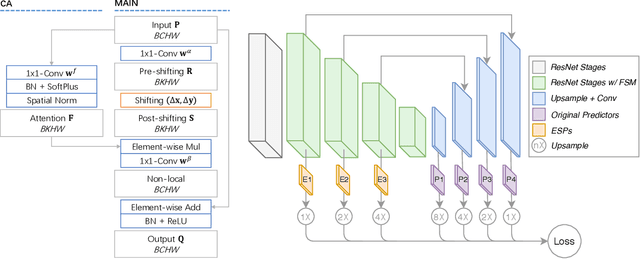
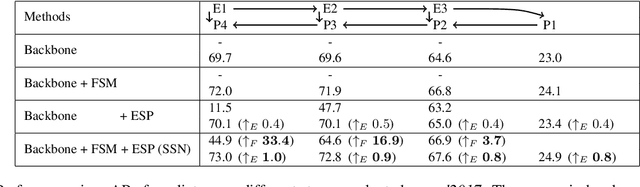
Like many computer vision problems, human pose estimation is a challenging problem in that recognizing a body part requires not only information from local area but also from areas with large spatial distance. In order to spatially pass information, large convolutional kernels and deep layers have been normally used, introducing high computation cost and large parameter space. Luckily for pose estimation, human body is geometrically structured in images, enabling modeling of spatial dependency. In this paper, we propose a spatial shortcut network for pose estimation task, where information is easier to flow spatially. We evaluate our model with detailed analyses and present its outstanding performance with smaller structure.