 Add to Chrome
 Add to Firefox
 Add to Edge
MVP-Nav: Multi-layer Value Map Planner Navigator
Jun 30, 2026
Zero-shot Object Goal Navigation (ZSON) with RGB-only perception poses a fundamental challenge for embodied agents, as the absence of explicit depth information introduces severe physical uncertainty and semantic-physical misalignment. Existing approaches either rely on high-level semantic reasoning without geometric grounding or learn end-to-end policies that lack explicit physical constraints, often resulting in semantically plausible but physically unsafe behaviors. In this paper, we propose MVP-Nav, a physical-aware RGB-only navigation framework that aligns perception, planning, and control with the real 3D world. MVP-Nav reconstructs explicit physical occupancy from monocular observations by leveraging 3D foundation models to project 2D semantic instances into 3D oriented bounding boxes, forming a global spatial semantic representation. To unify high-level semantic reasoning and low-level physical constraints, we introduce a Multi-layer Value Map (MVM) that integrates semantic priorities and reconstructed geometry into a shared cost space, enabling physically grounded geometric planning. Extensive experiments on zero-shot object navigation benchmarks demonstrate that MVP-Nav significantly outperforms existing depth-free methods, achieving state-of-the-art performance and validating that structured physical priors can effectively compensate for the absence of active depth sensors.

Light-VQA+: A Video Quality Assessment Model for Exposure Correction with Vision-Language Guidance
May 06, 2024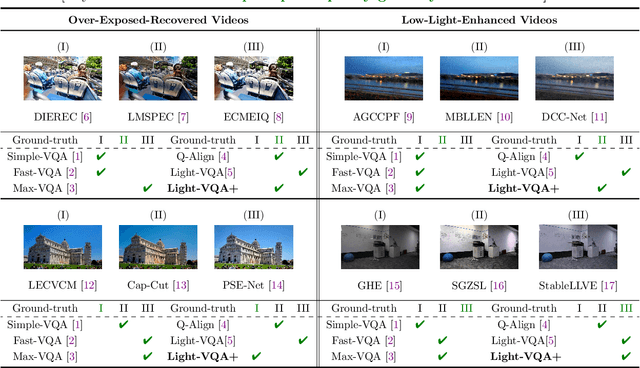
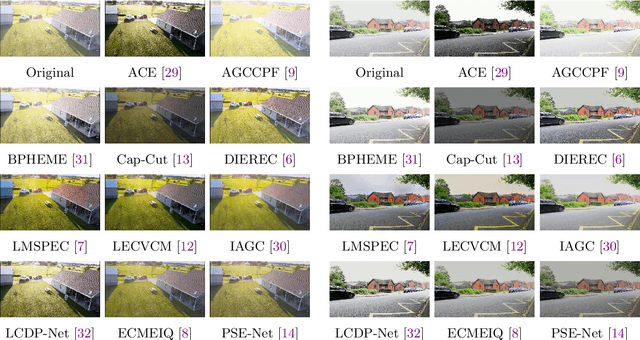
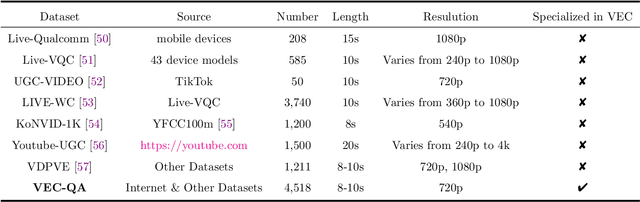
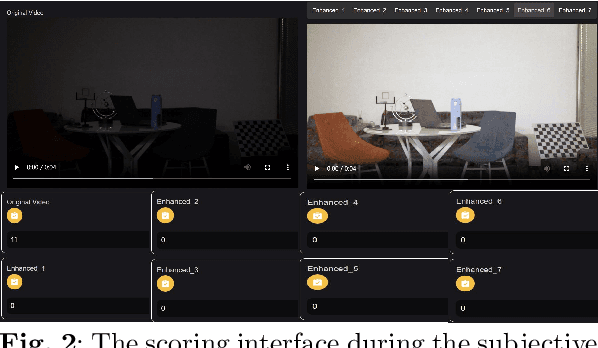
Recently, User-Generated Content (UGC) videos have gained popularity in our daily lives. However, UGC videos often suffer from poor exposure due to the limitations of photographic equipment and techniques. Therefore, Video Exposure Correction (VEC) algorithms have been proposed, Low-Light Video Enhancement (LLVE) and Over-Exposed Video Recovery (OEVR) included. Equally important to the VEC is the Video Quality Assessment (VQA). Unfortunately, almost all existing VQA models are built generally, measuring the quality of a video from a comprehensive perspective. As a result, Light-VQA, trained on LLVE-QA, is proposed for assessing LLVE. We extend the work of Light-VQA by expanding the LLVE-QA dataset into Video Exposure Correction Quality Assessment (VEC-QA) dataset with over-exposed videos and their corresponding corrected versions. In addition, we propose Light-VQA+, a VQA model specialized in assessing VEC. Light-VQA+ differs from Light-VQA mainly from the usage of the CLIP model and the vision-language guidance during the feature extraction, followed by a new module referring to the Human Visual System (HVS) for more accurate assessment. Extensive experimental results show that our model achieves the best performance against the current State-Of-The-Art (SOTA) VQA models on the VEC-QA dataset and other public datasets.
Light-VQA: A Multi-Dimensional Quality Assessment Model for Low-Light Video Enhancement
May 16, 2023
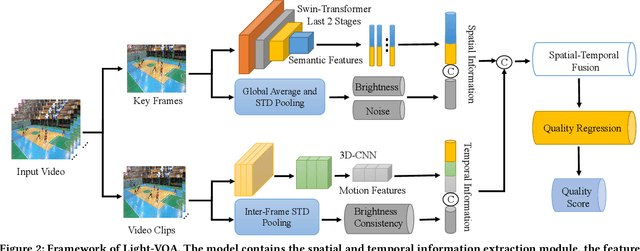
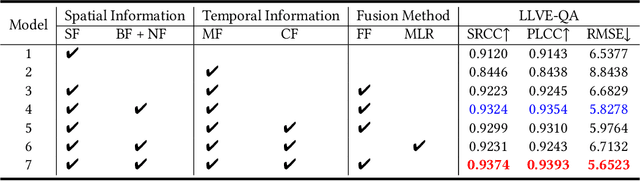

Recently, Users Generated Content (UGC) videos becomes ubiquitous in our daily lives. However, due to the limitations of photographic equipments and techniques, UGC videos often contain various degradations, in which one of the most visually unfavorable effects is the underexposure. Therefore, corresponding video enhancement algorithms such as Low-Light Video Enhancement (LLVE) have been proposed to deal with the specific degradation. However, different from video enhancement algorithms, almost all existing Video Quality Assessment (VQA) models are built generally rather than specifically, which measure the quality of a video from a comprehensive perspective. To the best of our knowledge, there is no VQA model specially designed for videos enhanced by LLVE algorithms. To this end, we first construct a Low-Light Video Enhancement Quality Assessment (LLVE-QA) dataset in which 254 original low-light videos are collected and then enhanced by leveraging 8 LLVE algorithms to obtain 2,060 videos in total. Moreover, we propose a quality assessment model specialized in LLVE, named Light-VQA. More concretely, since the brightness and noise have the most impact on low-light enhanced VQA, we handcraft corresponding features and integrate them with deep-learning-based semantic features as the overall spatial information. As for temporal information, in addition to deep-learning-based motion features, we also investigate the handcrafted brightness consistency among video frames, and the overall temporal information is their concatenation. Subsequently, spatial and temporal information is fused to obtain the quality-aware representation of a video. Extensive experimental results show that our Light-VQA achieves the best performance against the current State-Of-The-Art (SOTA) on LLVE-QA and public dataset. Dataset and Codes can be found at https://github.com/wenzhouyidu/Light-VQA.