 Add to Chrome
 Add to Firefox
 Add to Edge
Depth-Dominant Skeleton Detection for Natural Scenes
Aug 17, 2026
To date, all natural scene skeleton detection follows the paradigm of taking RGB images as the sole input; despite notable progress, methods under this paradigm suffer significant performance degradation on complex-content images. We observe that depth images are inherently insensitive to color and texture, and can provide clear regional contours and inter-region spatial relationships, which naturally alleviates the difficulty of skeleton detection in complex scenarios. Motivated by this observation, this paper proposes for the first time a novel skeleton detection paradigm where depth images serve as the dominant modality and RGB images act as the auxiliary, and accordingly presents a model DDSkel (short for Depth-Dominant Skeleton Detection) under this paradigm. DDSkel employs an asymmetric encoder design to fuse RGB information into depth features, with the RGB modality branch having only 12% the parameters of the depth modality branch. DDSkel has a simple structure without intricate designs. Nevertheless, with only 36% of the trainable parameters of the current best method, DDSkel outperforms all state-of-the-art approaches on SymPASCAL, the most challenging dataset with a large volume of complex images.

A Novel Paper Recommendation Method Empowered by Knowledge Graph: for Research Beginners
Mar 16, 2021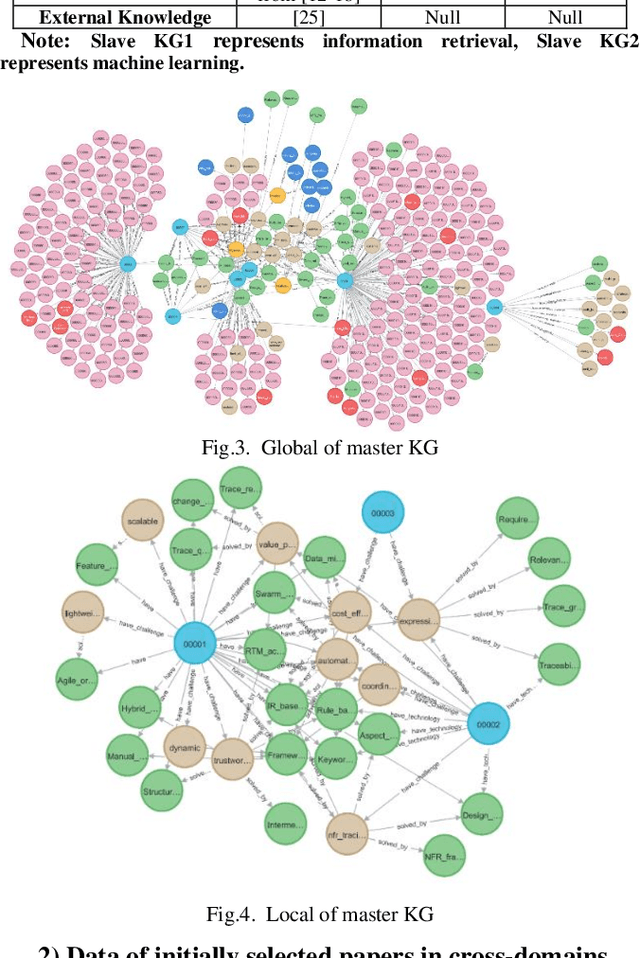
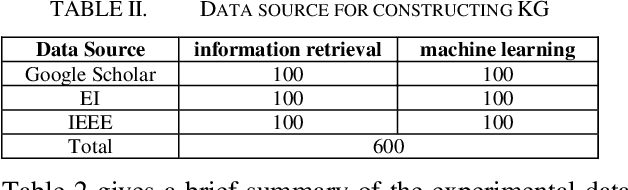
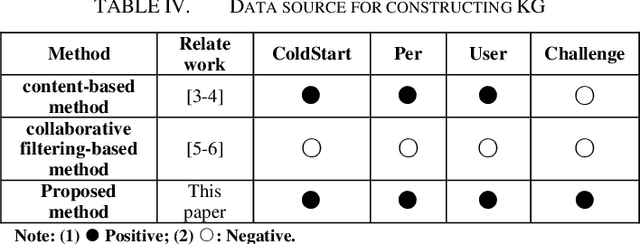
Searching for papers from different academic databases is the most commonly used method by research beginners to obtain cross-domain technical solutions. However, it is usually inefficient and sometimes even useless because traditional search methods neither consider knowledge heterogeneity in different domains nor build the bottom layer of search, including but not limited to the characteristic description text of target solutions and solutions to be excluded. To alleviate this problem, a novel paper recommendation method is proposed herein by introducing "master-slave" domain knowledge graphs, which not only help users express their requirements more accurately but also helps the recommendation system better express knowledge. Specifically, it is not restricted by the cold start problem and is a challenge-oriented method. To identify the rationality and usefulness of the proposed method, we selected two cross-domains and three different academic databases for verification. The experimental results demonstrate the feasibility of obtaining new technical papers in the cross-domain scenario by research beginners using the proposed method. Further, a new research paradigm for research beginners in the early stages is proposed herein.