 Add to Chrome
 Add to Firefox
 Add to Edge
Multipath Extended Target Tracking with Labeled Random Finite Sets
Feb 03, 2026
High-resolution radar sensors are critical for autonomous systems but pose significant challenges to traditional tracking algorithms due to the generation of multiple measurements per object and the presence of multipath effects. Existing solutions often rely on the point target assumption or treat multipath measurements as clutter, whereas current extended target trackers often lack the capability to maintain trajectory continuity in complex multipath environments. To address these limitations, this paper proposes the multipath extended target generalized labeled multi-Bernoulli (MPET-GLMB) filter. A unified Bayesian framework based on labeled random finite set theory is derived to jointly model target existence, measurement partitioning, and the association between measurements, targets, and propagation paths. This formulation enables simultaneous trajectory estimation for both targets and reflectors without requiring heuristic post-processing. To enhance computational efficiency, a joint prediction and update implementation based on Gibbs sampling is developed. Furthermore, a measurement-driven adaptive birth model is introduced to initialize tracks without prior knowledge of target positions. Experimental results from simulated scenarios and real-world automotive radar data demonstrate that the proposed filter outperforms state-of-the-art methods, achieving superior state estimation accuracy and robust trajectory maintenance in dynamic multipath environments.

A Novel Paper Recommendation Method Empowered by Knowledge Graph: for Research Beginners
Mar 16, 2021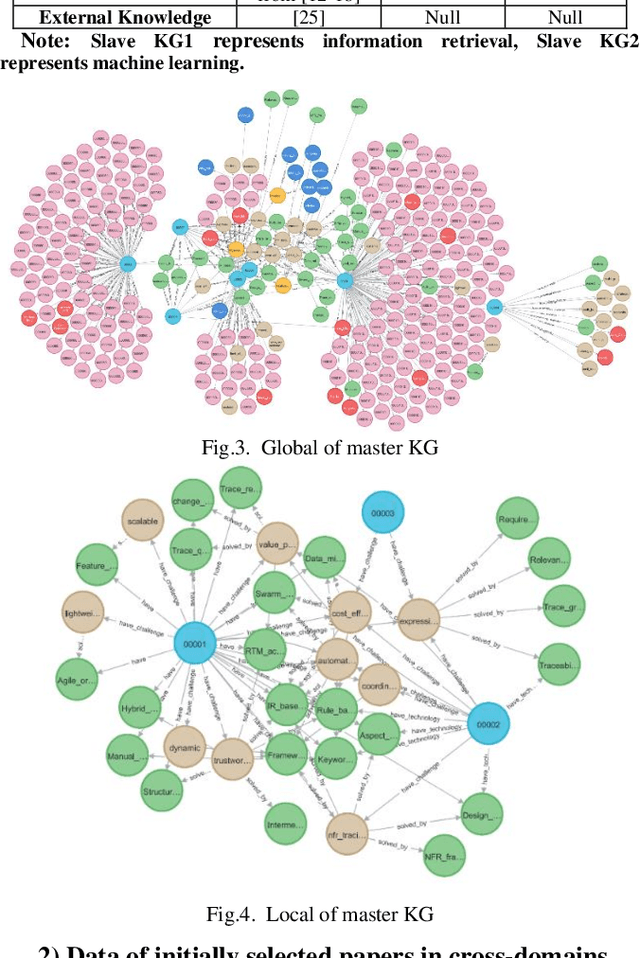
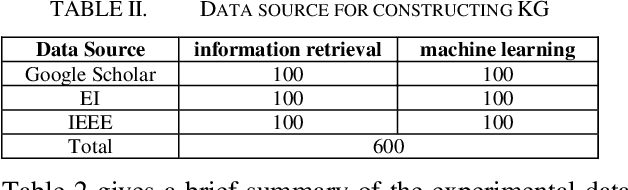
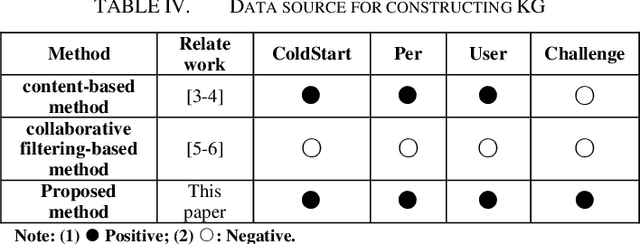
Searching for papers from different academic databases is the most commonly used method by research beginners to obtain cross-domain technical solutions. However, it is usually inefficient and sometimes even useless because traditional search methods neither consider knowledge heterogeneity in different domains nor build the bottom layer of search, including but not limited to the characteristic description text of target solutions and solutions to be excluded. To alleviate this problem, a novel paper recommendation method is proposed herein by introducing "master-slave" domain knowledge graphs, which not only help users express their requirements more accurately but also helps the recommendation system better express knowledge. Specifically, it is not restricted by the cold start problem and is a challenge-oriented method. To identify the rationality and usefulness of the proposed method, we selected two cross-domains and three different academic databases for verification. The experimental results demonstrate the feasibility of obtaining new technical papers in the cross-domain scenario by research beginners using the proposed method. Further, a new research paradigm for research beginners in the early stages is proposed herein.