 Add to Chrome
 Add to Firefox
 Add to Edge
Depth-Dominant Skeleton Detection for Natural Scenes
Aug 17, 2026
To date, all natural scene skeleton detection follows the paradigm of taking RGB images as the sole input; despite notable progress, methods under this paradigm suffer significant performance degradation on complex-content images. We observe that depth images are inherently insensitive to color and texture, and can provide clear regional contours and inter-region spatial relationships, which naturally alleviates the difficulty of skeleton detection in complex scenarios. Motivated by this observation, this paper proposes for the first time a novel skeleton detection paradigm where depth images serve as the dominant modality and RGB images act as the auxiliary, and accordingly presents a model DDSkel (short for Depth-Dominant Skeleton Detection) under this paradigm. DDSkel employs an asymmetric encoder design to fuse RGB information into depth features, with the RGB modality branch having only 12% the parameters of the depth modality branch. DDSkel has a simple structure without intricate designs. Nevertheless, with only 36% of the trainable parameters of the current best method, DDSkel outperforms all state-of-the-art approaches on SymPASCAL, the most challenging dataset with a large volume of complex images.

Visual Relationship Forecasting in Videos
Jul 02, 2021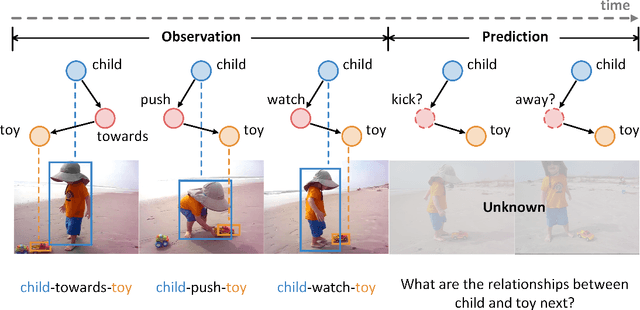

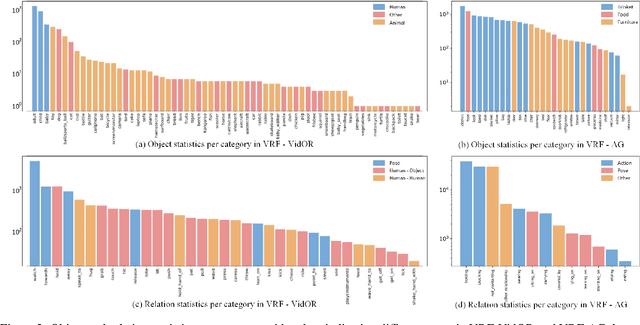
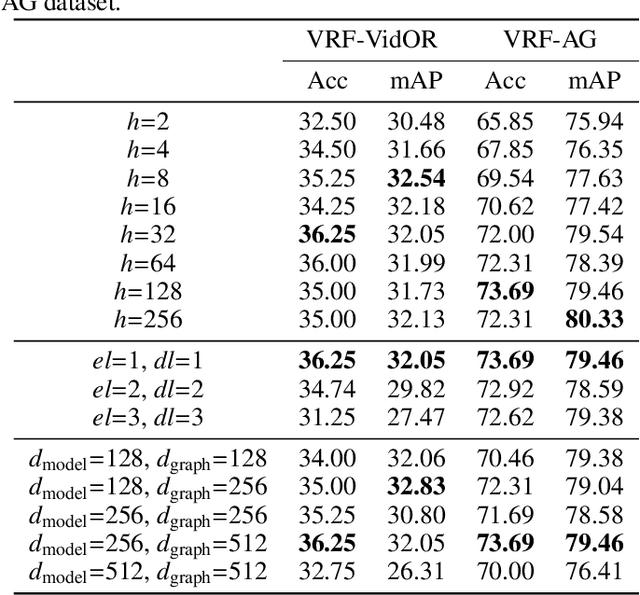
Real-world scenarios often require the anticipation of object interactions in unknown future, which would assist the decision-making process of both humans and agents. To meet this challenge, we present a new task named Visual Relationship Forecasting (VRF) in videos to explore the prediction of visual relationships in a reasoning manner. Specifically, given a subject-object pair with H existing frames, VRF aims to predict their future interactions for the next T frames without visual evidence. To evaluate the VRF task, we introduce two video datasets named VRF-AG and VRF-VidOR, with a series of spatio-temporally localized visual relation annotations in a video. These two datasets densely annotate 13 and 35 visual relationships in 1923 and 13447 video clips, respectively. In addition, we present a novel Graph Convolutional Transformer (GCT) framework, which captures both object-level and frame-level dependencies by spatio-temporal Graph Convolution Network and Transformer. Experimental results on both VRF-AG and VRF-VidOR datasets demonstrate that GCT outperforms the state-of-the-art sequence modelling methods on visual relationship forecasting.