 Add to Chrome
 Add to Firefox
 Add to Edge
Toward the Cognitive--Physical Limits of Embodied Intelligence through a World-Model-Centric Autonomous Racing Agent
Aug 11, 2026
Embodied artificial intelligence aims to develop agents that perceive, reason, and act through continuous interaction with the physical world. However, most embodied systems are still evaluated within conservative safety margins or moderate interaction regimes, leaving their capability boundaries under extreme conditions insufficiently understood. Autonomous racing provides a stringent testbed by combining high-frequency localization and perception, adversarial interaction, near-saturated vehicle dynamics, and strict safety constraints. Existing systems push high-speed performance but rarely model and refine cognitive and physical limits jointly. Here we show that a world-model-centric autonomous racing agent provides a concrete step toward exploring these coupled limits. The framework learns predictive world models from near-limit successes and failures to capture interaction evolution, ego dynamics, and feasible-motion boundaries, coupling world-state construction, future-aware reasoning, and near-limit control in a closed-loop refinement process. Training data were collected from real-vehicle autonomous racing, where the onboard system maintained robust localization and perception at speeds up to 256.3 km/h and peak lateral acceleration of 26.8 m/s$^2$. In full-scale simulated racing, the well trained world-model-centric agent achieves an 88.3% interaction success rate across various challenging simulated racing scenarios. Closed-loop refinement of the world model and policy further improved utilization of cognitive-physical limits, recovery from failure modes, and generalization across varying conditions and unseen circuits. These results suggest a boundary-aware methodology in which world models help embodied agents represent, predict, and continually refine their capability boundaries for safer real-world deployment.

Path Planning in Complex Environments with Superquadrics and Voronoi-Based Orientation
Nov 08, 2024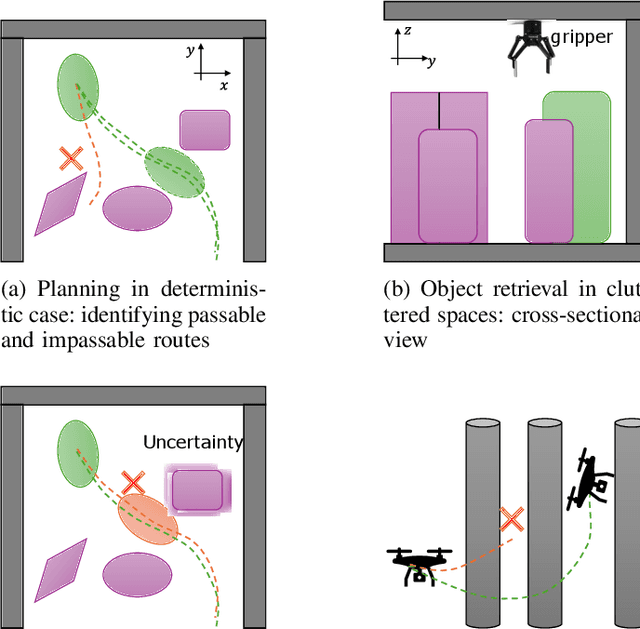
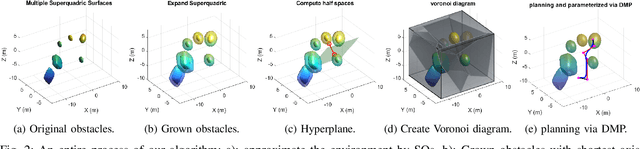
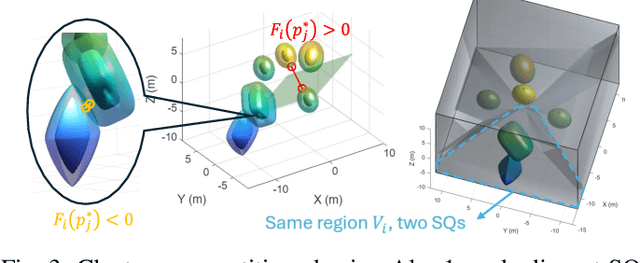
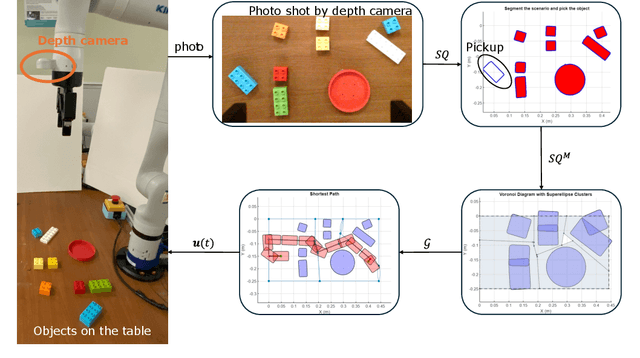
Path planning in narrow passages is a challenging problem in various applications. Traditional planning algorithms often face challenges in complex environments like mazes and traps, where narrow entrances require special orientation control for successful navigation. In this work, we present a novel approach that combines superquadrics (SQ) representation and Voronoi diagrams to solve the narrow passage problem in both 2D and 3D environment. Our method utilizes the SQ formulation to expand obstacles, eliminating impassable passages, while Voronoi hyperplane ensures maximum clearance path. Additionally, the hyperplane provides a natural reference for robot orientation, aligning its long axis with the passage direction. We validate our framework through a 2D object retrieval task and 3D drone simulation, demonstrating that our approach outperforms classical planners and a cutting-edge drone planner by ensuring passable trajectories with maximum clearance.