 Add to Chrome
 Add to Firefox
 Add to Edge
RareSpot+: A Benchmark, Model, and Active Learning Framework for Small and Rare Wildlife in Aerial Imagery
Apr 21, 2026
Automated wildlife monitoring from aerial imagery is vital for conservation but remains limited by two persistent challenges: the difficulty of detecting small, rare species and the high cost of large-scale expert annotation. Prairie dogs exemplify this problem -- they are ecologically important yet appear tiny, sparsely distributed, and visually indistinct from their surroundings, posing a severe challenge for conventional detection models. To overcome these limitations, we present RareSpot+, a detection framework that integrates multi-scale consistency learning, context-aware augmentation, and geospatially guided active learning to address these issues. A novel multi-scale consistency loss aligns intermediate feature maps across detection heads, enhancing localization of small (approx. 30 pixels wide) objects without architectural changes, while context-aware augmentation improves robustness by synthesizing hard, ecologically plausible examples. A geospatial active learning module exploits domain-specific spatial priors linking prairie dogs and burrows, together with test-time augmentation and a meta-uncertainty model, to reduce redundant labeling. On a 2 km^2 aerial dataset, RareSpot+ improves detection over the baseline mAP@50 by +35.2% (absolute +0.13). Cross-dataset tests on HerdNet, AED, and several other wildlife benchmarks demonstrate robust detector-level transferability. The active learning module further boosts prairie dog AP by 14.5% using an annotation budget of just 1.7% of the unlabeled tiles. Beyond detection, RareSpot+ enables spatial ecological analyses such as clustering and co-occurrence, linking vision-based detection with quantitative ecology.

Hyperspectral Trajectory Image for Multi-Month Trajectory Anomaly Detection
Mar 26, 2026Trajectory anomaly detection underpins applications from fraud detection to urban mobility analysis. Dense GPS methods preserve fine-grained evidence such as abnormal speeds and short-duration events, but their quadratic cost makes multi-month analysis intractable; consequently, no existing approach detects anomalies over multi-month dense GPS trajectories. The field instead relies on scalable sparse stay-point methods that discard this evidence, forcing separate architectures for each regime and preventing knowledge transfer. We argue this bottleneck is unnecessary: human trajectories, dense or sparse, share a natural two-dimensional cyclic structure along within-day and across-day axes. We therefore propose TITAnD (Trajectory Image Transformer for Anomaly Detection), which reformulates trajectory anomaly detection as a vision problem by representing trajectories as a Hyperspectral Trajectory Image (HTI): a day x time-of-day grid whose channels encode spatial, semantic, temporal, and kinematic information from either modality, unifying both under a single representation. Under this formulation, agent-level detection reduces to image classification and temporal localization to semantic segmentation. To model this representation, we introduce the Cyclic Factorized Transformer (CFT), which factorizes attention along the two temporal axes, encoding the cyclic inductive bias of human routines, while reducing attention cost by orders of magnitude and enabling dense multi-month anomaly detection for the first time. Empirically, TITAnD achieves the best AUC-PR across sparse and dense benchmarks, surpassing vision models like UNet while being 11-75x faster than the Transformer with comparable memory, demonstrating that vision reformulation and structure-aware modeling are jointly essential. Code will be made public soon.
Wrivinder: Towards Spatial Intelligence for Geo-locating Ground Images onto Satellite Imagery
Feb 16, 2026Aligning ground-level imagery with geo-registered satellite maps is crucial for mapping, navigation, and situational awareness, yet remains challenging under large viewpoint gaps or when GPS is unreliable. We introduce Wrivinder, a zero-shot, geometry-driven framework that aggregates multiple ground photographs to reconstruct a consistent 3D scene and align it with overhead satellite imagery. Wrivinder combines SfM reconstruction, 3D Gaussian Splatting, semantic grounding, and monocular depth--based metric cues to produce a stable zenith-view rendering that can be directly matched to satellite context for metrically accurate camera geo-localization. To support systematic evaluation of this task, which lacks suitable benchmarks, we also release MC-Sat, a curated dataset linking multi-view ground imagery with geo-registered satellite tiles across diverse outdoor environments. Together, Wrivinder and MC-Sat provide a first comprehensive baseline and testbed for studying geometry-centered cross-view alignment without paired supervision. In zero-shot experiments, Wrivinder achieves sub-30\,m geolocation accuracy across both dense and large-area scenes, highlighting the promise of geometry-based aggregation for robust ground-to-satellite localization.
Bright 4B: Scaling Hyperspherical Learning for Segmentation in 3D Brightfield Microscopy
Dec 27, 2025Label-free 3D brightfield microscopy offers a fast and noninvasive way to visualize cellular morphology, yet robust volumetric segmentation still typically depends on fluorescence or heavy post-processing. We address this gap by introducing Bright-4B, a 4 billion parameter foundation model that learns on the unit hypersphere to segment subcellular structures directly from 3D brightfield volumes. Bright-4B combines a hardware-aligned Native Sparse Attention mechanism (capturing local, coarse, and selected global context), depth-width residual HyperConnections that stabilize representation flow, and a soft Mixture-of-Experts for adaptive capacity. A plug-and-play anisotropic patch embed further respects confocal point-spread and axial thinning, enabling geometry-faithful 3D tokenization. The resulting model produces morphology-accurate segmentations of nuclei, mitochondria, and other organelles from brightfield stacks alone--without fluorescence, auxiliary channels, or handcrafted post-processing. Across multiple confocal datasets, Bright-4B preserves fine structural detail across depth and cell types, outperforming contemporary CNN and Transformer baselines. All code, pretrained weights, and models for downstream finetuning will be released to advance large-scale, label-free 3D cell mapping.
RareSpot: Spotting Small and Rare Wildlife in Aerial Imagery with Multi-Scale Consistency and Context-Aware Augmentation
Jun 23, 2025Automated detection of small and rare wildlife in aerial imagery is crucial for effective conservation, yet remains a significant technical challenge. Prairie dogs exemplify this issue: their ecological importance as keystone species contrasts sharply with their elusive presence--marked by small size, sparse distribution, and subtle visual features--which undermines existing detection approaches. To address these challenges, we propose RareSpot, a robust detection framework integrating multi-scale consistency learning and context-aware augmentation. Our multi-scale consistency approach leverages structured alignment across feature pyramids, enhancing fine-grained object representation and mitigating scale-related feature loss. Complementarily, context-aware augmentation strategically synthesizes challenging training instances by embedding difficult-to-detect samples into realistic environmental contexts, significantly boosting model precision and recall. Evaluated on an expert-annotated prairie dog drone imagery benchmark, our method achieves state-of-the-art performance, improving detection accuracy by over 35% compared to baseline methods. Importantly, it generalizes effectively across additional wildlife datasets, demonstrating broad applicability. The RareSpot benchmark and approach not only support critical ecological monitoring but also establish a new foundation for detecting small, rare species in complex aerial scenes.
ReeFRAME: Reeb Graph based Trajectory Analysis Framework to Capture Top-Down and Bottom-Up Patterns of Life
Oct 19, 2024In this paper, we present ReeFRAME, a scalable Reeb graph-based framework designed to analyze vast volumes of GPS-enabled human trajectory data generated at 1Hz frequency. ReeFRAME models Patterns-of-life (PoL) at both the population and individual levels, utilizing Multi-Agent Reeb Graphs (MARGs) for population-level patterns and Temporal Reeb Graphs (TERGs) for individual trajectories. The framework's linear algorithmic complexity relative to the number of time points ensures scalability for anomaly detection. We validate ReeFRAME on six large-scale anomaly detection datasets, simulating real-time patterns with up to 500,000 agents over two months.
CIMGEN: Controlled Image Manipulation by Finetuning Pretrained Generative Models on Limited Data
Jan 23, 2024Content creation and image editing can benefit from flexible user controls. A common intermediate representation for conditional image generation is a semantic map, that has information of objects present in the image. When compared to raw RGB pixels, the modification of semantic map is much easier. One can take a semantic map and easily modify the map to selectively insert, remove, or replace objects in the map. The method proposed in this paper takes in the modified semantic map and alter the original image in accordance to the modified map. The method leverages traditional pre-trained image-to-image translation GANs, such as CycleGAN or Pix2Pix GAN, that are fine-tuned on a limited dataset of reference images associated with the semantic maps. We discuss the qualitative and quantitative performance of our technique to illustrate its capacity and possible applications in the fields of image forgery and image editing. We also demonstrate the effectiveness of the proposed image forgery technique in thwarting the numerous deep learning-based image forensic techniques, highlighting the urgent need to develop robust and generalizable image forensic tools in the fight against the spread of fake media.
BLoad: Enhancing Neural Network Training with Efficient Sequential Data Handling
Oct 16, 2023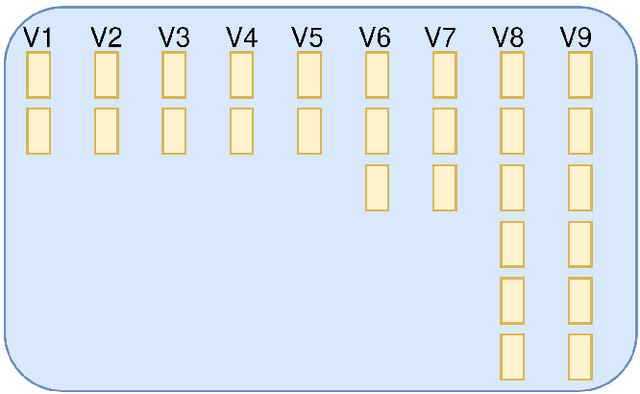
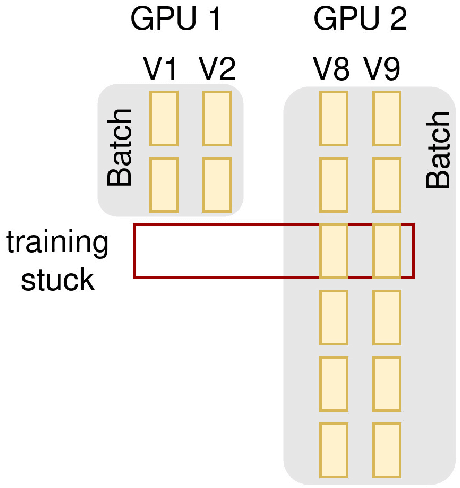
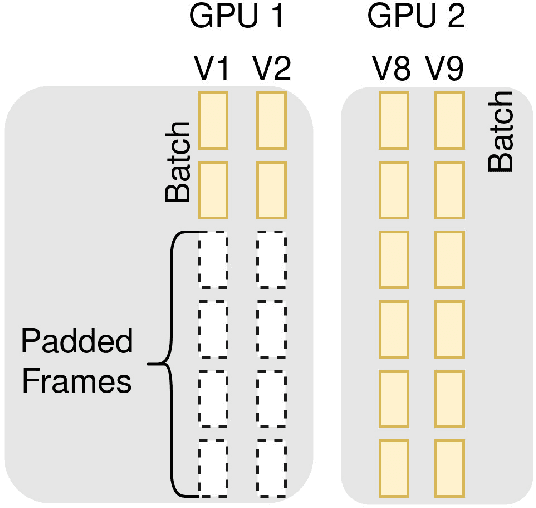
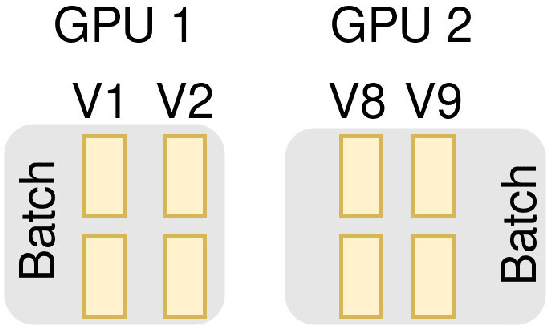
The increasing complexity of modern deep neural network models and the expanding sizes of datasets necessitate the development of optimized and scalable training methods. In this white paper, we addressed the challenge of efficiently training neural network models using sequences of varying sizes. To address this challenge, we propose a novel training scheme that enables efficient distributed data-parallel training on sequences of different sizes with minimal overhead. By using this scheme we were able to reduce the padding amount by more than 100$x$ while not deleting a single frame, resulting in an overall increased performance on both training time and Recall in our experiments.
Q-RBSA: High-Resolution 3D EBSD Map Generation Using An Efficient Quaternion Transformer Network
Mar 19, 2023Gathering 3D material microstructural information is time-consuming, expensive, and energy-intensive. Acquisition of 3D data has been accelerated by developments in serial sectioning instrument capabilities; however, for crystallographic information, the electron backscatter diffraction (EBSD) imaging modality remains rate limiting. We propose a physics-based efficient deep learning framework to reduce the time and cost of collecting 3D EBSD maps. Our framework uses a quaternion residual block self-attention network (QRBSA) to generate high-resolution 3D EBSD maps from sparsely sectioned EBSD maps. In QRBSA, quaternion-valued convolution effectively learns local relations in orientation space, while self-attention in the quaternion domain captures long-range correlations. We apply our framework to 3D data collected from commercially relevant titanium alloys, showing both qualitatively and quantitatively that our method can predict missing samples (EBSD information between sparsely sectioned mapping points) as compared to high-resolution ground truth 3D EBSD maps.
DDS: Decoupled Dynamic Scene-Graph Generation Network
Jan 18, 2023Scene-graph generation involves creating a structural representation of the relationships between objects in a scene by predicting subject-object-relation triplets from input data. However, existing methods show poor performance in detecting triplets outside of a predefined set, primarily due to their reliance on dependent feature learning. To address this issue we propose DDS -- a decoupled dynamic scene-graph generation network -- that consists of two independent branches that can disentangle extracted features. The key innovation of the current paper is the decoupling of the features representing the relationships from those of the objects, which enables the detection of novel object-relationship combinations. The DDS model is evaluated on three datasets and outperforms previous methods by a significant margin, especially in detecting previously unseen triplets.